River Trails, Fort Worth
Updated · 3,777 residents
River Trails is a suburban community in northeast Fort Worth defined by its extensive trail systems and proximity to the Trinity River. Residents benefit from exceptional walkability and access to the highly regarded Hurst-Euless-Bedford Independent School District.
Key Highlights
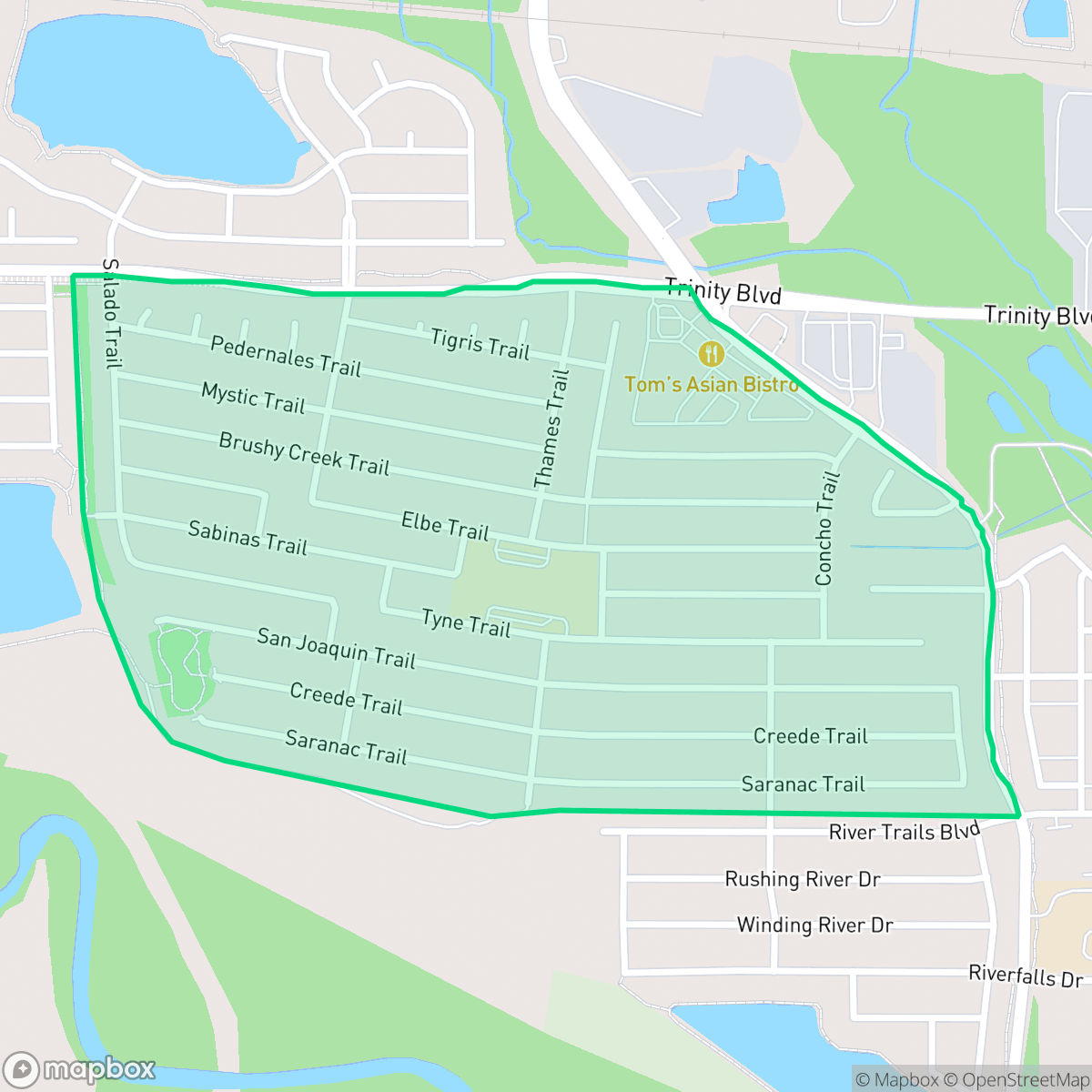
About River Trails
Laid out in the 1980s in far northeast Fort Worth, the suburban River Trails neighborhood is characterized by single-family homes and scenic green spaces near the Trinity River. The community is historically defined by its grassroots civic action; when early development plans failed to include a neighborhood park, the River Trails Homeowners Association, led by Mary Lynn Holder, partnered with the Hurst-Euless-Bedford Independent School District and the city’s park department. Through the Targeted Area Planning program, they negotiated a symbolic one-dollar-per-year lease on school district land to establish River Trails Park. This creative public-private alliance earned national recognition, helping Fort Worth win the National Gold Medal from the National Recreation and Park Association in 1996. Today, the neighborhood continues to expand with master-planned additions like the Lakes of River Trails.
This neighborhood offers a cohesive residential environment characterized by single-family homes and consistent, pedestrian-friendly infrastructure. The area features a comprehensive network of sidewalks and dedicated trails, making it one of the more walkable suburban settings in the region. With its proximity to natural green spaces and a focus on community-led development, the area maintains a quiet, organized atmosphere that prioritizes outdoor access and local connectivity.
While the area provides a stable environment for families, potential residents should note that the suburban density results in moderate noise levels primarily from road traffic. Air quality in this section of the city is lower than average, reflecting its position within the broader metropolitan landscape. The neighborhood is particularly well-suited for those seeking proximity to high-performing schools and a structured, family-oriented lifestyle within the Fort Worth area.
Neighborhood Scores Across 15 Qualities
Standard suburban lot sizes provide a moderate level of separation between homes, which is roughly in line with the Fort Worth average. According to iHuus data, houses are positioned with typical spacing that offers some buffer between neighbors.
Pedestrians benefit from a comprehensive sidewalk network and dedicated trail systems that are significantly more accessible than the Fort Worth average. According to iHuus data, wide sidewalks and ample crossings facilitate easy movement through both residential streets and main arterials.
Large homes with complex rooflines and private backyard pools characterize the area. This neighborhood offers a higher level of visual interest and manicured amenities than the Fort Worth average, according to iHuus data.
Large adjacent green spaces and lake trails provide ample room for walking pets away from traffic. Wide sidewalks and connected park buffers make this area more accommodating for dog owners than the Fort Worth average.
Residential areas consist primarily of dense single-family housing developments and tract housing. This landscape is consistent with the average urban-rural mix found across Fort Worth.
Residential life here is characterized by a serene, low-density atmosphere with limited local commercial activity. According to iHuus data, the area is notably less active than the Fort Worth average, offering a peaceful setting with significant open space and few nearby businesses.
Frequent noise from nearby highways and railroad tracks characterizes the area. According to iHuus data, acoustic comfort in this neighborhood is slightly below the Fort Worth average.
Frequent periods of unhealthy air levels pose a significant risk to sensitive groups. According to iHuus data, the air quality in this area is notably worse than the Fort Worth average.
Residential life here is notably free from warehouses or heavy industrial facilities, offering a cleaner environment than the Fort Worth average. According to iHuus data, the area consists primarily of quiet streets, green spaces, and light commercial uses with no detected industrial hazards.
Health insurance access is significantly higher than the Fort Worth average, according to iHuus data. This indicates a high level of-medical coverage among the local population.
Political views in this area are relatively split between conservative and liberal leanings. This represents a more even ideological distribution than the average found across Fort Worth.
Residents live alongside a balanced mix of young professionals, families, and seniors. This demographic spread is consistent with the city average, according to iHuus data.
Residual flood risk exists within certain areas of this neighborhood, though safety levels remain significantly higher than the Fort Worth average. According to iHuus data, parts of the community are situated within a 500-year floodplain.
Address-Level Insights for River Trails


iHuus Neighborhood Intelligence Insights
Get address-level neighborhood insights for River Trails
- Street-level scores — see how individual blocks compare, not just neighborhood averages
- Micro-zone boundaries — identify quiet pockets, flood boundaries, and walkable clusters before you visit
- 15 dimensions in full — walkability, noise, air quality, school quality, insurance coverage, population age profile, urban/rural index, and more
- Boundary risk alerts — know if your address sits near a block boundary where scores drop, the kind of detail no listing will ever mention
- School insights — individual school ratings and insights, not just district-level data
- Compare before you commit — side-by-side data across neighborhoods, down to block precision
No credit card required
Compare with Any Neighborhood
| Dimension | River Trails | Alamo Heights |
|---|---|---|
| 🚶 Walkabilityavg 7.5 | ||
| 🔊 Acoustic Comfortavg 4.12 | ||
| 🤫 Privacy Indexavg 5.64 | ||
| 🎨 Visual Appealavg 6.38 | ||
| 🐕 Dog Friendlinessavg 6.57 | ||
| 🗺️ Urban-Rural Indexavg 6.92 | ||
| ✨ Neighborhood Vibeavg 4.56 | ||
| 🏥 Health Insurance Coverageavg 5.8 | ||
| 🌿 Air Qualityavg 3.68 | ||
| 🏭 Industrial Proximityavg 8.13 | ||
| 🌊 Flood Safetyavg 3.61 | ||
| 🗳️ Ideological Leanavg 5.62 | ||
| 👥 Population Age Profileavg 4.51 | ||
| 🔥 Fire Safety | ||
| 🏫 School Quality |
River Trails Rankings
School Districts Serving River Trails
School Insights for River Trails
Below average outcomes; significant attendance and academic challenges.
School Insights
See what's really behind every school rating near River Trails
- Individual school ratings — each school's own score with outcome context, not just a district average
- Enrollment & class size data — student-to-teacher ratio and how it compares to the state average
- Full demographics breakdown — ethnicity and gender composition for every school in the enrollment zone
- Every school in the district — all schools within the enrollment boundary ranked by rating, not just the closest one
- Grade levels & benchmarks — elementary through high school, with below/above state-average flags
No credit card required