Ridgmar, Fort Worth
Updated · 6,135 residents
Ridgmar is a mid-century residential enclave located six miles west of downtown Fort Worth, known for its distinct architectural character and generous lot sizes. While the area offers a lively suburban atmosphere with convenient access to local dining and retail, residents should be prepared for noticeable road noise from nearby highways. The neighborhood balances established greenery with a car-dependent layout, making it a functional choice for those prioritizing space and community access.
Key Highlights
About Ridgmar
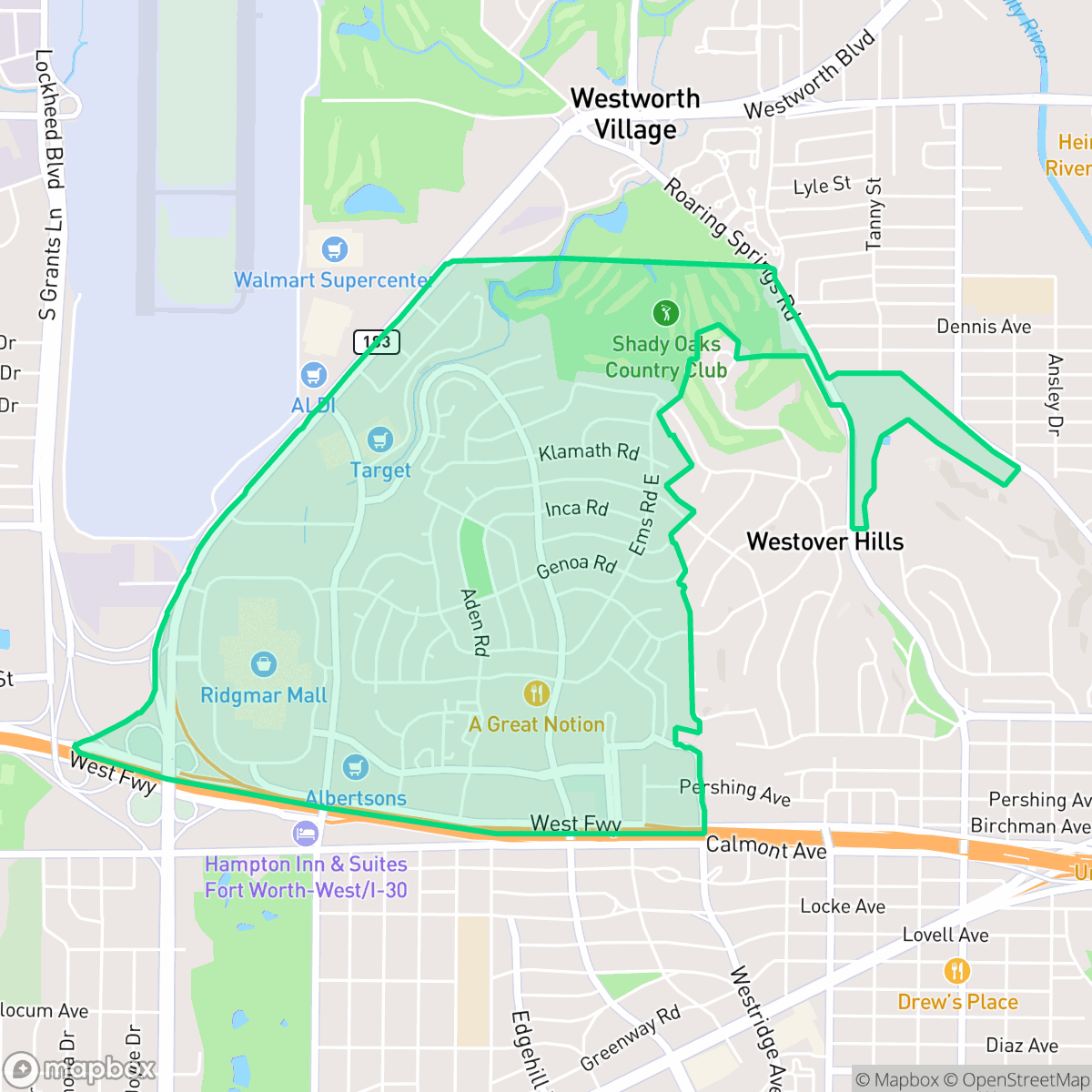
Located six miles west of downtown Fort Worth, the Ridgmar neighborhood began development in 1957 after the Amon G. Carter Foundation sold a 1,200-acre tract to J. Marvin Leonard. Leonard quickly established the Shady Oaks Country Club on the northern portion, while residential construction commenced along Dakar Road. During World War II, prior to residential development, the unimproved land housed anti-aircraft bunkers built to protect the nearby "bomber plant" (now Lockheed Martin). The neighborhood is characterized by custom-built mid-century ranch, Spanish-style, and colonial-revival homes, built under strict deed restrictions that mandated generous 40-foot setbacks. In 1976, the area became home to the Ridgmar Mall, Fort Worth's first fully enclosed shopping center.
The neighborhood maintains a strong visual identity through its mix of mid-century ranch and custom homes, which benefit from spacious setbacks and mature landscaping. Residents enjoy a lively suburban environment that includes a variety of local dining options and proximity to essential services, contributing to a high visual appeal. The presence of significant tree canopy and dedicated green spaces provides a pleasant aesthetic, distinguishing the area from more densely packed urban corridors.
Living here requires a reliance on personal vehicles, as the layout is designed for suburban transit rather than pedestrian travel. Prospective residents should note that the proximity to major highways results in elevated noise levels, which may impact acoustic comfort. Additionally, while the area is free from industrial hazards, the local flood safety profile warrants consideration. It is best suited for families or individuals who value established architectural character and suburban amenities over absolute quiet or high walkability.
Neighborhood Scores Across 15 Qualities
Residential spacing provides a moderate level of separation between neighbors, sitting slightly above the Fort Worth average. While single-family homes offer typical suburban setbacks, the presence of denser apartment blocks in the southern portion of the area reduces overall buffer zones.
Low-traffic residential loops and continuous sidewalks provide safe routes for pedestrians, though walkability is slightly below the Fort Worth average. Some pathways may be partially obscured by tree canopy in certain sections of the neighborhood.
Large homes with complex architecture and private backyard pools contribute to a visual environment that is notably more polished than the Fort Worth average. Extensive driveways and upscale amenities are frequent throughout the area, according to iHuus data.
Expansive green spaces, continuous street-side verges, and large park areas make this neighborhood more dog friendly than the Fort Worth average. According to iHuus data, the presence of significant tree canopy and wide paths provides safe, connected environments for pet owners.
Open land and scattered homes provide a sense of space that is slightly more rural than the Fort Worth average. Large-scale retail and industrial zones sit alongside residential clusters and nearby airfield areas, according to iHuus data.
A variety of dining, wellness, and leisure amenities offer more activity than the Fort Worth average. While many blocks feature a lively suburban atmosphere, the car-dependent layout makes navigating the area's businesses difficult without a vehicle.
Frequent noise from nearby highways and rail lines makes this area louder than the Fort Worth average. Residents may experience consistent auditory disturbances from heavy transit activity.
Air quality levels in Ridgmar fluctuate between acceptable and unhealthy on certain days. This represents a cleaner environment than the average found across Fort Worth, according to iHuus data.
Residents can enjoy an environment free from warehouses, heavy machinery, or industrial hazards. This level of separation from industrial activity is significantly higher than the Fort Worth average, according to iHuus data.
Health insurance accessibility is notably higher than the Fort Worth average, according to iHuus data. Most residents in this area have access to comprehensive medical coverage.
Political leanings in this area are notably more conservative than the Fort Worth average. According to iHuus data, the neighborhood maintains a strong conservative majority with a small opposing presence.
A diverse mix of young professionals, families, and seniors resides here, representing a slightly more varied age distribution than the Fort Worth average according to iHuus data.
Significant flood risk exists within this area as portions of the neighborhood fall inside the 100-year floodplain, which is higher than the Fort Worth average. According to iHuus data, residents should anticipate that flood insurance is typically required for properties here.
Address-Level Insights for Ridgmar


iHuus Neighborhood Intelligence Insights
Get address-level neighborhood insights for Ridgmar
- Street-level scores — see how individual blocks compare, not just neighborhood averages
- Micro-zone boundaries — identify quiet pockets, flood boundaries, and walkable clusters before you visit
- 15 dimensions in full — walkability, noise, air quality, school quality, insurance coverage, population age profile, urban/rural index, and more
- Boundary risk alerts — know if your address sits near a block boundary where scores drop, the kind of detail no listing will ever mention
- School insights — individual school ratings and insights, not just district-level data
- Compare before you commit — side-by-side data across neighborhoods, down to block precision
No credit card required
Compare with Any Neighborhood
| Dimension | Ridgmar | Alamo Heights |
|---|---|---|
| 🚶 Walkabilityavg 7.5 | ||
| 🔊 Acoustic Comfortavg 4.12 | ||
| 🤫 Privacy Indexavg 5.64 | ||
| 🎨 Visual Appealavg 6.38 | ||
| 🐕 Dog Friendlinessavg 6.57 | ||
| 🗺️ Urban-Rural Indexavg 6.92 | ||
| ✨ Neighborhood Vibeavg 4.56 | ||
| 🏥 Health Insurance Coverageavg 5.8 | ||
| 🌿 Air Qualityavg 3.68 | ||
| 🏭 Industrial Proximityavg 8.13 | ||
| 🌊 Flood Safetyavg 3.61 | ||
| 🗳️ Ideological Leanavg 5.62 | ||
| 👥 Population Age Profileavg 4.51 | ||
| 🔥 Fire Safety | ||
| 🏫 School Quality |
Ridgmar Rankings
School Districts Serving Ridgmar
School Insights for Ridgmar
Below average outcomes; significant attendance and academic challenges.
School Insights
See what's really behind every school rating near Ridgmar
- Individual school ratings — each school's own score with outcome context, not just a district average
- Enrollment & class size data — student-to-teacher ratio and how it compares to the state average
- Full demographics breakdown — ethnicity and gender composition for every school in the enrollment zone
- Every school in the district — all schools within the enrollment boundary ranked by rating, not just the closest one
- Grade levels & benchmarks — elementary through high school, with below/above state-average flags
No credit card required