Ridglea, Fort Worth
Updated · 346 residents
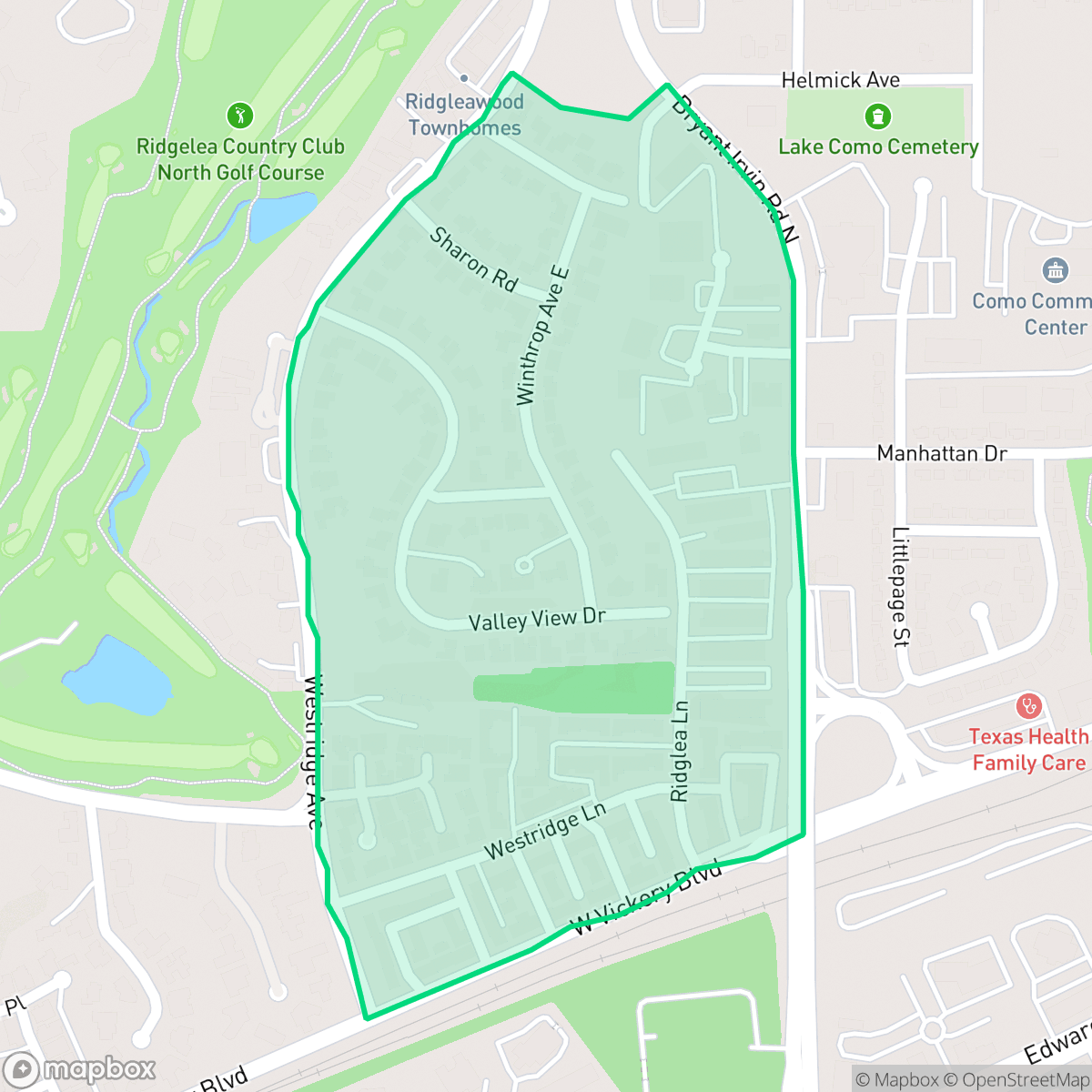
Ridglea is a historic Fort Worth neighborhood defined by its mid-century Mediterranean architecture and quiet, low-density residential streets. The area offers exceptional visual appeal and high privacy, providing a tranquil environment that feels well-removed from urban industrial zones.
Key Highlights
About Ridglea
Planned as a country club community in the 1920s, Fort Worth’s Ridglea neighborhood was largely developed in the 1940s and 1950s by A.C. Luther. Luther designed the area around Camp Bowie Boulevard, establishing the Spanish-Mediterranean-style Ridglea Village shopping complexes and the Curzon Place Apartments. The neighborhood’s crown jewel is the historic Ridglea Theater, which opened in 1950. Listed on the National Register of Historic Places, the theater features a landmark 70-foot stone tower, a hand-painted mural by Eugene Gilboe, and classic Mediterranean architecture. The neighborhood's history also reflects mid-century segregation; in 1947, the city closed connecting streets and erected the "Ridglea Wall," a ten-block, barbed-wire-topped fence that separated the white Ridglea development from the historically Black Como neighborhood to the east.
The neighborhood serves as a quiet residential enclave characterized by expansive green spaces and a notable lack of industrial proximity. Residents benefit from a high level of privacy and strong visual appeal, with well-maintained streets and architecture that reflects its mid-century planning roots. While the area maintains a high walkability score, the overall pace of life is measured, with limited commercial density contributing to a subdued, quiet atmosphere.
Potential residents should consider the current state of the local school district, which faces significant financial and operational challenges. While the area offers excellent flood safety and high rates of health insurance coverage, those seeking a highly active nightlife or dense retail options may find the neighborhood more suited to a slower, suburban pace of life.
Neighborhood Scores Across 15 Qualities
Large residential lots with significant separation between homes provide more privacy than is typical for Fort Worth. According to iHuus data, the neighborhood offers greater seclusion compared to the city average.
Sidewalks are available on one side of the streets with safe crossings provided for pedestrians. This level of accessibility is slightly below the Fort Worth average according to iHuus data.
Large residential properties and well-maintained amenities define the local landscape. According to iHuus data, the area offers significantly higher visual appeal than the Fort Worth average.
Connected green spaces and wide, low-traffic paths offer favorable conditions for pet owners. According to iHuus data, this level of accessibility for dogs is higher than the Fort Worth average.
Frequent open land and scattered homes amidst woodland characterize this area. This landscape provides a more open, semi-rural environment than the typical Fort Worth urban setting, according to iHuus data.
Low density and significant open space create a serene atmosphere, but most amenities require a vehicle for access. This area lacks a distinct commercial character and is less lively than the Fort Worth average.
Frequent noise from nearby highways and railroad tracks characterizes the area. According to iHuus data, acoustic comfort levels in Ridglea are lower than the Fort Worth average.
Air quality levels in Ridglea fluctuate between acceptable and unhealthy, presenting occasional concerns for sensitive groups. According to iHuus data, the local air quality is slightly better than the Fort Worth average.
Industrial presence is non-existent here, providing a landscape free from warehouses or hazardous facilities. This lack of heavy industry is notably higher than the Fort Worth average, offering a quiet environment focused on residential life and green spaces.
Health insurance enrollment among residents is higher than the Fort Worth average, according to iHuus data.
Political views in this area are split fairly evenly between conservative and liberal leanings, representing a more moderate landscape than the city average according to iHuus data.
Residents live alongside a balanced variety of young adults, families, and seniors. According to iHuus data, this demographic spread is more varied than the average age distribution found across Fort Worth.
Flood risk in this area is higher than the Fort Worth average, though a precise assessment is currently unavailable due to pending federal studies. Residents should remain aware of potential vulnerabilities as official FEMA mapping for this specific zone is not yet finalized.
Address-Level Insights for Ridglea


iHuus Neighborhood Intelligence Insights
Get address-level neighborhood insights for Ridglea
- Street-level scores — see how individual blocks compare, not just neighborhood averages
- Micro-zone boundaries — identify quiet pockets, flood boundaries, and walkable clusters before you visit
- 15 dimensions in full — walkability, noise, air quality, school quality, insurance coverage, population age profile, urban/rural index, and more
- Boundary risk alerts — know if your address sits near a block boundary where scores drop, the kind of detail no listing will ever mention
- School insights — individual school ratings and insights, not just district-level data
- Compare before you commit — side-by-side data across neighborhoods, down to block precision
No credit card required
Compare with Any Neighborhood
| Dimension | Ridglea | Alamo Heights |
|---|---|---|
| 🚶 Walkabilityavg 7.5 | ||
| 🔊 Acoustic Comfortavg 4.12 | ||
| 🤫 Privacy Indexavg 5.64 | ||
| 🎨 Visual Appealavg 6.38 | ||
| 🐕 Dog Friendlinessavg 6.57 | ||
| 🗺️ Urban-Rural Indexavg 6.92 | ||
| ✨ Neighborhood Vibeavg 4.56 | ||
| 🏥 Health Insurance Coverageavg 5.8 | ||
| 🌿 Air Qualityavg 3.68 | ||
| 🏭 Industrial Proximityavg 8.13 | ||
| 🌊 Flood Safetyavg 3.61 | ||
| 🗳️ Ideological Leanavg 5.62 | ||
| 👥 Population Age Profileavg 4.51 | ||
| 🔥 Fire Safety | ||
| 🏫 School Quality |
Ridglea Rankings
School Districts Serving Ridglea
School Insights for Ridglea
Below average outcomes; significant attendance and academic challenges.
School Insights
See what's really behind every school rating near Ridglea
- Individual school ratings — each school's own score with outcome context, not just a district average
- Enrollment & class size data — student-to-teacher ratio and how it compares to the state average
- Full demographics breakdown — ethnicity and gender composition for every school in the enrollment zone
- Every school in the district — all schools within the enrollment boundary ranked by rating, not just the closest one
- Grade levels & benchmarks — elementary through high school, with below/above state-average flags
No credit card required