Ridglea North, Fort Worth
Updated · 4,696 residents
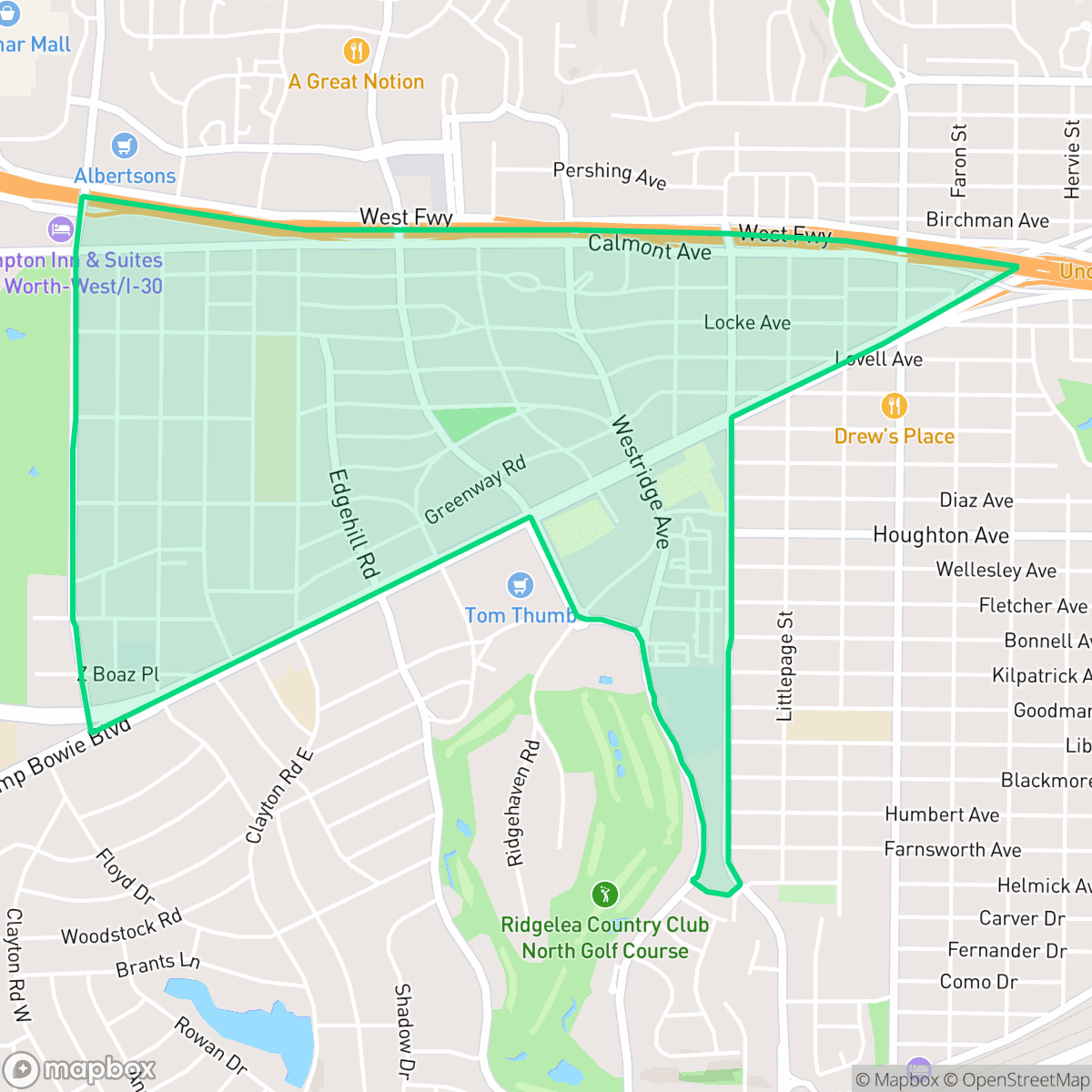
Ridglea North is a lively Fort Worth neighborhood defined by its mature tree-lined streets and a diverse mix of mid-century residential architecture. While the area offers excellent access to local dining and green spaces like Morris E. Berney Park, residents should expect a car-dependent lifestyle and consistent background noise from nearby road traffic.
Key Highlights
About Ridglea North
Platted in 1928 by developers Morris E. Berney and Bernie L. Anderson, the Ridglea North neighborhood in Fort Worth, Texas, was designed around the central Morris E. Berney Park. Although the first homes were constructed in 1930, the Great Depression stalled development. During World War II, the area saw a surge of small bungalows built for workers at the nearby Bomber Plant and Tarrant Field. In the late 1940s, developers Luther Bros. & Wilson, Inc. purchased the tract north of Camp Bowie Boulevard, sparking a major postwar residential building boom. This era also brought the construction of the historic Spanish-Mediterranean style Ridglea Theater in 1947, which remains a prominent local landmark. Today, the neighborhood is characterized by its mature tree-lined streets and a diverse mix of mid-century bungalows, ranch homes, and newer builds.
The area balances residential comfort with active commercial corridors, featuring a variety of single-family homes and mid-sized apartment blocks. According to iHuus data, the neighborhood maintains high air quality and minimal industrial presence, creating a clean environment for its residents. Local amenities include popular dining destinations such as Little Lilly Sushi and Campisi's, which contribute to the vibrant atmosphere along the main thoroughfares.
Prospective residents should note that the neighborhood is primarily car-dependent, with a walkability level that reflects a standard grid layout often obscured by dense tree canopies. While the proximity to major highways provides convenient transit, it also results in elevated noise levels averaging 64 decibels. Families may find the local elementary school highly rated, though the broader school district faces ongoing systemic challenges. This area is best suited for those who prioritize a central location and established community character over quiet seclusion or pedestrian accessibility.
Neighborhood Scores Across 15 Qualities
Residential plots offer a moderate level of separation between neighbors, providing more privacy than the Fort Worth average. While single-family homes feature typical suburban setbacks, density increases slightly in the southern portions of the area due to apartment clusters.
Established sidewalks and low-traffic residential loops provide safe routes for walking; this level of accessibility is roughly in line with the Fort Worth average.
Manicured landscapes and large estates with private amenities define the area, offering a higher level of visual appeal than the Fort Worth average. According to iHuus data, the presence of complex architectural features and substantial lot sizes contributes to a premium aesthetic.
Abundant green verges, large parklands, and a significant tree canopy provide ample space for walking dogs. This area offers better access to continuous, low-traffic greenery than the Fort Worth average, according to iHuus data.
Residential density varies between single-family homes and multi-story apartment complexes, closely mirroring the overall urban-rural balance found across Fort Worth. According to iHuus data, the area features a blend of established suburban grids and pockets of higher-density housing near major transit corridors.
Diverse dining and local social spots provide a noticeable energy that is significantly higher than the Fort Worth average. While many amenities and leisure locations are accessible, the area remains primarily car-dependent.
Frequent sounds from nearby railroad tracks and heavy freeway traffic characterize this area. Acoustic comfort in Ridglea North is lower than the Fort Worth average, according to iHuus data.
Air quality levels are generally acceptable but may occasionally pose risks to sensitive groups. According to iHuus data, the air quality in this area is notably better than the Fort Worth city average.
Residential and light commercial uses dominate the area with no detectable warehouses or heavy industrial facilities. This lack of industrial presence is even more pronounced than the Fort Worth average, according to iHuus data.
Health insurance access in this area is slightly higher than the Fort Worth average. According to iHuus data, a portion of the resident population remains uninsured.
Political views in this area are divided relatively evenly between conservative and liberal leanings. This reflects a more moderate ideological landscape than the broader Fort Worth average, according to iHuus data.
Residents live alongside a balanced demographic of young professionals, families, and seniors. According to iHuus data, this age distribution is slightly more varied than the typical Fort Worth profile.
Frequent flood risk exists here because parts of the area fall within a designated floodplain. According to iHuus data, this level of risk is higher than the average for Fort Worth, which may necessitate flood insurance for residents.
Address-Level Insights for Ridglea North


iHuus Neighborhood Intelligence Insights
Get address-level neighborhood insights for Ridglea North
- Street-level scores — see how individual blocks compare, not just neighborhood averages
- Micro-zone boundaries — identify quiet pockets, flood boundaries, and walkable clusters before you visit
- 15 dimensions in full — walkability, noise, air quality, school quality, insurance coverage, population age profile, urban/rural index, and more
- Boundary risk alerts — know if your address sits near a block boundary where scores drop, the kind of detail no listing will ever mention
- School insights — individual school ratings and insights, not just district-level data
- Compare before you commit — side-by-side data across neighborhoods, down to block precision
No credit card required
Compare with Any Neighborhood
| Dimension | Ridglea North | Alamo Heights |
|---|---|---|
| 🚶 Walkabilityavg 7.5 | ||
| 🔊 Acoustic Comfortavg 4.12 | ||
| 🤫 Privacy Indexavg 5.64 | ||
| 🎨 Visual Appealavg 6.38 | ||
| 🐕 Dog Friendlinessavg 6.57 | ||
| 🗺️ Urban-Rural Indexavg 6.92 | ||
| ✨ Neighborhood Vibeavg 4.56 | ||
| 🏥 Health Insurance Coverageavg 5.8 | ||
| 🌿 Air Qualityavg 3.68 | ||
| 🏭 Industrial Proximityavg 8.13 | ||
| 🌊 Flood Safetyavg 3.61 | ||
| 🗳️ Ideological Leanavg 5.62 | ||
| 👥 Population Age Profileavg 4.51 | ||
| 🔥 Fire Safety | ||
| 🏫 School Quality |
Ridglea North Rankings
School Districts Serving Ridglea North
School Insights for Ridglea North
Below average outcomes; significant attendance and academic challenges.
School Insights
See what's really behind every school rating near Ridglea North
- Individual school ratings — each school's own score with outcome context, not just a district average
- Enrollment & class size data — student-to-teacher ratio and how it compares to the state average
- Full demographics breakdown — ethnicity and gender composition for every school in the enrollment zone
- Every school in the district — all schools within the enrollment boundary ranked by rating, not just the closest one
- Grade levels & benchmarks — elementary through high school, with below/above state-average flags
No credit card required