Ridglea Hills, Fort Worth
Updated · 6,684 residents
Ridglea Hills is a quiet, low-density suburb defined by its mature tree canopies and mid-century ranch architecture. While the area offers high visual appeal and abundant green space, residents are largely dependent on personal vehicles for daily needs.
Key Highlights
About Ridglea Hills
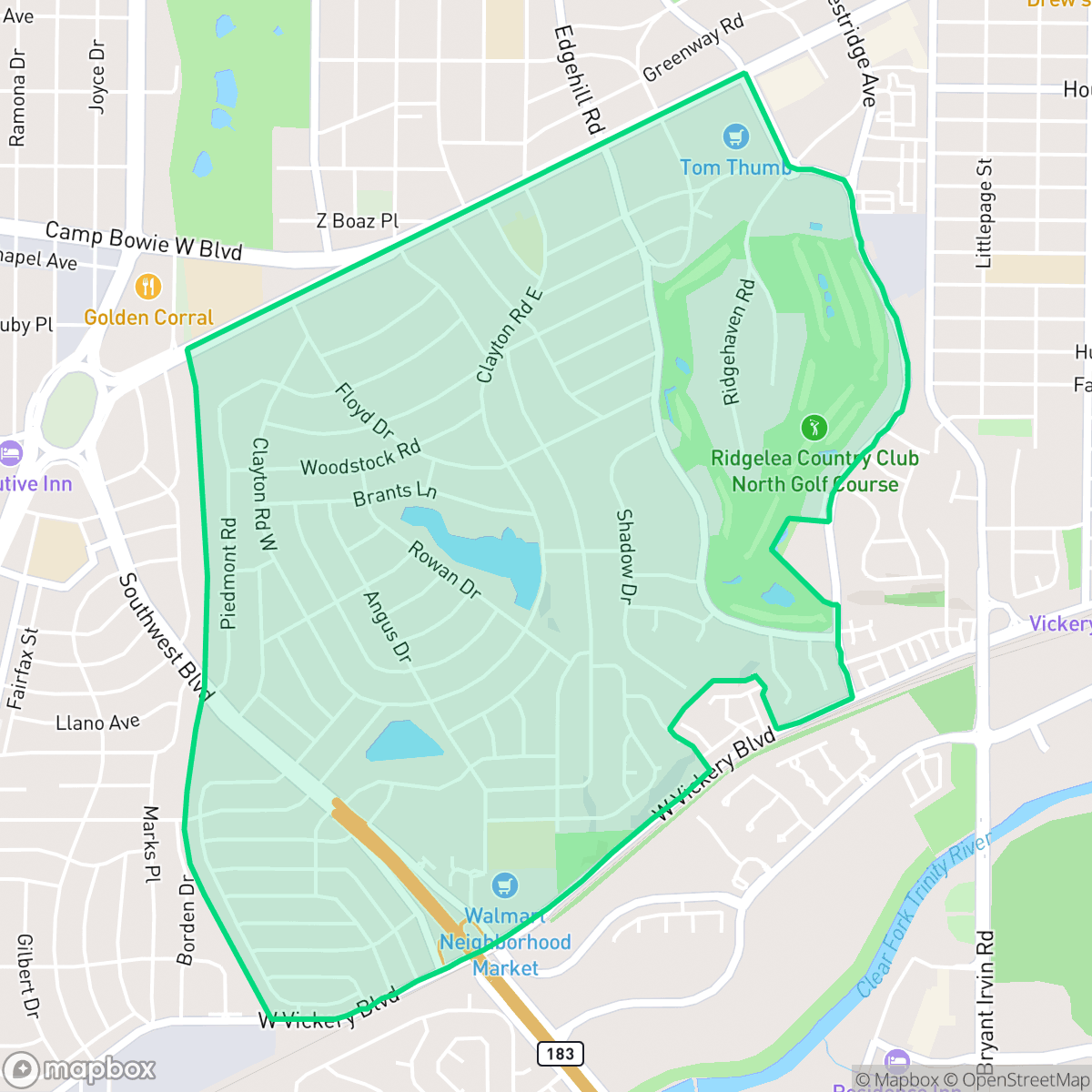
Located six miles west of downtown Fort Worth, Ridglea Hills transitioned from early 20th-century ranch land into a postwar suburb platted in 1946 by developer A.C. Luther. Luther, who famously grazed Angus cattle on unsold residential lots during early development, also co-founded the neighborhood’s centerpiece, the Ridglea Country Club, in 1954. Characterized by its rolling topography, mature tree canopies, and mid-century ranch-style homes on oversized lots, the neighborhood also features the Fuller House, a geometric masterpiece designed by architect A. Quincy Jones. Historically, the area was impacted by segregation; in 1947, the city closed connecting streets, and a barbed-wire-topped barrier known as the "Ridglea Wall" was erected to separate the neighborhood from the adjacent, historically Black Como community. Today, the neighborhood maintains its distinct mid-century charm alongside the 6.1-acre Ridglea Hills Park, acquired in 1960.
The area is characterized by its rolling topography and a blend of residential streets and localized commercial hubs. It provides a visually appealing environment that balances quiet, low-density living with proximity to essential services and lifestyle businesses. Residents benefit from significant open spaces, which contribute to a tranquil atmosphere despite the presence of nearby major thoroughfares.
Prospective residents should note that the neighborhood is car-dependent, with limited walkability to daily amenities. According to iHuus data, acoustic comfort is impacted by road traffic, and the local school district is currently navigating significant operational and financial challenges. Despite these factors, the area maintains strong health insurance coverage and a stable, suburban environment suitable for those prioritizing aesthetic appeal and a quieter pace of life.
Neighborhood Scores Across 15 Qualities
Homes are typically spaced with moderate distance between neighbors, offering more separation than the Fort Worth average. According to iHuus data, the neighborhood features established suburban layouts with small private backyards and consistent buffers between structures.
Pedestrian infrastructure is consistent with the city average, featuring many street-level sidewalks and safe crossings. While some suburban residential streets lack continuous sidewalks, the low traffic volume and presence of bridges over the highway facilitate safe passage.
Manicured lawns and large residences with private pools create a highly polished landscape. This level of visual appeal is notably higher than the Fort Worth city average, according to iHuus data.
Connected green belts and a nearby golf course provide ample space for pets, making the area slightly more dog friendly than the Fort Worth average. Residential streets feature many fenced yards and grassy verges along the river corridor.
Scattered homes and open greenery provide a more spacious, low-density atmosphere that is slightly more rural than the Fort Worth average. According to iHuus data, the area features a mix of wooded lots and suburban residential pockets.
A mix of quiet residential streets and active social pockets provides more variety in dining and leisure than the Fort Worth average. While some areas feature walkable paths to local spots, much of the neighborhood remains car-dependent for accessing larger commercial hubs.
Frequent noise from nearby freeways and rail lines contributes to an acoustic environment that is less quiet than the Fort Worth average. According to iHuus data, residents may experience more consistent sound disturbances than those in other parts of the city.
Air quality in this area typically fluctuates between acceptable and unhealthy levels. According to iHuus data, the air quality is slightly better than the Fort Worth average, though sensitive groups should remain cautious on certain days.
Industrial activity is absent from this area, providing a strictly residential and light commercial environment that is significantly cleaner than the Fort Worth average. According to iHuus data, there are no detectable warehouses, heavy industrial facilities, or hazardous sites within the neighborhood boundaries.
Health insurance enrollment among residents is notably higher than the Fort Worth average, according to iHuus data.
Political views in this area are split relatively evenly between conservative and liberal leanings, making the community less partisan than the Fort Worth average according to iHuus data.
Residents will find a balanced demographic of young adults, families, and older individuals. This age distribution is slightly more varied than the Fort Worth average, according to iHuus data.
Flood risk levels in this area are higher than the Fort Worth average, though official FEMA studies for this specific location are currently incomplete. According to iHuus data, the lack of a detailed flood study means residents should remain cautious of potential drainage issues during heavy rain events.
Address-Level Insights for Ridglea Hills


iHuus Neighborhood Intelligence Insights
Get address-level neighborhood insights for Ridglea Hills
- Street-level scores — see how individual blocks compare, not just neighborhood averages
- Micro-zone boundaries — identify quiet pockets, flood boundaries, and walkable clusters before you visit
- 15 dimensions in full — walkability, noise, air quality, school quality, insurance coverage, population age profile, urban/rural index, and more
- Boundary risk alerts — know if your address sits near a block boundary where scores drop, the kind of detail no listing will ever mention
- School insights — individual school ratings and insights, not just district-level data
- Compare before you commit — side-by-side data across neighborhoods, down to block precision
No credit card required
Compare with Any Neighborhood
| Dimension | Ridglea Hills | Alamo Heights |
|---|---|---|
| 🚶 Walkabilityavg 7.5 | ||
| 🔊 Acoustic Comfortavg 4.12 | ||
| 🤫 Privacy Indexavg 5.64 | ||
| 🎨 Visual Appealavg 6.38 | ||
| 🐕 Dog Friendlinessavg 6.57 | ||
| 🗺️ Urban-Rural Indexavg 6.92 | ||
| ✨ Neighborhood Vibeavg 4.56 | ||
| 🏥 Health Insurance Coverageavg 5.8 | ||
| 🌿 Air Qualityavg 3.68 | ||
| 🏭 Industrial Proximityavg 8.13 | ||
| 🌊 Flood Safetyavg 3.61 | ||
| 🗳️ Ideological Leanavg 5.62 | ||
| 👥 Population Age Profileavg 4.51 | ||
| 🔥 Fire Safety | ||
| 🏫 School Quality |
Ridglea Hills Rankings
School Districts Serving Ridglea Hills
School Insights for Ridglea Hills
Below average outcomes; significant attendance and academic challenges.
School Insights
See what's really behind every school rating near Ridglea Hills
- Individual school ratings — each school's own score with outcome context, not just a district average
- Enrollment & class size data — student-to-teacher ratio and how it compares to the state average
- Full demographics breakdown — ethnicity and gender composition for every school in the enrollment zone
- Every school in the district — all schools within the enrollment boundary ranked by rating, not just the closest one
- Grade levels & benchmarks — elementary through high school, with below/above state-average flags
No credit card required