Ridglea Country Club, Fort Worth
Updated · 1,599 residents
Ridglea Country Club is a tranquil, suburban enclave in western Fort Worth defined by its mid-century character and expansive green spaces. While the area offers high visual appeal and exceptional dog friendliness, it remains a car-dependent community with limited nightlife and significant flood risk.
Key Highlights
About Ridglea Country Club
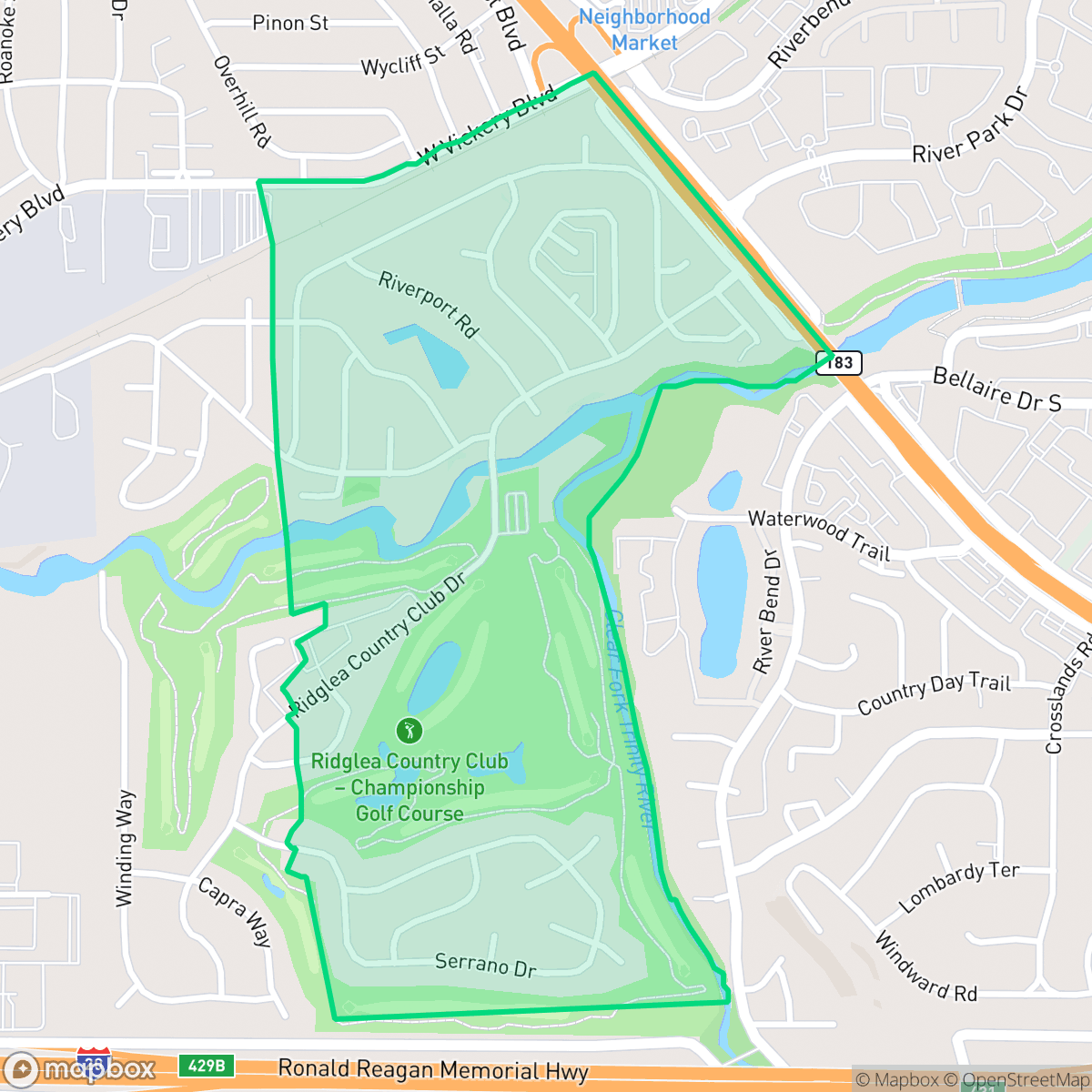
The Ridglea Country Club neighborhood in western Fort Worth, Texas, traces its roots to 1850s land surveys and a historic pioneer cemetery on Streamwood Road containing Civil War veterans and members of the Wilburn family. Originally home to Allen Farms, the modern neighborhood took shape in 1966 when developers J.T. Luther and Fritz Barton began transforming the 184-acre tract into a secluded residential community centered around the Ridglea Country Club. The club itself, originally established in 1954, features a sprawling, mid-century modern clubhouse designed by Los Angeles architect Burton A. Schutt. Characterized by its winding, tree-lined streets, brick ranch-style homes, and scenic vistas along Mary’s Creek and the Clear Fork of the Trinity River, the neighborhood maintains a distinct suburban-country character, preserved since 1970 by its local homeowners association.
The neighborhood provides a quiet living environment characterized by its aesthetic appeal and proximity to natural features like Mary’s Creek and the Clear Fork of the Trinity River. Residents benefit from a peaceful acoustic environment that ranks well above the city average, making the area a calm retreat from urban noise. It functions as a blend of residential streets and localized commercial zones, though the daily reliance on vehicles is high given the limited walkability of the community. The landscape features a mix of brick ranch-style homes and wellness businesses, maintaining a distinct suburban-country feel.
Prospective residents should consider specific infrastructure challenges, including a notably low flood safety rating and the current operational instability within the local Fort Worth Independent School District. While the area excels in high health insurance coverage rates and pet-friendly amenities, it is best suited for those who prioritize a low-key lifestyle over proximity to active entertainment or high-density transit. The demographic profile leans toward an older population compared to the city average, reflecting the established and settled nature of the community.
Neighborhood Scores Across 15 Qualities
Residential spacing varies between single-family homes and multi-family units, providing slightly more separation than the Fort Worth average. According to iHuus data, most neighbors maintain a moderate buffer, though some apartment buildings feature closer proximity.
Extensive sidewalk networks and a dedicated trail system along the waterway provide safe pedestrian routes. This level of connectivity is slightly above the Fort Worth average, according to iHuus data.
Large homes, private pools, and well-maintained landscapes characterize this area. According to iHuus data, the visual quality of the neighborhood is notably higher than the Fort Worth average.
Abundant green belts and a river corridor with connected paths provide much more space for walking dogs than the Fort Worth average. Many residential yards are fenced, and the presence of nearby parks offers ample outdoor area for pets.
Residential layouts consist of a dense suburban mix of single-family homes and apartment complexes, matching the typical urban-rural balance found across Fort Worth. According to iHuus data, the area features a blend of neighborhood retail centers and residential pockets without leaning heavily toward either dense urbanity or rural isolation.
A steady rhythm of residential life and wellness services defines this area, which offers slightly more activity than the Fort Worth average. While some pockets near highways and water features provide accessible social hubs, much of the landscape remains a low-density, serene environment with limited commercial density.
Frequent noise from nearby transit corridors and flight paths makes this area noisier than the Fort Worth average, according to iHuus data.
Air quality fluctuates between acceptable and unhealthy levels, though conditions are slightly better than the Fort Worth average according to iHuus data. Sensitive groups should remain mindful of occasional periods of poor air quality.
Industrial hazards and heavy warehouses are absent from this area. According to iHuus data, the neighborhood features a purely residential and light commercial landscape that is notably cleaner of industrial presence than the Fort Worth average.
Health insurance access is significantly higher here than the Fort Worth average, according to iHuus data. Residents benefit from a much larger proportion of the population possessing comprehensive medical coverage.
Political leanings in this area are predominantly conservative, representing a notable shift from the more moderate political landscape seen across the rest of Fort Worth.
A diverse range of age groups resides here, including young adults, families, and seniors. This demographic spread is slightly more varied than the average found across Fort Worth, according to iHuus data.
Flood risk in this area is slightly higher than the Fort Worth average, though detailed FEMA studies for the neighborhood are currently unavailable.
Address-Level Insights for Ridglea Country Club


iHuus Neighborhood Intelligence Insights
Get address-level neighborhood insights for Ridglea Country Club
- Street-level scores — see how individual blocks compare, not just neighborhood averages
- Micro-zone boundaries — identify quiet pockets, flood boundaries, and walkable clusters before you visit
- 15 dimensions in full — walkability, noise, air quality, school quality, insurance coverage, population age profile, urban/rural index, and more
- Boundary risk alerts — know if your address sits near a block boundary where scores drop, the kind of detail no listing will ever mention
- School insights — individual school ratings and insights, not just district-level data
- Compare before you commit — side-by-side data across neighborhoods, down to block precision
No credit card required
Compare with Any Neighborhood
| Dimension | Ridglea Country Club | Alamo Heights |
|---|---|---|
| 🚶 Walkabilityavg 7.5 | ||
| 🔊 Acoustic Comfortavg 4.12 | ||
| 🤫 Privacy Indexavg 5.64 | ||
| 🎨 Visual Appealavg 6.38 | ||
| 🐕 Dog Friendlinessavg 6.57 | ||
| 🗺️ Urban-Rural Indexavg 6.92 | ||
| ✨ Neighborhood Vibeavg 4.56 | ||
| 🏥 Health Insurance Coverageavg 5.8 | ||
| 🌿 Air Qualityavg 3.68 | ||
| 🏭 Industrial Proximityavg 8.13 | ||
| 🌊 Flood Safetyavg 3.61 | ||
| 🗳️ Ideological Leanavg 5.62 | ||
| 👥 Population Age Profileavg 4.51 | ||
| 🔥 Fire Safety | ||
| 🏫 School Quality |
Ridglea Country Club Rankings
School Districts Serving Ridglea Country Club
School Insights for Ridglea Country Club
Below average outcomes; significant attendance and academic challenges.
School Insights
See what's really behind every school rating near Ridglea Country Club
- Individual school ratings — each school's own score with outcome context, not just a district average
- Enrollment & class size data — student-to-teacher ratio and how it compares to the state average
- Full demographics breakdown — ethnicity and gender composition for every school in the enrollment zone
- Every school in the district — all schools within the enrollment boundary ranked by rating, not just the closest one
- Grade levels & benchmarks — elementary through high school, with below/above state-average flags
No credit card required