Park Hill, Fort Worth
Updated · 375 residents
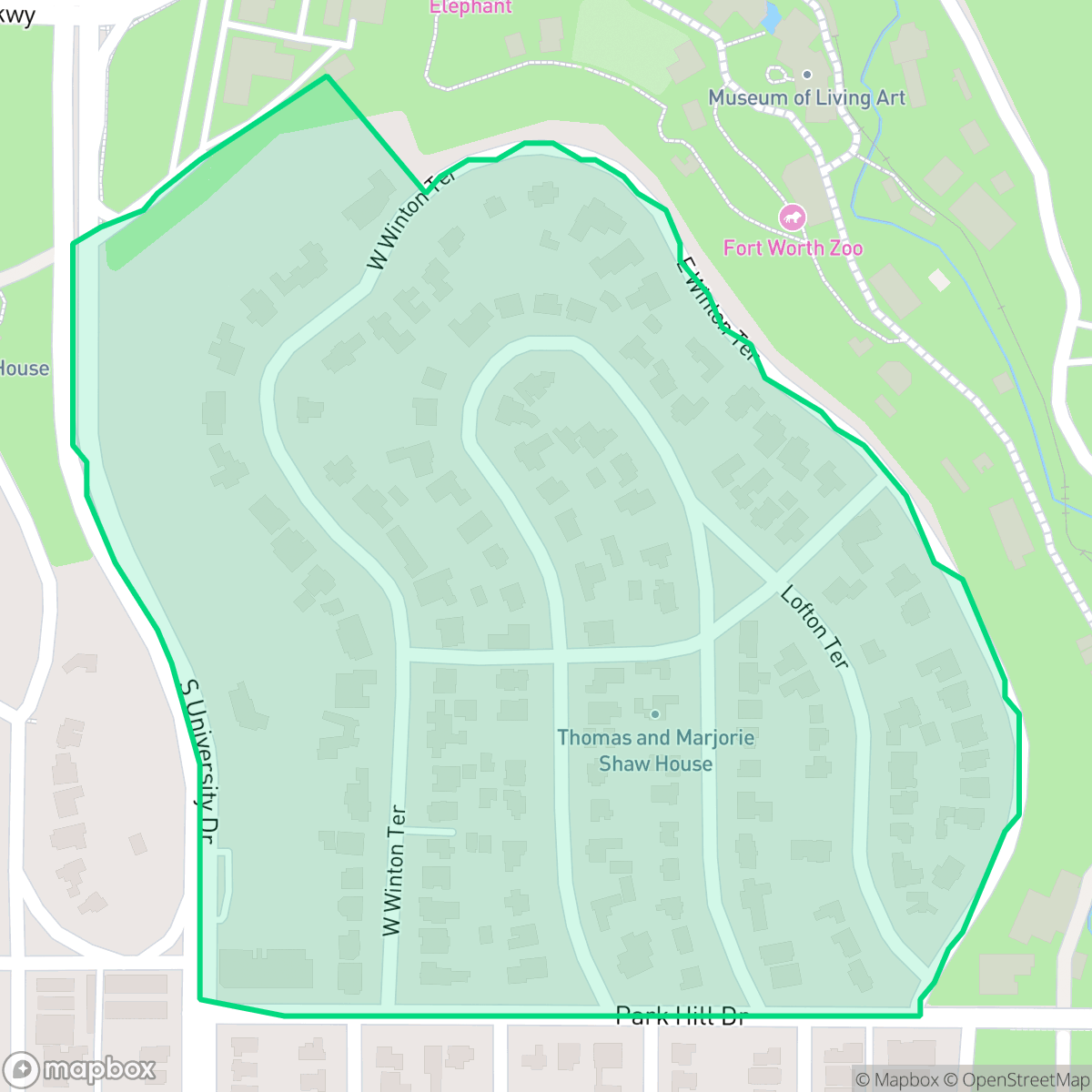
Park Hill is a historic Fort Worth neighborhood defined by its circular street layout and distinctive Tudor and Spanish-style architecture. Residents enjoy a highly walkable environment with exceptional dog friendliness and a lively atmosphere, though the area experiences moderate noise levels from road traffic.
Key Highlights
About Park Hill
Platted in 1925 by the Fairmount Land Company, the historic Park Hill neighborhood in Fort Worth was designed by the renowned landscape architecture firm Hare & Hare. Developed on a bluff overlooking Forest Park and the Fort Worth Zoo, the neighborhood's circular street layout was first anchored by the Fort Worth Free Baby Hospital (later Cook Children's Hospital) in 1918. Residential construction began in 1926 under developers William C. Bryce and William Craton Guthrie, attracting prominent oil-industry professionals and city leaders. Architect Joseph Pelich designed many of Park Hill's distinctive Tudor Revival and Spanish-style homes. Today, the neighborhood retains its early 20th-century elegance, characterized by mature tree canopies, historic entrance gates, and period streetlights installed in 1927.
The area offers a blend of historic charm and modern convenience, characterized by its mature tree canopies and well-preserved residential character. It maintains a strong sense of place, supported by high visual appeal and a layout that encourages pedestrian activity. Local amenities, including diverse dining options, contribute to a vibrant atmosphere that distinguishes the neighborhood from its quieter surroundings. According to data, the area provides a balance of urban access and residential comfort, making it a unique enclave within the city.
While the neighborhood excels in walkability and pet friendliness, prospective residents should consider the acoustic environment, as road traffic contributes to moderate noise levels. The local school district, Fort Worth ISD, is currently navigating significant financial and operational challenges that may influence family housing decisions. Despite these factors, the area remains a stable residential community with robust flood safety measures and high rates of health insurance coverage, making it well-suited for those who prioritize neighborhood character and accessibility over school district performance.
Neighborhood Scores Across 15 Qualities
Residential spacing offers a moderate level of separation between neighbors, which is slightly higher than the Fort Worth average according to iHuus data.
Pedestrian travel is convenient due to sidewalks on one side of streets and safe crossings. According to iHuus data, walkability in this area is slightly above the Fort Worth average.
Large residential properties and frequent upscale amenities provide a highly aesthetic environment that is noticeably more visually pleasing than the Fort Worth average. According to iHuus data, the area features spacious driveways and well-maintained landscapes.
Abundant large parks, trails, and open spaces provide significant opportunities for pet owners. According to iHuus data, the availability of these recreational areas is well above the Fort Worth average.
Open land and scattered homes amid woodland characterize this area. According to iHuus data, the landscape is more open and less dense than the Fort Worth average.
Local dining options and social landmarks like Log Cabin Village provide a noticeable concentration of activity, making the area significantly livelier than the Fort Worth average. While many blocks offer diverse food choices, some areas remain low density with a reliance on driving to reach commercial units.
Frequent noise from nearby railroad tracks and heavy freeway traffic characterizes the area. This level of acoustic disturbance is notably higher than the Fort Worth average, according to iHuus data.
Air quality levels fluctuate between acceptable and unhealthy periods, which may cause occasional concern for sensitive groups. According to iHuus data, conditions in Park Hill are slightly better than the Fort Worth average.
Industrial facilities and warehouses are absent from this area, providing a residential environment that is significantly cleaner than the Fort Worth average. According to iHuus data, the neighborhood consists of quiet streets and open green spaces with no detected hazard sites.
Health insurance access is significantly higher here than the Fort Worth average, according to iHuus data. Residents in this area benefit from much greater rates of coverage compared to most other parts of the city.
Political leanings in this area are significantly more conservative than the Fort Worth average. According to iHuus data, the neighborhood contains a conservative majority with a modest opposing presence.
Residents live alongside a balanced mix of young adults, families, and seniors. This demographic spread is slightly more varied than the average found across Fort Worth, according to iHuus data.
Flood safety in this area is significantly higher than the Fort Worth average, though some residual risk remains within the 500-year floodplain according to iHuus data.
Address-Level Insights for Park Hill


iHuus Neighborhood Intelligence Insights
Get address-level neighborhood insights for Park Hill
- Street-level scores — see how individual blocks compare, not just neighborhood averages
- Micro-zone boundaries — identify quiet pockets, flood boundaries, and walkable clusters before you visit
- 15 dimensions in full — walkability, noise, air quality, school quality, insurance coverage, population age profile, urban/rural index, and more
- Boundary risk alerts — know if your address sits near a block boundary where scores drop, the kind of detail no listing will ever mention
- School insights — individual school ratings and insights, not just district-level data
- Compare before you commit — side-by-side data across neighborhoods, down to block precision
No credit card required
Compare with Any Neighborhood
| Dimension | Park Hill | Alamo Heights |
|---|---|---|
| 🚶 Walkabilityavg 7.5 | ||
| 🔊 Acoustic Comfortavg 4.12 | ||
| 🤫 Privacy Indexavg 5.64 | ||
| 🎨 Visual Appealavg 6.38 | ||
| 🐕 Dog Friendlinessavg 6.57 | ||
| 🗺️ Urban-Rural Indexavg 6.92 | ||
| ✨ Neighborhood Vibeavg 4.56 | ||
| 🏥 Health Insurance Coverageavg 5.8 | ||
| 🌿 Air Qualityavg 3.68 | ||
| 🏭 Industrial Proximityavg 8.13 | ||
| 🌊 Flood Safetyavg 3.61 | ||
| 🗳️ Ideological Leanavg 5.62 | ||
| 👥 Population Age Profileavg 4.51 | ||
| 🔥 Fire Safety | ||
| 🏫 School Quality |
Park Hill Rankings
School Districts Serving Park Hill
School Insights for Park Hill
Below average outcomes; significant attendance and academic challenges.
School Insights
See what's really behind every school rating near Park Hill
- Individual school ratings — each school's own score with outcome context, not just a district average
- Enrollment & class size data — student-to-teacher ratio and how it compares to the state average
- Full demographics breakdown — ethnicity and gender composition for every school in the enrollment zone
- Every school in the district — all schools within the enrollment boundary ranked by rating, not just the closest one
- Grade levels & benchmarks — elementary through high school, with below/above state-average flags
No credit card required