Park Glen, Fort Worth
Updated · 14,101 residents
Park Glen is a highly walkable community characterized by an extensive network of sidewalks and trails that connect residential streets to large green spaces like Arcadia Trail Park. While the area offers a visually appealing suburban aesthetic with well-maintained homes and private pools, residents should expect moderate road noise and a dense housing layout.
Key Highlights
About Park Glen
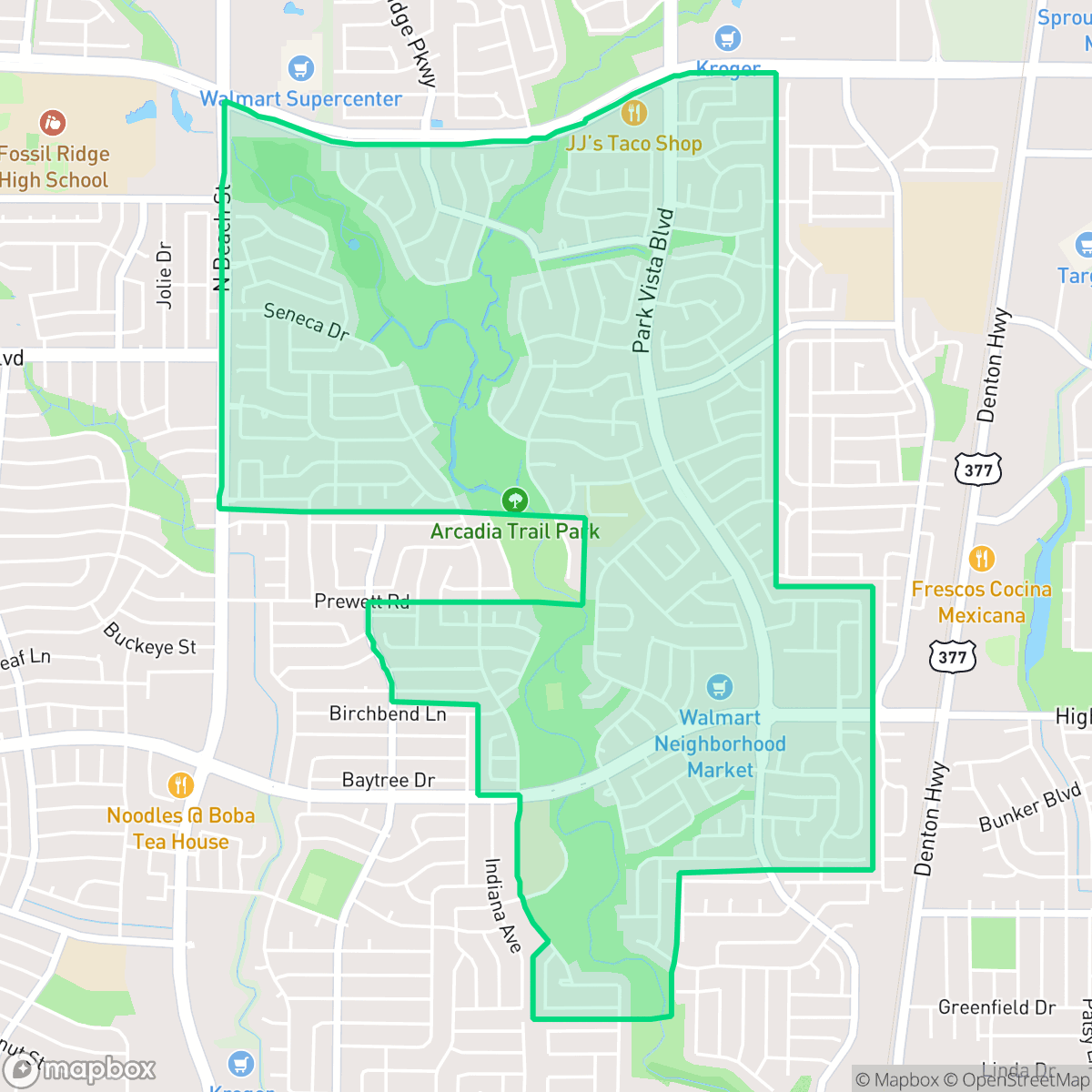
Developed in 1988 by Ross Perot Jr.’s Hillwood Residential, Park Glen is a master-planned community in North Fort Worth. It holds historical distinction as Hillwood’s very first master-planned development and was established as Fort Worth’s first Public Improvement District (PID #6) to support regional growth along the emerging AllianceTexas corridor. Spanning 13 distinct residential villages, the neighborhood features more than 3,300 single-family homes. Park Glen's character is defined by its extensive green spaces, most notably Arcadia Trail Park, a 217-acre public park that runs through the heart of the community, offering multi-use trails, playgrounds, and athletic fields. This family-oriented neighborhood is served by both the Keller and Birdville Independent School Districts.
The area is defined by its strong commitment to pedestrian infrastructure, earning top marks for its comprehensive sidewalk network and off-road paths. This layout encourages an active lifestyle, allowing residents to easily navigate between homes and local recreational amenities. The visual character of the neighborhood is marked by upscale single-family homes, often featuring complex rooflines and private backyard swimming pools, which contribute to a polished suburban appearance.
Prospective residents should consider the trade-offs of this dense suburban environment, where homes are positioned closely together with limited yard space. While the neighborhood is free from industrial hazards and benefits from strong health insurance coverage, the acoustic environment is impacted by consistent road traffic noise. The community is well-suited for families seeking access to high-performing schools and a structured, safe environment, though those prioritizing absolute quiet or expansive private acreage may find the density a notable factor.
Neighborhood Scores Across 15 Qualities
Homes are situated with standard suburban spacing and narrow side yards, providing a level of privacy that is roughly in line with the Fort Worth average. Fenced backyards and occasional greenbelts offer some separation between neighbors, though houses are often closely grouped.
Extensive sidewalk networks and dedicated paved trails through the greenbelt provide exceptional pedestrian connectivity. This level of accessibility for walkers and runners is significantly higher than the Fort Worth average according to iHuus data.
Large homes with complex rooflines and a high density of private backyard pools create a more polished aesthetic than the Fort Worth average. According to iHuus data, the presence of well-manicured lawns and spacious driveways contributes to a visually affluent environment.
Extensive greenbelts, continuous sidewalks, and wide grassy verges provide ample space for pets away from traffic. According to iHuus data, these connected trails and park areas offer significantly more walking opportunities than the Fort Worth average.
Open land and scattered homes amid woodland characterize this area, though it feels slightly more developed than the Fort Worth average. Residents will find a mix of single-family housing and integrated greenbelts according to iHuus data.
Mixed pockets of activity and quiet residential streets provide a liveliness that sits above the Fort Worth average. While some areas offer walkable access to various dining options, other parts of the neighborhood remain primarily suburban and quiet.
Frequent sounds from nearby heavy traffic and rail lines characterize this area. Acoustic comfort in Park Glen is notably lower than the Fort Worth average, according to iHuus data.
Frequent unhealthy air quality levels pose a significant risk to sensitive groups. This area experiences much worse air conditions than the Fort Worth average, according to iHuus data.
Primarily consisting of residential, recreational, and light commercial zones, this area lacks the heavy warehouses or industrial hazards found more frequently in other parts of Fort Worth. According to iHuus data, the neighborhood is largely free from large-scale industrial activity and adjacent manufacturing facilities.
Health insurance access is notably higher here than the Fort Worth average, according to iHuus data. Most residents in the area are covered by health insurance plans.
Conservative viewpoints hold a significant majority within this community, representing a notable departure from the more balanced political landscape seen across Fort Worth.
Residents live alongside a balanced mix of young adults, families, and older populations. This age distribution aligns closely with the Fort Worth average according to iHuus data.
Flood risk in this area is higher than the Fort Worth average, though FEMA has not yet finished a detailed study to confirm the specific level of danger. Residents should remain cautious as the official risk level for this neighborhood remains undetermined.
Address-Level Insights for Park Glen


iHuus Neighborhood Intelligence Insights
Get address-level neighborhood insights for Park Glen
- Street-level scores — see how individual blocks compare, not just neighborhood averages
- Micro-zone boundaries — identify quiet pockets, flood boundaries, and walkable clusters before you visit
- 15 dimensions in full — walkability, noise, air quality, school quality, insurance coverage, population age profile, urban/rural index, and more
- Boundary risk alerts — know if your address sits near a block boundary where scores drop, the kind of detail no listing will ever mention
- School insights — individual school ratings and insights, not just district-level data
- Compare before you commit — side-by-side data across neighborhoods, down to block precision
No credit card required
Compare with Any Neighborhood
| Dimension | Park Glen | Alamo Heights |
|---|---|---|
| 🚶 Walkabilityavg 7.5 | ||
| 🔊 Acoustic Comfortavg 4.12 | ||
| 🤫 Privacy Indexavg 5.64 | ||
| 🎨 Visual Appealavg 6.38 | ||
| 🐕 Dog Friendlinessavg 6.57 | ||
| 🗺️ Urban-Rural Indexavg 6.92 | ||
| ✨ Neighborhood Vibeavg 4.56 | ||
| 🏥 Health Insurance Coverageavg 5.8 | ||
| 🌿 Air Qualityavg 3.68 | ||
| 🏭 Industrial Proximityavg 8.13 | ||
| 🌊 Flood Safetyavg 3.61 | ||
| 🗳️ Ideological Leanavg 5.62 | ||
| 👥 Population Age Profileavg 4.51 | ||
| 🔥 Fire Safety | ||
| 🏫 School Quality |
Park Glen Rankings
School Districts Serving Park Glen
School Insights for Park Glen
Below average outcomes; significant attendance and academic challenges.
School Insights
See what's really behind every school rating near Park Glen
- Individual school ratings — each school's own score with outcome context, not just a district average
- Enrollment & class size data — student-to-teacher ratio and how it compares to the state average
- Full demographics breakdown — ethnicity and gender composition for every school in the enrollment zone
- Every school in the district — all schools within the enrollment boundary ranked by rating, not just the closest one
- Grade levels & benchmarks — elementary through high school, with below/above state-average flags
No credit card required