Overton Woods, Fort Worth
Updated · 616 residents
Overton Woods is a quiet, residential enclave in southwest Fort Worth defined by its mature tree canopy and proximity to the Trinity Trails system. The neighborhood offers an exceptionally dog-friendly environment with high visual appeal, though it remains a secluded area with limited local commercial activity.
Key Highlights
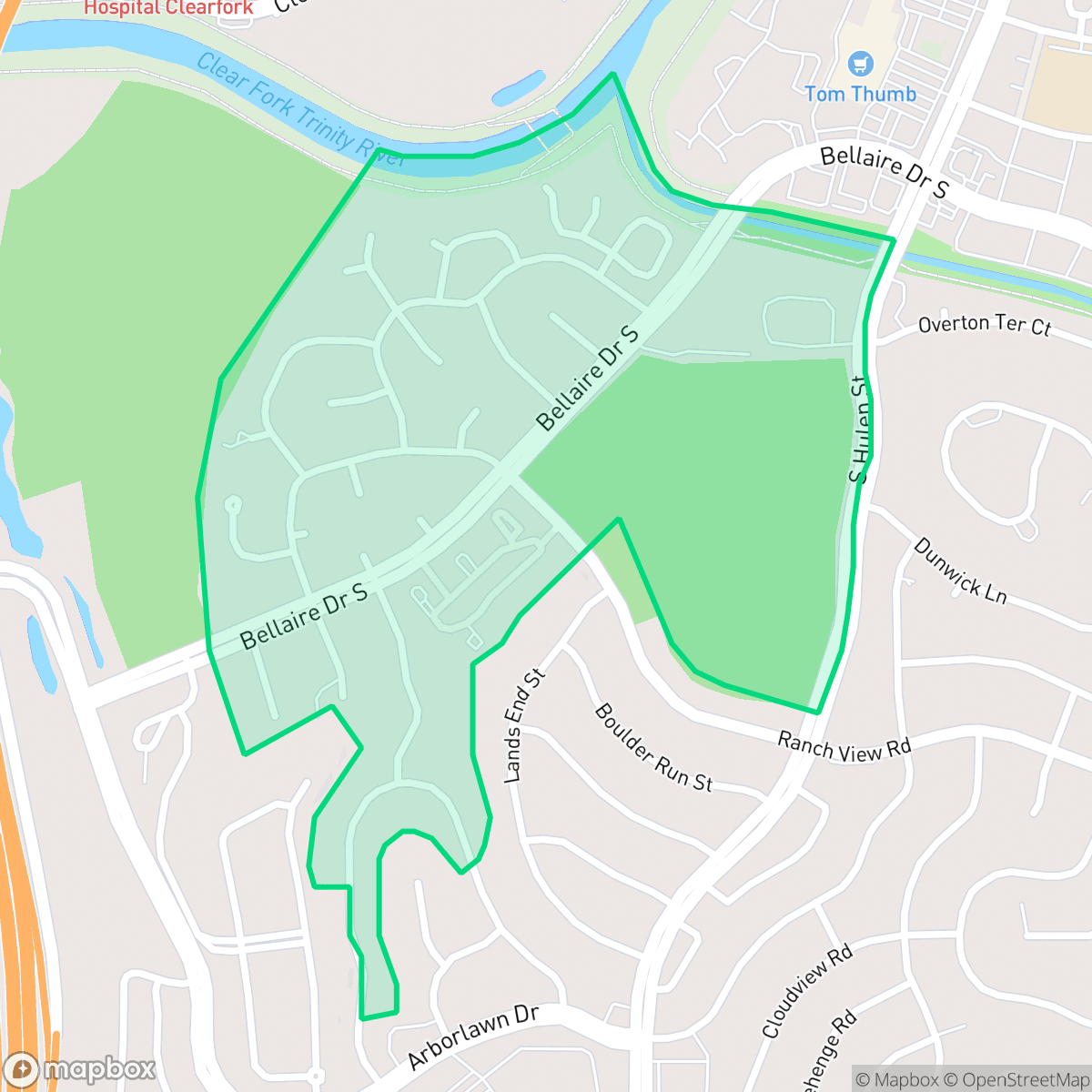
About Overton Woods
Located along the Clear Fork of the Trinity River in southwest Fort Worth, Overton Woods was developed on land that was originally part of the historic Edwards Ranch. Established in 1848 by Lemuel Edwards, the massive 7,000-acre cattle ranch predated the city of Fort Worth itself. In 1956, the Edwards family formed the Cassco Development Company to gradually transition the ranchland into master-planned communities. Residential development in Overton Woods began in 1980, transforming the former pastureland into an upscale, quiet neighborhood characterized by large, tree-canopied lots. The neighborhood features a mix of traditional, ranch, Colonial, and French-style homes built primarily between 1980 and 1999. Today, the neighborhood is bounded by the scenic Trinity Trails system and sits adjacent to modern developments like The Shops at Clearfork.
This area serves as a tranquil residential retreat, characterized by its spacious lots and established landscape. Residents benefit from high levels of health insurance coverage and a strong sense of privacy, making it an attractive option for those seeking a suburban environment away from the city's commercial hubs. The proximity to the Clear Fork of the Trinity River provides residents with immediate access to outdoor recreation, which contributes to the area's high ratings for dog friendliness and visual appeal.
Prospective residents should be aware of certain trade-offs, including the current challenges facing the Fort Worth Independent School District, which currently holds a low rating due to systemic financial and operational instability. While the neighborhood is generally peaceful, road traffic contributes to moderate noise levels, and the lack of nearby businesses requires residents to commute for most daily errands. According to iHuus data, the area maintains a distinct suburban character that prioritizes residential space over urban density, making it better suited for those who value quiet streets over walkability to retail or dining.
Neighborhood Scores Across 15 Qualities
Residential spacing in Overton Woods provides a moderate level of separation between homes. According to iHuus data, this degree of buffer between neighbors is slightly higher than the Fort Worth average.
Sidewalks and safe crossings allow for easy pedestrian movement, making this area more walkable than the Fort Worth average. Most local errands can be navigated on foot according to iHuus data.
Large residential properties and frequent upscale amenities contribute to a landscape that is more visually polished than the Fort Worth average. According to iHuus data, the area features spacious driveways and well-maintained architectural elements.
Connected green spaces and wide, traffic-free paths make this area much more suitable for pet owners than the Fort Worth average. According to iHuus data, the neighborhood provides ample safe space for walking dogs.
Open land and scattered homes among woodland areas provide a more spacious atmosphere than the Fort Worth average. This setting offers a balance of natural landscapes and residential privacy according to iHuus data.
Low density and significant open space create a quiet, suburban landscape, though the lack of local business hubs makes most errands dependent on a vehicle. This area is notably less active than the Fort Worth average due to a scarcity of walkable commercial character.
A steady hum from nearby busy streets is present. According to iHuus data, acoustic levels are slightly higher than the Fort Worth average.
Air quality levels fluctuate between acceptable and unhealthy periods, posing occasional concerns for sensitive groups. According to iHuus data, the air quality in this area is slightly better than the Fort Worth average.
Industrial activity is nonexistent within the neighborhood boundaries, offering a cleaner environment than the Fort Worth average. According to iHuus data, the area consists solely of residential streets and open green spaces without proximity to warehouses or hazard sites.
Health insurance access is exceptionally high among residents, significantly surpassing the Fort Worth average according to iHuus data.
Conservative political leanings are dominant in this area, representing a much more conservative profile than the Fort Worth average according to iHuus data.
Residents encounter a diverse age range including young professionals, families, and seniors. This demographic spread is more varied than the typical profile found across Fort Worth, according to iHuus data.
Flood risk in this area is slightly higher than the Fort Worth average. According to iHuus data, the lack of a detailed FEMA study means the specific susceptibility to flooding remains undetermined.
Address-Level Insights for Overton Woods


iHuus Neighborhood Intelligence Insights
Get address-level neighborhood insights for Overton Woods
- Street-level scores — see how individual blocks compare, not just neighborhood averages
- Micro-zone boundaries — identify quiet pockets, flood boundaries, and walkable clusters before you visit
- 15 dimensions in full — walkability, noise, air quality, school quality, insurance coverage, population age profile, urban/rural index, and more
- Boundary risk alerts — know if your address sits near a block boundary where scores drop, the kind of detail no listing will ever mention
- School insights — individual school ratings and insights, not just district-level data
- Compare before you commit — side-by-side data across neighborhoods, down to block precision
No credit card required
Compare with Any Neighborhood
| Dimension | Overton Woods | Alamo Heights |
|---|---|---|
| 🚶 Walkabilityavg 7.5 | ||
| 🔊 Acoustic Comfortavg 4.12 | ||
| 🤫 Privacy Indexavg 5.64 | ||
| 🎨 Visual Appealavg 6.38 | ||
| 🐕 Dog Friendlinessavg 6.57 | ||
| 🗺️ Urban-Rural Indexavg 6.92 | ||
| ✨ Neighborhood Vibeavg 4.56 | ||
| 🏥 Health Insurance Coverageavg 5.8 | ||
| 🌿 Air Qualityavg 3.68 | ||
| 🏭 Industrial Proximityavg 8.13 | ||
| 🌊 Flood Safetyavg 3.61 | ||
| 🗳️ Ideological Leanavg 5.62 | ||
| 👥 Population Age Profileavg 4.51 | ||
| 🔥 Fire Safety | ||
| 🏫 School Quality |
Overton Woods Rankings
School Districts Serving Overton Woods
School Insights for Overton Woods
Below average outcomes; significant attendance and academic challenges.
School Insights
See what's really behind every school rating near Overton Woods
- Individual school ratings — each school's own score with outcome context, not just a district average
- Enrollment & class size data — student-to-teacher ratio and how it compares to the state average
- Full demographics breakdown — ethnicity and gender composition for every school in the enrollment zone
- Every school in the district — all schools within the enrollment boundary ranked by rating, not just the closest one
- Grade levels & benchmarks — elementary through high school, with below/above state-average flags
No credit card required