Overton South, Fort Worth
Updated · 4,692 residents
Overton South is a residential neighborhood in southwest Fort Worth defined by its mid-century architectural character and proximity to major commercial corridors. While the area offers high visual appeal with spacious properties and private amenities, residents should expect a car-dependent lifestyle and elevated noise levels from nearby highway traffic.
Key Highlights
About Overton South
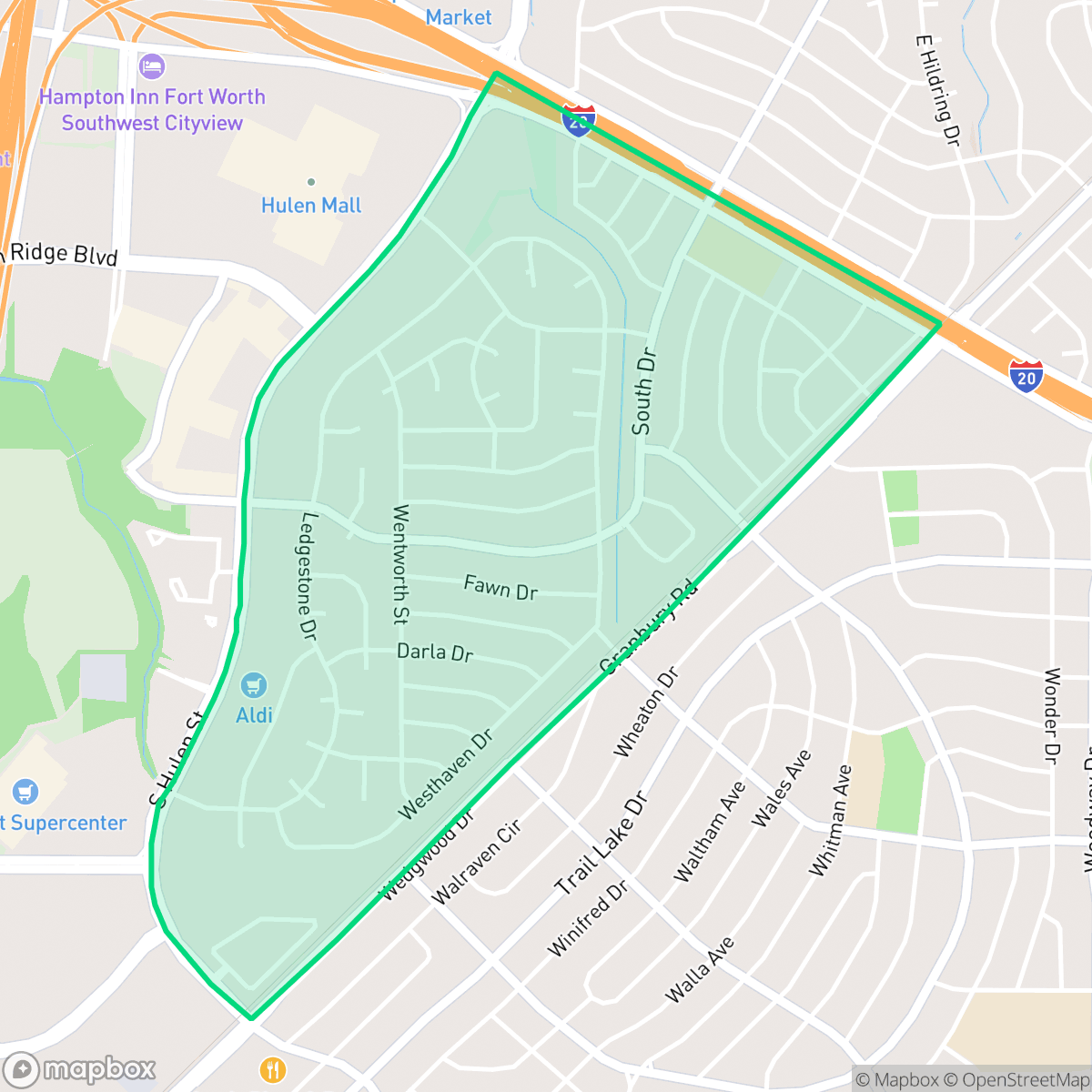
Located in southwest Fort Worth, Overton South was originally part of the historic Edwards Ranch, which was established in 1846. The greater Overton area was named in honor of rancher Lemuel G. Edwards’ son, Cass Overton Edwards, who was born on the property in 1851. Bounded by Hulen Street, Granbury Road, and Interstate 20, the neighborhood transitioned from historic ranching land into a suburban residential community during the mid-to-late 20th century, with the majority of its single-family homes, duplexes, and apartment complexes constructed between 1970 and 1999. Today, the community's interests are represented by the active Overton South Neighborhood Association (OSNA), which was formed in 2008 to advocate for residents and manage local environmental and zoning concerns.
Overton South serves as a well-established residential enclave that balances suburban quiet with immediate access to essential retail and dining along the Hulen Street and Granbury Road corridors. The neighborhood is characterized by its visual appeal, featuring large single-family homes and private amenities like backyard pools that contribute to a well-maintained aesthetic. Residents benefit from a lack of industrial encroachment, ensuring the area remains focused on residential and commercial use. The community maintains an active association that monitors local environmental and zoning concerns, fostering a stable suburban environment. Living in this area requires a reliance on personal vehicles, as the layout is designed for suburban transit rather than pedestrian movement. Potential residents should be aware of the acoustic environment, as proximity to Interstate 20 results in noticeable road noise. Additionally, the area is served by a mix of school districts, including Crowley Independent School District and Fort Worth Independent School District, where academic outcomes vary significantly across local campuses. This community is best suited for families or professionals who prioritize home size and central access to Fort Worth amenities over walkability or absolute acoustic silence.
Neighborhood Scores Across 15 Qualities
Residential spacing is consistent with the Fort Worth average, featuring a mix of closely situated homes and some larger setbacks. Some areas contain high density housing with shared walls, while other blocks provide more buffer between neighbors.
Residential streets feature safe crossings and sidewalks, although connectivity is interrupted by high-traffic arterials and large commercial lots. This level of pedestrian accessibility is slightly below the Fort Worth average.
Manicured landscapes and large homes with private pools contribute to a visual character that is slightly above the Fort Worth average. Streetscapes feature a mix of affluent estates and standard middle-class housing developments.
Public park access and wide grass verges are scarce in this area. Most greenery is confined to private fenced yards, making the neighborhood less dog friendly than the Fort Worth average.
Residential areas feature a dense suburban blend of single-family homes, apartment complexes, and commercial retail strips. This landscape is largely comparable to the broader Fort Worth area according to iHuus data.
A mix of quiet residential blocks and active commercial pockets provides more activity than the Fort Worth average. While some areas offer walkable access to dining and wellness shops, other sections remain car-dependent due to proximity to major highways and industrial zones.
Frequent noise from nearby railroad tracks and heavy freeway traffic characterizes the area. According to iHuus data, acoustic comfort in this neighborhood is lower than the Fort Worth average.
Air quality in this area fluctuates between acceptable and unhealthy levels, though it remains slightly better than the Fort Worth average. Sensitive groups should monitor local conditions during periods of occasional concern.
Industrial presence is virtually non-existent here, as the area consists primarily of residential streets and retail commerce. According to iHuus data, this lack of heavy industry and hazardous sites is notably higher than the Fort Worth average.
Health insurance access among residents is notably higher than the Fort Worth average, according to iHuus data.
Political leanings in this area are split fairly evenly between conservative and liberal perspectives, mirroring the broader political landscape of Fort Worth according to iHuus data.
Residents live alongside a balanced mix of young adults, families, and older populations. According to iHuus data, this age distribution is slightly more varied than the Fort Worth average.
Flood risk in this area is slightly higher than the Fort Worth average because parts of the neighborhood fall within a designated floodplain. According to iHuus data, residents should anticipate a higher likelihood of needing flood insurance.
Address-Level Insights for Overton South


iHuus Neighborhood Intelligence Insights
Get address-level neighborhood insights for Overton South
- Street-level scores — see how individual blocks compare, not just neighborhood averages
- Micro-zone boundaries — identify quiet pockets, flood boundaries, and walkable clusters before you visit
- 15 dimensions in full — walkability, noise, air quality, school quality, insurance coverage, population age profile, urban/rural index, and more
- Boundary risk alerts — know if your address sits near a block boundary where scores drop, the kind of detail no listing will ever mention
- School insights — individual school ratings and insights, not just district-level data
- Compare before you commit — side-by-side data across neighborhoods, down to block precision
No credit card required
Compare with Any Neighborhood
| Dimension | Overton South | Alamo Heights |
|---|---|---|
| 🚶 Walkabilityavg 7.5 | ||
| 🔊 Acoustic Comfortavg 4.12 | ||
| 🤫 Privacy Indexavg 5.64 | ||
| 🎨 Visual Appealavg 6.38 | ||
| 🐕 Dog Friendlinessavg 6.57 | ||
| 🗺️ Urban-Rural Indexavg 6.92 | ||
| ✨ Neighborhood Vibeavg 4.56 | ||
| 🏥 Health Insurance Coverageavg 5.8 | ||
| 🌿 Air Qualityavg 3.68 | ||
| 🏭 Industrial Proximityavg 8.13 | ||
| 🌊 Flood Safetyavg 3.61 | ||
| 🗳️ Ideological Leanavg 5.62 | ||
| 👥 Population Age Profileavg 4.51 | ||
| 🔥 Fire Safety | ||
| 🏫 School Quality |
Overton South Rankings
School Districts Serving Overton South
School Insights for Overton South
Below average outcomes; significant attendance and academic challenges.
School Insights
See what's really behind every school rating near Overton South
- Individual school ratings — each school's own score with outcome context, not just a district average
- Enrollment & class size data — student-to-teacher ratio and how it compares to the state average
- Full demographics breakdown — ethnicity and gender composition for every school in the enrollment zone
- Every school in the district — all schools within the enrollment boundary ranked by rating, not just the closest one
- Grade levels & benchmarks — elementary through high school, with below/above state-average flags
No credit card required