Overton Park, Fort Worth
Updated · 1,958 residents
Overton Park is a visually appealing, mid-century residential enclave known for its mature trees and direct access to the Trinity Trails. While the area offers high walkability for recreation, it functions as a quiet, car-oriented suburb with limited local commercial activity.
Key Highlights
About Overton Park
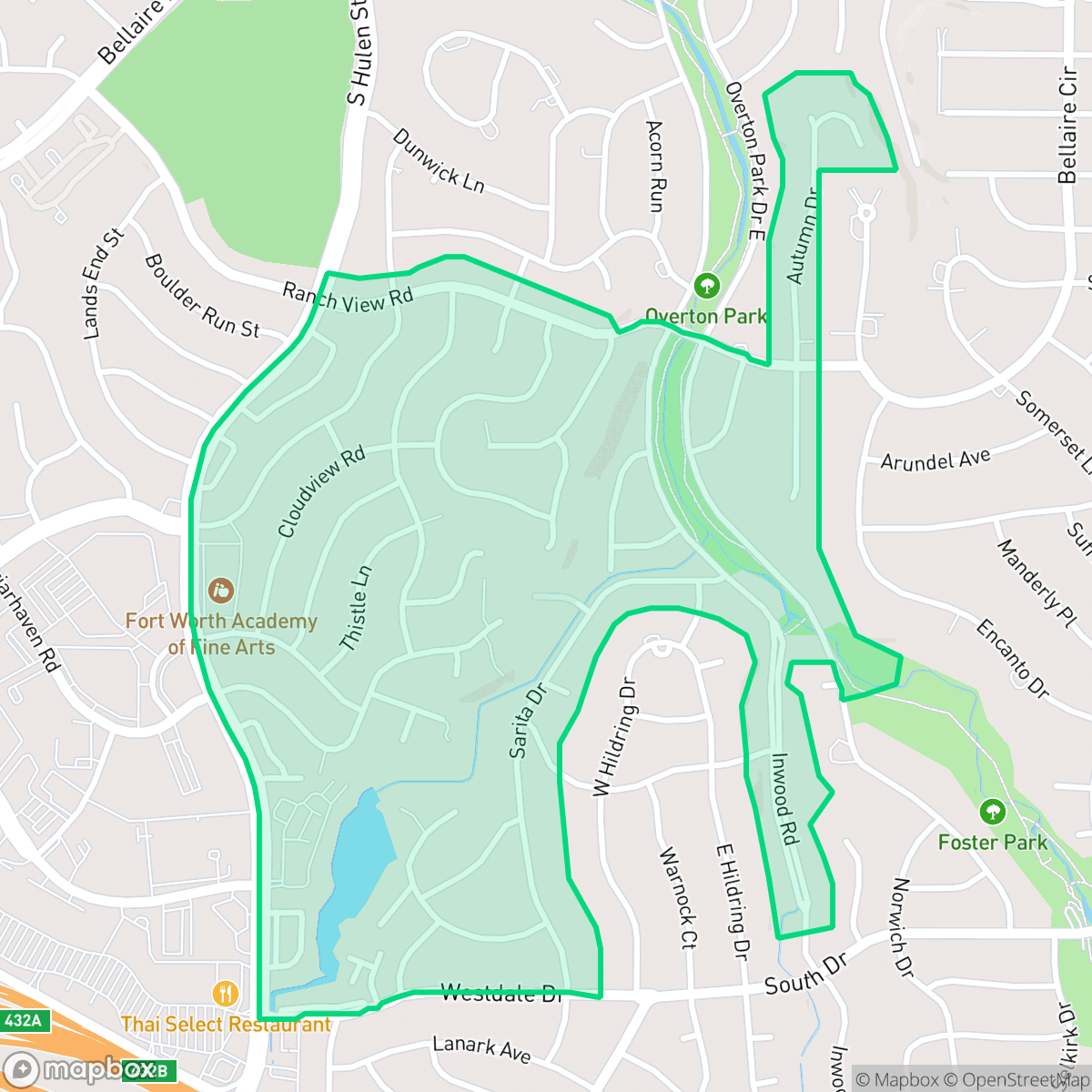
Located five miles southwest of downtown Fort Worth along the Trinity River, Overton Park was originally part of the historic L.G. Edwards ranch, established in 1846. The neighborhood was named after Edwards’ son, Cass Overton Edwards. The land operated as a working cattle ranch until 1954, when the Edwards family’s Cassco Land Company began residential development. Most of the neighborhood's mid-century homes were constructed between 1955 and 1968. In 1959, Cassco deeded a 12-acre strip of land that was later expanded into the 49-acre Overton Park, a scenic linear greenbelt that features trails and recreation areas linking local neighborhoods. Today, the neighborhood maintains its quiet residential charm, characterized by mature trees, large lots, and proximity to the Trinity Trails.
The area stands out for its strong visual appeal and commitment to outdoor recreation, providing residents with an environment that feels removed from the density of central Fort Worth. Its layout encourages pedestrian movement along greenbelts, making it a favorable location for dog owners and those who prioritize natural surroundings over urban density. The neighborhood maintains a stable demographic profile, with high levels of health insurance coverage among its residents.
Prospective residents should account for specific trade-offs, including higher ambient noise levels from road traffic and a lower score for flood safety. While the area lacks a bustling commercial center, it remains a settled community. It is best suited for individuals who value established, quiet residential streets and proximity to nature over immediate access to nightlife or high-frequency retail hubs.
Neighborhood Scores Across 15 Qualities
Residential spacing provides some buffer between neighbors, offering a slightly higher degree of privacy than the Fort Worth average.
Sidewalks are present on one side of the streets with safe crossings available, though the area is slightly less walkable than the Fort Worth average according to iHuus data.
Large residential properties and high-end amenities characterize the area. According to iHuus data, the visual landscape is notably more polished than the Fort Worth average.
Connected green spaces and wide, traffic-safe paths make this area slightly more accommodating to dog owners than the Fort Worth average, according to iHuus data.
Open land and scattered homes among wooded areas characterize the landscape, matching the typical urban-rural balance found across Fort Worth according to iHuus data.
Low-density residential blocks and significant green space define this area, though a lack of nearby commercial hubs makes most errands dependent on a vehicle. According to iHuus data, the neighborhood offers a more subdued pace of activity than the Fort Worth average.
Steady sounds from nearby busy streets are present, though the level of acoustic disturbance is slightly higher than the Fort Worth average.
Air quality fluctuates between acceptable and unhealthy levels, though conditions are slightly better than the Fort Worth average according to iHuus data. Sensitive groups may experience occasional concerns on certain days.
Industrial activity and nearby hazard sites are entirely absent from this area. According to iHuus data, the neighborhood is significantly more free of industrial proximity than the Fort Worth average.
Health insurance enrollment among residents is significantly higher than the Fort Worth average, according to iHuus data.
Conservative voters hold a significant majority in this area, representing a much more conservative leaning than the Fort Worth average according to iHuus data.
Residents live alongside a balanced mix of young professionals, families, and seniors. According to iHuus data, the age distribution in Overton Park is slightly more varied than the average seen across Fort Worth.
Frequent flood risks exist here due to the area being situated within a designated floodplain. According to iHuus data, this vulnerability is slightly higher than the average for Fort Worth.
Address-Level Insights for Overton Park


iHuus Neighborhood Intelligence Insights
Get address-level neighborhood insights for Overton Park
- Street-level scores — see how individual blocks compare, not just neighborhood averages
- Micro-zone boundaries — identify quiet pockets, flood boundaries, and walkable clusters before you visit
- 15 dimensions in full — walkability, noise, air quality, school quality, insurance coverage, population age profile, urban/rural index, and more
- Boundary risk alerts — know if your address sits near a block boundary where scores drop, the kind of detail no listing will ever mention
- School insights — individual school ratings and insights, not just district-level data
- Compare before you commit — side-by-side data across neighborhoods, down to block precision
No credit card required
Compare with Any Neighborhood
| Dimension | Overton Park | Alamo Heights |
|---|---|---|
| 🚶 Walkabilityavg 7.5 | ||
| 🔊 Acoustic Comfortavg 4.12 | ||
| 🤫 Privacy Indexavg 5.64 | ||
| 🎨 Visual Appealavg 6.38 | ||
| 🐕 Dog Friendlinessavg 6.57 | ||
| 🗺️ Urban-Rural Indexavg 6.92 | ||
| ✨ Neighborhood Vibeavg 4.56 | ||
| 🏥 Health Insurance Coverageavg 5.8 | ||
| 🌿 Air Qualityavg 3.68 | ||
| 🏭 Industrial Proximityavg 8.13 | ||
| 🌊 Flood Safetyavg 3.61 | ||
| 🗳️ Ideological Leanavg 5.62 | ||
| 👥 Population Age Profileavg 4.51 | ||
| 🔥 Fire Safety | ||
| 🏫 School Quality |
Overton Park Rankings
School Districts Serving Overton Park
School Insights for Overton Park
Below average outcomes; significant attendance and academic challenges.
School Insights
See what's really behind every school rating near Overton Park
- Individual school ratings — each school's own score with outcome context, not just a district average
- Enrollment & class size data — student-to-teacher ratio and how it compares to the state average
- Full demographics breakdown — ethnicity and gender composition for every school in the enrollment zone
- Every school in the district — all schools within the enrollment boundary ranked by rating, not just the closest one
- Grade levels & benchmarks — elementary through high school, with below/above state-average flags
No credit card required