Oakhurst, Fort Worth
Updated · 1,735 residents
Oakhurst is a quiet residential enclave in northeast Fort Worth, defined by its hilly topography and scenic views of the Trinity River. While it offers a peaceful atmosphere and exceptional dog friendliness, residents should anticipate moderate road noise and a reliance on personal vehicles for daily errands.
Key Highlights
About Oakhurst
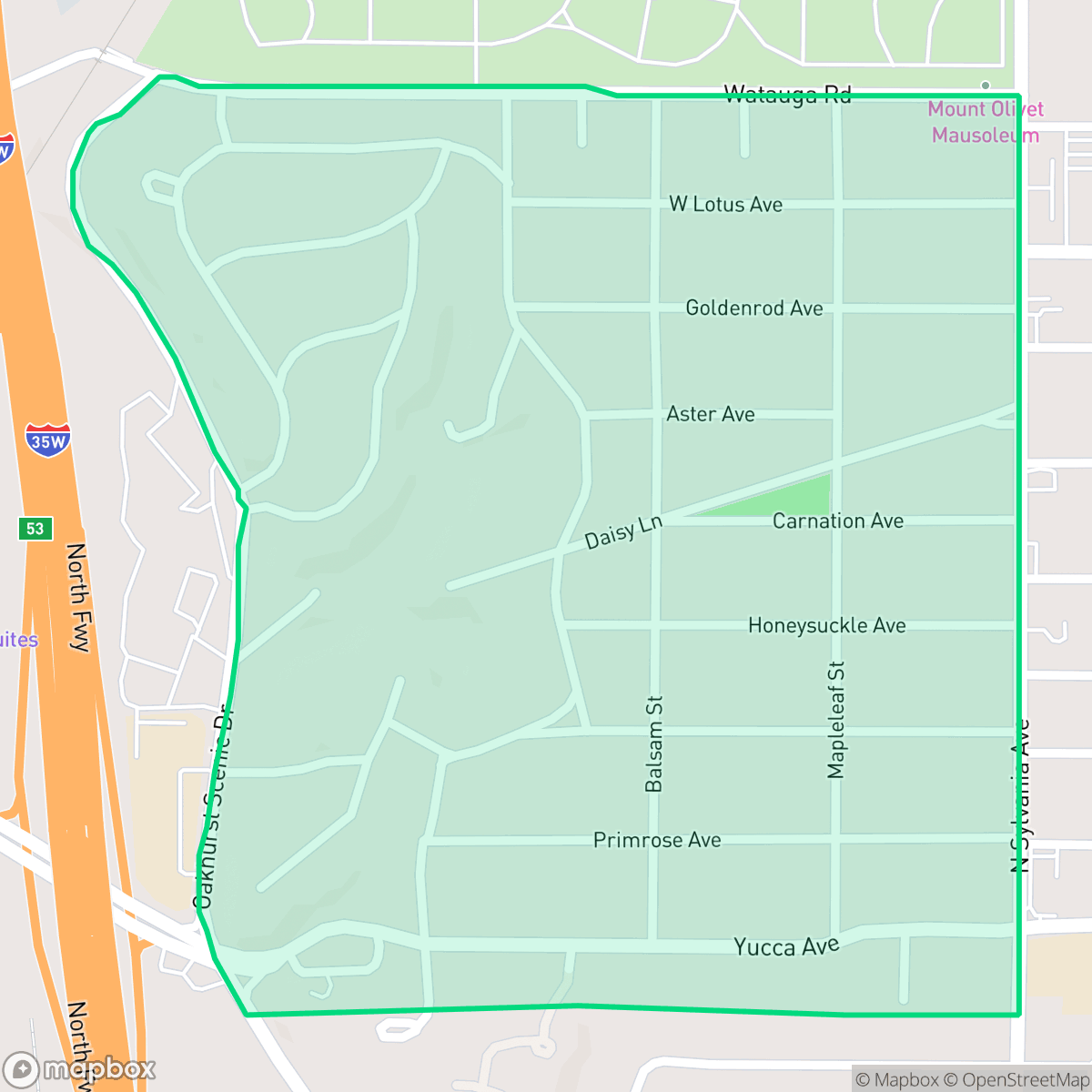
Established in 1924 by John P. King’s Oakhurst Land Company, the Oakhurst neighborhood in northeast Fort Worth was designed as a "country-suburban" retreat. In 1927, King hired the renowned landscape architecture firm Hare & Hare, who shaped the development with winding roads contoured to the natural topography, preserving local trees and scenic vistas. Added to the National Register of Historic Places in 2010, the district is celebrated for its well-preserved residential architecture, dominated by 1920s and 1930s Tudor Revival and Craftsman bungalows alongside post-World War II Ranch-style homes. Signature features include the historic stone entrance columns on Daisy Lane, the central Oakhurst Park, and Oakhurst Scenic Drive, which offers sweeping views of the Trinity River and the downtown Fort Worth skyline.
The area maintains a distinct residential identity characterized by its winding streets and proximity to natural green spaces. It presents a suburban environment that balances established housing with a sense of seclusion. According to iHuus data, the neighborhood provides a higher level of privacy compared to the city average, making it a stable choice for those seeking a retreat from denser urban centers. The layout encourages a slower pace of life, supported by a community that values its quiet, tree-lined blocks and local park access.
Prospective residents should note that the neighborhood has moderate walkability, necessitating a vehicle for most daily tasks. While the area is highly welcoming to dog owners, it faces challenges related to air quality and proximity to industrial zones. Families should also consider the current state of the Fort Worth Independent School District, which is experiencing significant budget and operational instability that may impact long-term educational planning. As noted by iHuus, the area remains a quiet, settled location for those prioritizing privacy and a suburban feel over urban convenience.
Neighborhood Scores Across 15 Qualities
Residential spacing offers a modest buffer between homes, providing slightly more separation between neighbors than the Fort Worth average. According to iHuus data, the neighborhood features standard suburban density without the presence of shared walls.
Low-traffic residential streets and a grid layout with dedicated sidewalks facilitate easy movement on foot. This level of walkability is roughly comparable to the Fort Worth average.
Modest single-family homes with uniform rooflines and small yards define the landscape. The visual variety is roughly in line with the Fort Worth average.
Wide green verges between sidewalks and roads offer consistent, safe areas for pet walking. According to iHuus data, these connected green spaces make the neighborhood more dog friendly than the Fort Worth average.
Open land and scattered woodland characterize much of the area, though it remains slightly less rural than the Fort Worth average. Residents will find a mix of dense suburban residential grids and low-density areas featuring industrial warehouses and large transportation infrastructure.
Local amenities and dining options provide more activity than the Fort Worth average, though much of the area remains quiet and suburban. While some streets feature diverse social spots, other sections are more remote and heavily influenced by nearby industrial zones and highways.
Steady sounds from nearby busy streets are present, though the acoustic environment is slightly more tranquil than the average for Fort Worth according to iHuus data.
Frequent unhealthy air quality levels pose a significant risk to sensitive groups. According to iHuus data, the air quality in Oakhurst is notably worse than the Fort Worth average.
No warehouses, industrial facilities, or hazard sites are present within the neighborhood. This area is strictly residential and institutional, providing a cleaner environment than the Fort Worth average according to iHuus data.
Health insurance coverage among residents is notably lower than the Fort Worth average, according to iHuus data. This indicates a higher proportion of uninsured individuals living in the area.
Political leanings in Oakhurst trend more liberal than the Fort Worth average. Residents may find a community with a moderate liberal majority and a modest opposing presence according to iHuus data.
Residents live alongside a balanced mix of young adults, families, and seniors. This demographic spread is slightly more varied than the average found across Fort Worth, according to iHuus data.
Properties in this area are located within a designated floodplain, which often necessitates flood insurance. According to iHuus data, the risk of flooding in Oakhurst is slightly higher than the average for Fort Worth.
Address-Level Insights for Oakhurst


iHuus Neighborhood Intelligence Insights
Get address-level neighborhood insights for Oakhurst
- Street-level scores — see how individual blocks compare, not just neighborhood averages
- Micro-zone boundaries — identify quiet pockets, flood boundaries, and walkable clusters before you visit
- 15 dimensions in full — walkability, noise, air quality, school quality, insurance coverage, population age profile, urban/rural index, and more
- Boundary risk alerts — know if your address sits near a block boundary where scores drop, the kind of detail no listing will ever mention
- School insights — individual school ratings and insights, not just district-level data
- Compare before you commit — side-by-side data across neighborhoods, down to block precision
No credit card required
Compare with Any Neighborhood
| Dimension | Oakhurst | Alamo Heights |
|---|---|---|
| 🚶 Walkabilityavg 7.5 | ||
| 🔊 Acoustic Comfortavg 4.12 | ||
| 🤫 Privacy Indexavg 5.64 | ||
| 🎨 Visual Appealavg 6.38 | ||
| 🐕 Dog Friendlinessavg 6.57 | ||
| 🗺️ Urban-Rural Indexavg 6.92 | ||
| ✨ Neighborhood Vibeavg 4.56 | ||
| 🏥 Health Insurance Coverageavg 5.8 | ||
| 🌿 Air Qualityavg 3.68 | ||
| 🏭 Industrial Proximityavg 8.13 | ||
| 🌊 Flood Safetyavg 3.61 | ||
| 🗳️ Ideological Leanavg 5.62 | ||
| 👥 Population Age Profileavg 4.51 | ||
| 🔥 Fire Safety | ||
| 🏫 School Quality |
Oakhurst Rankings
School Districts Serving Oakhurst
School Insights for Oakhurst
Below average outcomes; significant attendance and academic challenges.
School Insights
See what's really behind every school rating near Oakhurst
- Individual school ratings — each school's own score with outcome context, not just a district average
- Enrollment & class size data — student-to-teacher ratio and how it compares to the state average
- Full demographics breakdown — ethnicity and gender composition for every school in the enrollment zone
- Every school in the district — all schools within the enrollment boundary ranked by rating, not just the closest one
- Grade levels & benchmarks — elementary through high school, with below/above state-average flags
No credit card required