North Side, Fort Worth
Updated · 12,101 residents
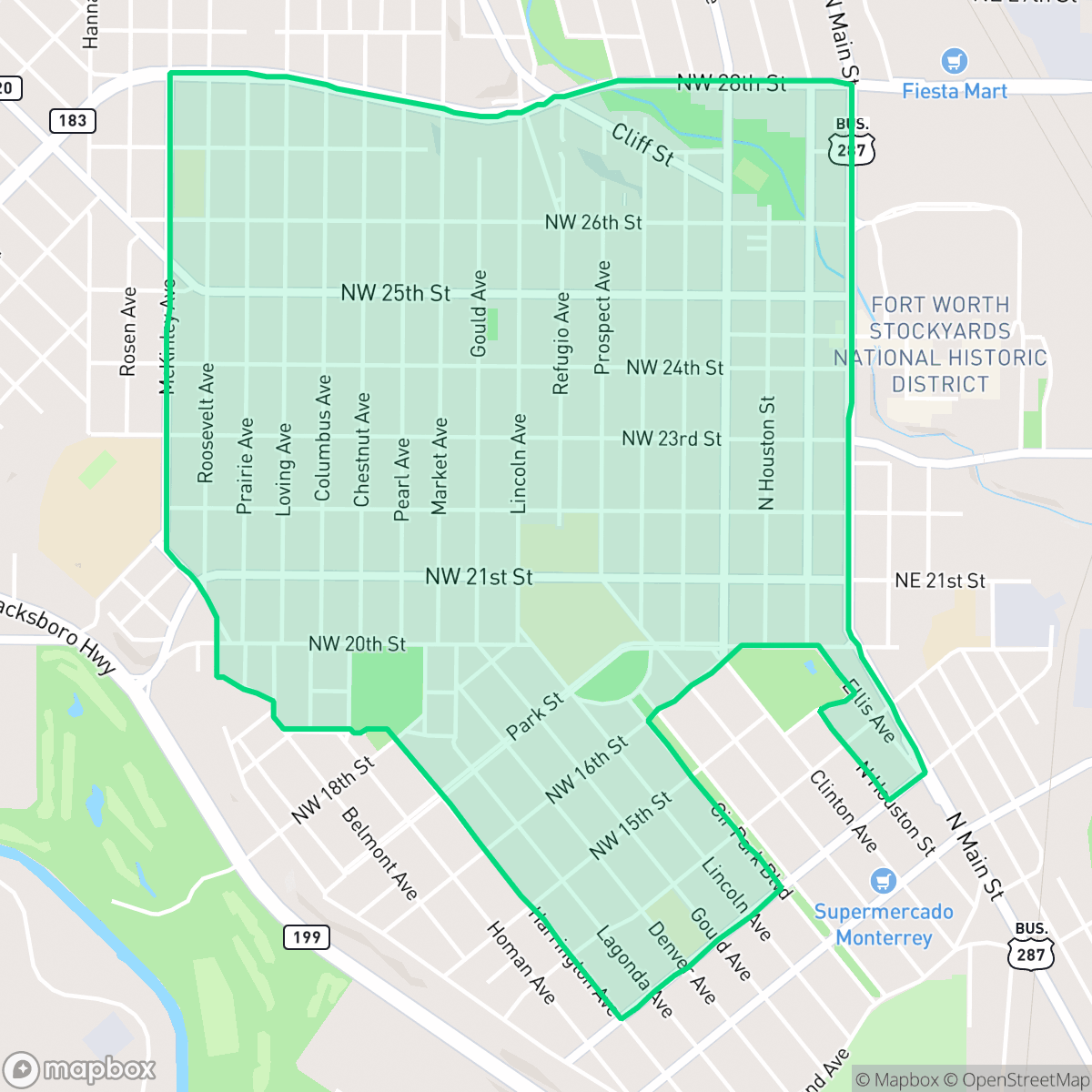
North Side is a culturally rich Fort Worth community defined by its deep Hispanic heritage and proximity to the historic Stockyards. The area features a dense, walkable residential grid, though residents must navigate challenges related to environmental factors and local infrastructure.
Key Highlights
About North Side
The Historic Northside neighborhood in Fort Worth originated in 1884 as the community of Marine, later incorporating as the Town of North Fort Worth in 1902 following an 1888 plat. The neighborhood experienced explosive growth in the early 20th century, driven by the neighboring Fort Worth Stockyards and meatpacking industries, which fueled rapid residential development and a thriving commercial district along North Main Street. Today, the Northside is deeply defined by its rich Hispanic heritage and cultural landmarks. Key historic sites include Marine Park, established in 1892 as one of Tarrant County's first municipal parks, the Rose Marine Theater, and the Art Deco-style North Side High School, designed by architect Wiley G. Clarkson in 1937. The neighborhood remains a vibrant cultural hub, anchored by local businesses and community programming along the historic North Main Street corridor.
The area maintains a distinct character shaped by its evolution from a 19th-century meatpacking hub into a vibrant, modern community. It features a dense suburban grid with modest, single-family homes and a central high school campus. Local life centers around diverse dining options along the main corridors, where residents frequent established spots like Taqueria El Bayo and various regional eateries. According to iHuus data, the area offers a lively social atmosphere, though the layout necessitates car travel for many daily errands beyond the immediate neighborhood blocks.
Prospective residents should consider the trade-offs of living in this historic district. While the neighborhood provides a walkable street grid, it contends with significant noise levels from road traffic and concerns regarding air quality and flood risk. The local school district faces systemic financial and operational challenges, which may influence educational planning for families. The area is best suited for those seeking a culturally active environment with strong community ties, provided they are comfortable navigating the specific infrastructure and environmental realities of this established urban setting.
Neighborhood Scores Across 15 Qualities
Residential spacing is consistent with the Fort Worth average, offering a mix of closely packed houses and modest yards. According to iHuus data, some areas feature narrow side yards while others provide more buffer between neighbors.
Residential streets feature a grid layout with sidewalks present on many blocks, though connectivity is slightly below the Fort Worth average. Some corridors offer safe crossings and low traffic, but sidewalk consistency varies throughout the area according to iHuus data.
Uniform tract housing and small yard spaces characterize this area, which offers less visual variety than the Fort Worth average. According to iHuus data, the landscape consists primarily of simple roof geometries and compact lots with few luxury amenities.
Walking opportunities for pets vary by block, as some areas offer large public parks and green verges while others feature narrow sidewalks and minimal park access. According to iHuus data, the overall accessibility to open green space for dogs is slightly below the Fort Worth average.
Residential patterns consist of dense suburban grids and single-family homes. According to iHuus data, this area is slightly less rural than the Fort Worth average, featuring more consistent residential structures and fewer open fields.
Diverse dining and social hubs provide a more active atmosphere than the Fort Worth average, though many areas remain car-dependent. According to iHuus data, the area shifts between quiet residential streets and lively pockets of commercial activity.
Frequent noise from nearby freeways and railroad tracks makes this area louder than the Fort Worth average. According to iHuus data, residents may experience regular auditory disturbances from heavy transit corridors.
Frequent unhealthy air quality levels pose a significant risk to sensitive groups. According to iHuus data, air quality in this area is notably worse than the Fort Worth average.
Residential life is largely uninterrupted by heavy industry, as the area consists primarily of homes, schools, and light commercial services. This lack of industrial activity is notably better than the Fort Worth average, according to iHuus data.
Health insurance coverage among residents is significantly lower than the Fort Worth average, according to iHuus data. This indicates a high level of uninsured individuals living in the area.
Voting patterns and census indicators show a strong liberal leaning that is notably higher than the Fort Worth average, according to iHuus data.
Residents live alongside a balanced mix of young adults, families, and older populations. This demographic distribution is consistent with the average seen across Fort Worth.
Flood risk is significant in this area because portions of the neighborhood fall within the 100-year floodplain. According to iHuus data, this level of risk is considerably higher than the Fort Worth average and typically necessitates flood insurance.
Address-Level Insights for North Side


iHuus Neighborhood Intelligence Insights
Get address-level neighborhood insights for North Side
- Street-level scores — see how individual blocks compare, not just neighborhood averages
- Micro-zone boundaries — identify quiet pockets, flood boundaries, and walkable clusters before you visit
- 15 dimensions in full — walkability, noise, air quality, school quality, insurance coverage, population age profile, urban/rural index, and more
- Boundary risk alerts — know if your address sits near a block boundary where scores drop, the kind of detail no listing will ever mention
- School insights — individual school ratings and insights, not just district-level data
- Compare before you commit — side-by-side data across neighborhoods, down to block precision
No credit card required
Compare with Any Neighborhood
| Dimension | North Side | Alamo Heights |
|---|---|---|
| 🚶 Walkabilityavg 7.5 | ||
| 🔊 Acoustic Comfortavg 4.12 | ||
| 🤫 Privacy Indexavg 5.64 | ||
| 🎨 Visual Appealavg 6.38 | ||
| 🐕 Dog Friendlinessavg 6.57 | ||
| 🗺️ Urban-Rural Indexavg 6.92 | ||
| ✨ Neighborhood Vibeavg 4.56 | ||
| 🏥 Health Insurance Coverageavg 5.8 | ||
| 🌿 Air Qualityavg 3.68 | ||
| 🏭 Industrial Proximityavg 8.13 | ||
| 🌊 Flood Safetyavg 3.61 | ||
| 🗳️ Ideological Leanavg 5.62 | ||
| 👥 Population Age Profileavg 4.51 | ||
| 🔥 Fire Safety | ||
| 🏫 School Quality |
North Side Rankings
School Districts Serving North Side
School Insights for North Side
Below average outcomes; significant attendance and academic challenges.
School Insights
See what's really behind every school rating near North Side
- Individual school ratings — each school's own score with outcome context, not just a district average
- Enrollment & class size data — student-to-teacher ratio and how it compares to the state average
- Full demographics breakdown — ethnicity and gender composition for every school in the enrollment zone
- Every school in the district — all schools within the enrollment boundary ranked by rating, not just the closest one
- Grade levels & benchmarks — elementary through high school, with below/above state-average flags
No credit card required