North Greenbriar, Fort Worth
Updated · 1,429 residents
North Greenbriar is a quiet, mid-century residential pocket in Fort Worth characterized by tightly packed single-family homes. While the area provides access to local green belts and a central park, residents experience significant road noise from nearby highways and frequent proximity to industrial zones.
Key Highlights
About North Greenbriar
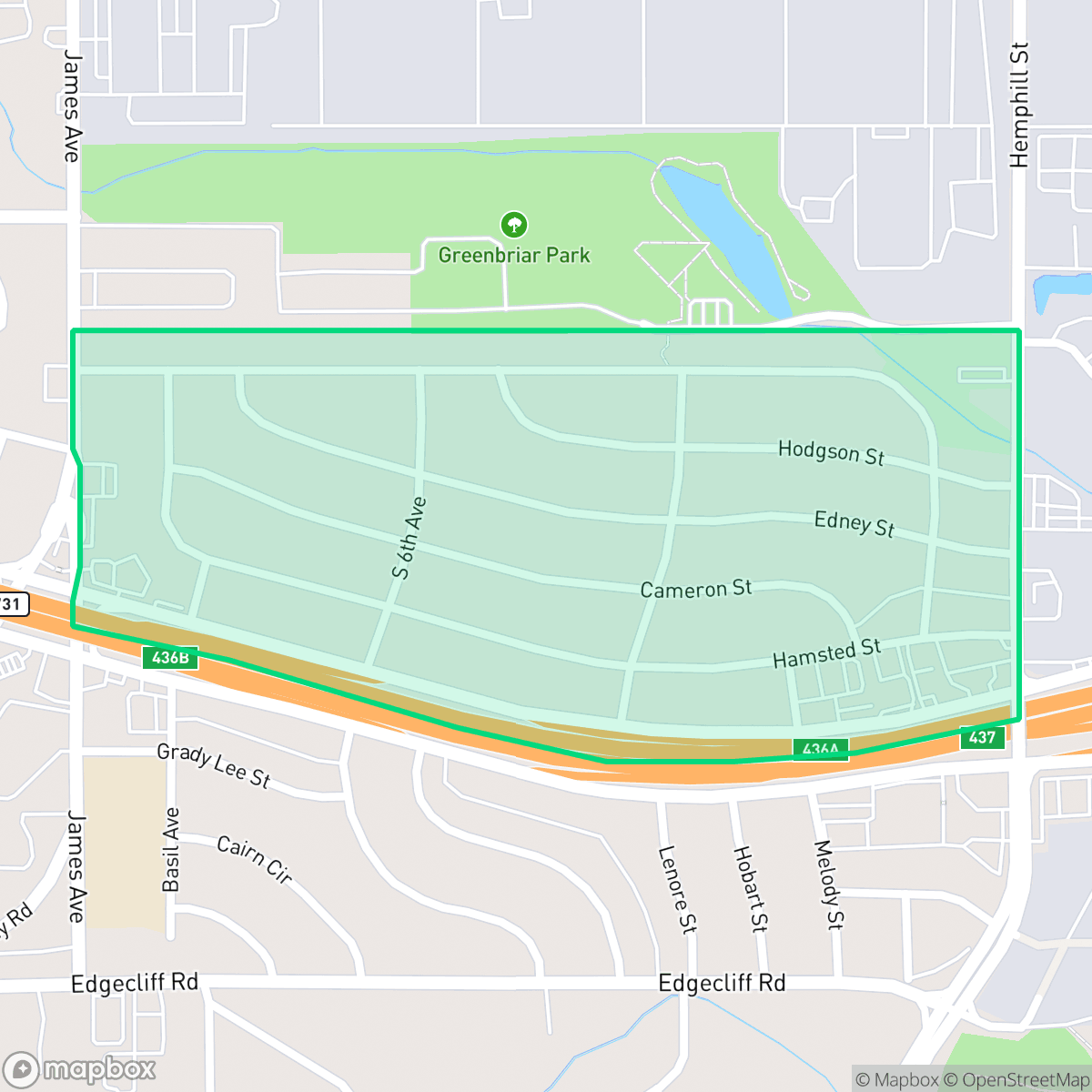
Developed starting in 1951 by Worth Builders, the Greenbriar area (including North Greenbriar) was established as a 250-acre residential addition south of the Quartermaster Depot along U.S. Highway 81 (South Hemphill Street). Designed to accommodate returning World War II veterans, the neighborhood featured mid-priced, FHA- and VA-approved single-family homes. By late 1952, nearly 400 families resided in the rapidly growing development, which soon welcomed the Greenbriar Shopping Center. A key neighborhood landmark, Greenbriar Elementary School, opened its doors in 1955. Designed by the prominent architectural firm Wilson, Patterson, Sowden, Dunlap and Epperly, the red-brick building features a low-pitched gable roof and notable International Style influences. Today, North Greenbriar remains a well-established, diverse residential pocket characterized by mid-century housing stock.
The neighborhood functions as a dense suburban environment that blends residential blocks with industrial infrastructure. The area is defined by its proximity to freight corridors and warehouses, which contribute to a utilitarian atmosphere. Although the street network lacks consistent sidewalks, the low-traffic residential roads allow for basic pedestrian movement. The community maintains a distinct mid-century identity, though it is physically separated by major transit routes that impact the overall character of the area.
According to iHuus data, prospective residents should consider several livability trade-offs, including low air quality, notable road noise, and significant flood risk. The local schools, managed by the Fort Worth Independent School District, are currently navigating systemic financial and operational challenges. This neighborhood is best suited for those who prioritize established, mid-century housing stock and proximity to industrial employment hubs over the amenities typically found in newer suburban developments.
Neighborhood Scores Across 15 Qualities
Residential spacing is moderate, with some houses positioned closely together and others featuring more standard suburban setbacks. This level of separation is slightly below the Fort Worth average according to iHuus data.
Quiet residential streets and cul-de-sacs offer low-traffic routes for walking, though a major high-speed highway divides the area and sidewalks are inconsistent. This level of walkability is below the Fort Worth average according to iHuus data.
Standard tract housing with small yards and consistent roof geometries defines the area. This visual landscape is slightly less varied than the Fort Worth average, according to iHuus data.
While a central park with a pond offers space for exercise, most residential streets feature narrow sidewalks and rely primarily on private fenced backyards. According to iHuus data, pet-friendly amenities in this area are below the Fort Worth average.
A blend of dense residential blocks and large-scale industrial warehouses defines this area. This landscape is slightly more urbanized than the average for Fort Worth according to iHuus data.
Low activity levels and a focus on industrial and suburban utility result in a subdued atmosphere that is less vibrant than the Fort Worth average. Most areas consist of quiet warehouses, greenery, and essential-service dining that prioritize convenience over social density.
Frequent noise from nearby major freeways and railroad tracks makes this area significantly louder than the Fort Worth average. Residents can expect consistent auditory disturbances from heavy traffic and transit corridors, according to iHuus data.
Frequent unhealthy air quality levels present significant risks to sensitive groups; according to iHuus data, these conditions are notably worse than the Fort Worth average.
Large logistics hubs and warehouse operations are concentrated near the northern and eastern quadrants of the neighborhood. This level of industrial activity is notably lower than the Fort Worth average, though semi-truck traffic and commercial depots remain present alongside residential areas.
Health insurance access among residents is below the Fort Worth average, according to iHuus data.
Political leanings in this area are split nearly evenly between conservative and liberal voters. This demographic mix is slightly more balanced than the average across Fort Worth, according to iHuus data.
Residents experience a varied demographic mix of young adults, families, and seniors. This age distribution is slightly lower than the Fort Worth average, according to iHuus data.
Properties within this area are situated inside a designated floodplain, which represents a significantly higher risk of flooding than the Fort Worth average. According to iHuus data, residents should anticipate a likely requirement for flood insurance.
Address-Level Insights for North Greenbriar


iHuus Neighborhood Intelligence Insights
Get address-level neighborhood insights for North Greenbriar
- Street-level scores — see how individual blocks compare, not just neighborhood averages
- Micro-zone boundaries — identify quiet pockets, flood boundaries, and walkable clusters before you visit
- 15 dimensions in full — walkability, noise, air quality, school quality, insurance coverage, population age profile, urban/rural index, and more
- Boundary risk alerts — know if your address sits near a block boundary where scores drop, the kind of detail no listing will ever mention
- School insights — individual school ratings and insights, not just district-level data
- Compare before you commit — side-by-side data across neighborhoods, down to block precision
No credit card required
Compare with Any Neighborhood
| Dimension | North Greenbriar | Alamo Heights |
|---|---|---|
| 🚶 Walkabilityavg 7.5 | ||
| 🔊 Acoustic Comfortavg 4.12 | ||
| 🤫 Privacy Indexavg 5.64 | ||
| 🎨 Visual Appealavg 6.38 | ||
| 🐕 Dog Friendlinessavg 6.57 | ||
| 🗺️ Urban-Rural Indexavg 6.92 | ||
| ✨ Neighborhood Vibeavg 4.56 | ||
| 🏥 Health Insurance Coverageavg 5.8 | ||
| 🌿 Air Qualityavg 3.68 | ||
| 🏭 Industrial Proximityavg 8.13 | ||
| 🌊 Flood Safetyavg 3.61 | ||
| 🗳️ Ideological Leanavg 5.62 | ||
| 👥 Population Age Profileavg 4.51 | ||
| 🔥 Fire Safety | ||
| 🏫 School Quality |
North Greenbriar Rankings
School Districts Serving North Greenbriar
School Insights for North Greenbriar
Below average outcomes; significant attendance and academic challenges.
School Insights
See what's really behind every school rating near North Greenbriar
- Individual school ratings — each school's own score with outcome context, not just a district average
- Enrollment & class size data — student-to-teacher ratio and how it compares to the state average
- Full demographics breakdown — ethnicity and gender composition for every school in the enrollment zone
- Every school in the district — all schools within the enrollment boundary ranked by rating, not just the closest one
- Grade levels & benchmarks — elementary through high school, with below/above state-average flags
No credit card required