Near East Side, Fort Worth
Updated · 890 residents
The Near East Side is an industrial district located immediately east of downtown Fort Worth, defined by its historic warehouse architecture and proximity to major logistics hubs. While the area offers close access to the city center, it is characterized by significant traffic noise and limited pedestrian infrastructure.
Key Highlights
About Near East Side
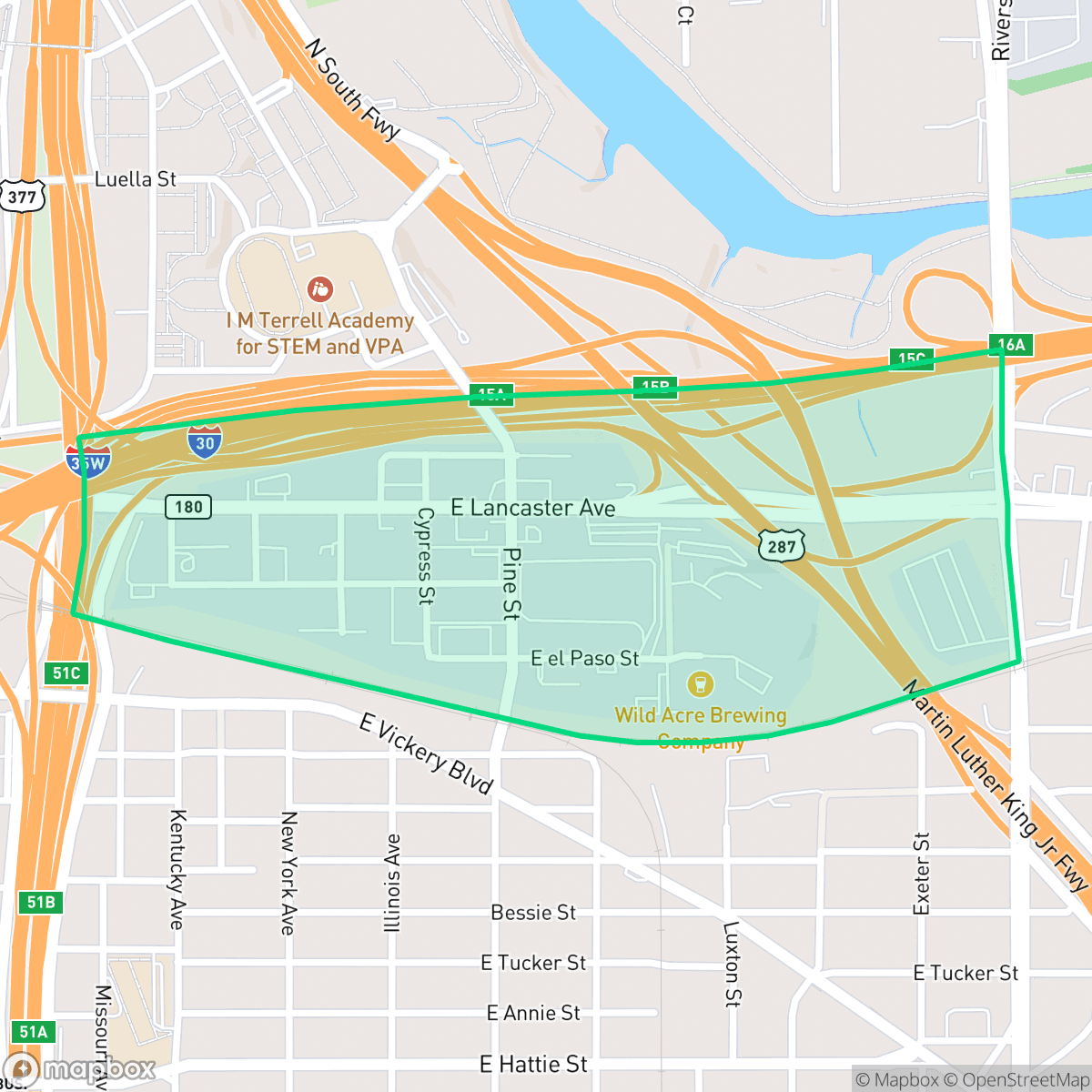
Located just east of downtown Fort Worth, the Near East Side neighborhood centers along East Lancaster Avenue, a historic corridor that once served as Front Street and part of the transcontinental Bankhead Highway. Characterized by its 1920s industrial and warehouse architecture, the area underwent dramatic transformations in the 1950s when freeway construction isolated the neighborhood and urban renewal projects led to widespread demolitions. Historically, the Near East Side was home to Butler Place, a 1940 New Deal-era public housing project named after Henry Harrison Butler, a Civil War veteran and pioneering African American educator. Today, the neighborhood is recognized as a designated Urban Village, blending its historic industrial stock with local social service agencies, artist lofts, and public art installations like the *Avenue Tapestry*.
This neighborhood functions primarily as an industrial and logistics corridor, anchored by its proximity to downtown Fort Worth and major highway interchanges. The landscape consists of a mix of historic warehouse structures and modern industrial facilities, creating a distinct, utilitarian aesthetic. While the area lacks the dense commercial amenities found in more residential districts, it serves as a central hub for regional freight movement and logistics operations.
Living in the area requires navigating specific trade-offs, particularly regarding environmental and acoustic conditions. Residents experience elevated noise levels primarily due to consistent road traffic and freight rail activity. Furthermore, the neighborhood faces challenges with air quality and high industrial proximity, which may impact long-term livability for some. Families should also note that local educational options are primarily served by the Fort Worth Independent School District, which currently faces significant operational and financial constraints.
Neighborhood Scores Across 15 Qualities
Residential spacing is mixed with some buffers between neighbors, providing a level of seclusion slightly above the Fort Worth average according to iHuus data.
Limited sidewalk availability and heavy traffic patterns make pedestrian travel uncomfortable. This area is significantly less walkable than the Fort Worth average, according to iHuus data.
Standard tract housing with modest yards defines the local landscape. The area lacks significant ornamental greenery and presents a more utilitarian aesthetic than the Fort Worth average.
Access to connected green spaces and wide, low-traffic paths makes this area slightly more accommodating for dog owners than the Fort Worth average, according to iHuus data.
A blend of industrial warehouses, highway infrastructure, and river-adjacent green space creates a transition zone that is less densely urbanized than the Fort Worth average. This landscape offers a mix of large-scale commercial structures and pockets of low-density residential housing.
Limited social activity and a landscape dominated by warehouses and freight corridors result in a much lower level of liveliness than the Fort Worth average. Most residents will find a tranquil, subdued atmosphere with only a few essential services available within the immediate area.
Constant noise from nearby airport runways and heavy rail lines makes this area significantly louder than the Fort Worth average. According to iHuus data, residents will experience frequent auditory disturbances from industrial and transportation activity.
Air quality levels here fluctuate between acceptable and unhealthy, presenting occasional concerns for sensitive groups. According to iHuus data, these conditions are slightly worse than the Fort Worth average.
Light industrial operations and commercial units are interspersed with residential areas, resulting in a significantly lower industrial density than the Fort Worth average. Residents may experience occasional operational hums or intermittent truck activity near certain pockets of the neighborhood.
Health insurance accessibility in this area is slightly below the Fort Worth average, according to iHuus data. Residents may find fewer options for employer-sponsored or community-based coverage compared to other parts of the city.
Voting patterns and census indicators show a predominantly liberal leaning that is significantly higher than the Fort Worth average, according to iHuus data.
Residents live alongside a balanced demographic of young professionals, families, and seniors. This age distribution is consistent with the broader Fort Worth area according to iHuus data.
Flood risk is significant in this area because parts of the neighborhood sit within a designated floodplain. According to iHuus data, this vulnerability is much higher than the Fort Worth average and likely necessitates flood insurance.
Address-Level Insights for Near East Side


iHuus Neighborhood Intelligence Insights
Get address-level neighborhood insights for Near East Side
- Street-level scores — see how individual blocks compare, not just neighborhood averages
- Micro-zone boundaries — identify quiet pockets, flood boundaries, and walkable clusters before you visit
- 15 dimensions in full — walkability, noise, air quality, school quality, insurance coverage, population age profile, urban/rural index, and more
- Boundary risk alerts — know if your address sits near a block boundary where scores drop, the kind of detail no listing will ever mention
- School insights — individual school ratings and insights, not just district-level data
- Compare before you commit — side-by-side data across neighborhoods, down to block precision
No credit card required
Compare with Any Neighborhood
| Dimension | Near East Side | Alamo Heights |
|---|---|---|
| 🚶 Walkabilityavg 7.5 | ||
| 🔊 Acoustic Comfortavg 4.12 | ||
| 🤫 Privacy Indexavg 5.64 | ||
| 🎨 Visual Appealavg 6.38 | ||
| 🐕 Dog Friendlinessavg 6.57 | ||
| 🗺️ Urban-Rural Indexavg 6.92 | ||
| ✨ Neighborhood Vibeavg 4.56 | ||
| 🏥 Health Insurance Coverageavg 5.8 | ||
| 🌿 Air Qualityavg 3.68 | ||
| 🏭 Industrial Proximityavg 8.13 | ||
| 🌊 Flood Safetyavg 3.61 | ||
| 🗳️ Ideological Leanavg 5.62 | ||
| 👥 Population Age Profileavg 4.51 | ||
| 🔥 Fire Safety | ||
| 🏫 School Quality |
Near East Side Rankings
School Districts Serving Near East Side
School Insights for Near East Side
Below average outcomes; significant attendance and academic challenges.
School Insights
See what's really behind every school rating near Near East Side
- Individual school ratings — each school's own score with outcome context, not just a district average
- Enrollment & class size data — student-to-teacher ratio and how it compares to the state average
- Full demographics breakdown — ethnicity and gender composition for every school in the enrollment zone
- Every school in the district — all schools within the enrollment boundary ranked by rating, not just the closest one
- Grade levels & benchmarks — elementary through high school, with below/above state-average flags
No credit card required