Monticello, Fort Worth
Updated · 2,041 residents
Monticello is a visually distinct neighborhood defined by its historic architecture and tree-lined streets near downtown Fort Worth. While it offers high walkability and strong appeal for pet owners, residents should be aware of significant aviation noise levels and the current challenges facing the local school district.
Key Highlights
About Monticello
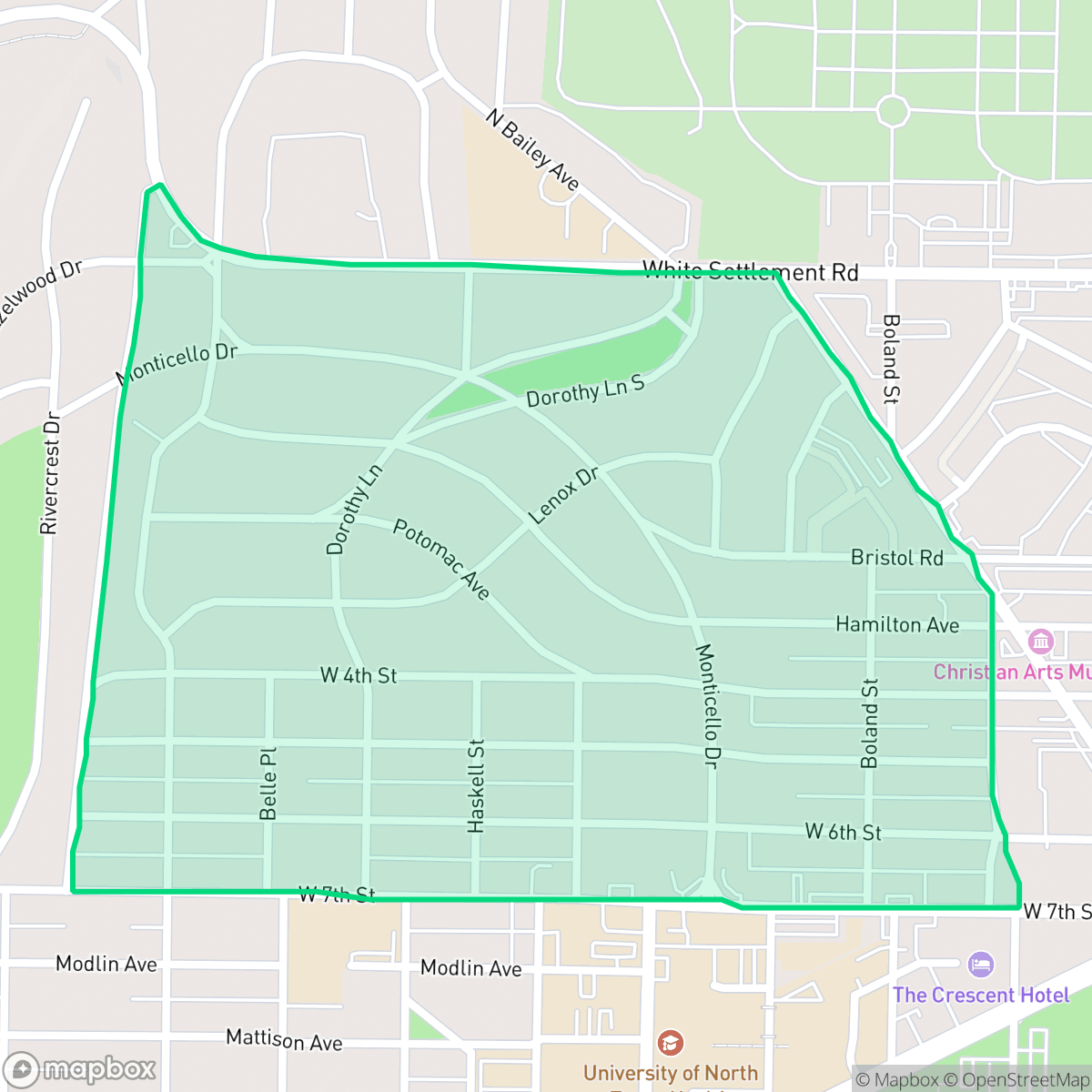
Located two miles west of downtown Fort Worth, the Monticello neighborhood sits on land that once served as an infantry training ground for the 36th Division of the Texas-Oklahoma National Guard during World War I. In 1928, developer William J. Bailey established the Monticello Land Company to transform the 160-acre tract into "the subdivision with a personality". The Kansas City landscape architecture firm Hare & Hare designed the neighborhood's gently curving, tree-lined streets. To maintain a cohesive aesthetic, early deed restrictions mandated that homes be built of brick, stone, or stucco, resulting in an elegant mix of Spanish Colonial Revival, Tudor Revival, and Mediterranean-Classical Revival architecture. Local landmarks include the historic Harmon Park, funded in part by a 1920s donation from the Harmon Foundation.
The area maintains a cohesive residential identity, characterized by its mature landscapes and consistent architectural styles. Its proximity to downtown Fort Worth makes it a convenient location for those seeking a balance between urban accessibility and an established, quiet atmosphere. Residents benefit from high levels of walkability and access to local green spaces, which contribute to a strong sense of community and visual charm throughout the neighborhood.
Potential residents should consider the local acoustic environment, as aviation activity contributes to elevated noise levels. Furthermore, while the neighborhood offers a stable residential environment with high rates of health insurance coverage, families with school-aged children may find the current state of the Fort Worth Independent School District to be a significant factor in their decision-making process. The area is best suited for those who prioritize architectural character and neighborhood walkability over absolute quiet.
Neighborhood Scores Across 15 Qualities
Variable spacing between homes and the presence of shared-wall multi-family units result in privacy levels that are slightly below the Fort Worth average. According to iHuus data, some areas feature closely spaced bungalows that offer less buffer between neighbors.
Pedestrians can rely on a consistent sidewalk network along main arterials and throughout the residential grid. This level of accessibility is notably higher than the Fort Worth average.
Large homes and upscale amenities provide a visual experience that is more attractive than the Fort Worth average. While some areas feature standard urban density and apartment complexes, much of the neighborhood is characterized by spacious driveways and well-maintained properties.
Abundant green space from local parks and apartment courtyards provides more safe, connected walking paths than the Fort Worth average. Wide, traffic-separated routes make this area particularly suitable for pet owners, according to iHuus data.
Residential streets and green spaces are distributed in roughly equal measure, though the area is less densely urbanized than the Fort Worth average. Some pockets feature a dense mix of mid-rise apartments and commercial blocks alongside tightly packed single-family homes.
Dynamic pockets of dense dining and social hubs coexist with quieter, suburban blocks and green spaces. This area offers more activity and a broader selection of amenities than the Fort Worth average, according to iHuus data.
Frequent disturbances from nearby railroad tracks and heavy freeway traffic characterize this area. According to iHuus data, acoustic comfort is significantly lower than the Fort Worth average.
Air quality in this area fluctuates between acceptable and unhealthy levels, though it remains slightly better than the Fort Worth average according to iHuus data. Sensitive groups may experience occasional concern during certain periods.
Residential tranquility is a defining feature here, as no warehouses, industrial facilities, or heavy manufacturing sites are present. This area maintains a notably cleaner profile regarding industrial proximity compared to the Fort Worth average.
Health insurance access among residents is notably higher than the Fort Worth average, according to iHuus data.
Conservative residents form a significant majority here, representing a more right-leaning political landscape than the Fort Worth average according to iHuus data.
A balanced mix of young adults, families, and older residents defines the community. This demographic variety is slightly more varied than the typical Fort Worth age profile, according to iHuus data.
Flood risk in this area is higher than the Fort Worth average, though current FEMA studies have not yet provided a detailed assessment of specific vulnerabilities. Residents should remain aware of potential uncertainty regarding precise flood zones according to iHuus data.
Address-Level Insights for Monticello


iHuus Neighborhood Intelligence Insights
Get address-level neighborhood insights for Monticello
- Street-level scores — see how individual blocks compare, not just neighborhood averages
- Micro-zone boundaries — identify quiet pockets, flood boundaries, and walkable clusters before you visit
- 15 dimensions in full — walkability, noise, air quality, school quality, insurance coverage, population age profile, urban/rural index, and more
- Boundary risk alerts — know if your address sits near a block boundary where scores drop, the kind of detail no listing will ever mention
- School insights — individual school ratings and insights, not just district-level data
- Compare before you commit — side-by-side data across neighborhoods, down to block precision
No credit card required
Compare with Any Neighborhood
| Dimension | Monticello | Alamo Heights |
|---|---|---|
| 🚶 Walkabilityavg 7.5 | ||
| 🔊 Acoustic Comfortavg 4.12 | ||
| 🤫 Privacy Indexavg 5.64 | ||
| 🎨 Visual Appealavg 6.38 | ||
| 🐕 Dog Friendlinessavg 6.57 | ||
| 🗺️ Urban-Rural Indexavg 6.92 | ||
| ✨ Neighborhood Vibeavg 4.56 | ||
| 🏥 Health Insurance Coverageavg 5.8 | ||
| 🌿 Air Qualityavg 3.68 | ||
| 🏭 Industrial Proximityavg 8.13 | ||
| 🌊 Flood Safetyavg 3.61 | ||
| 🗳️ Ideological Leanavg 5.62 | ||
| 👥 Population Age Profileavg 4.51 | ||
| 🔥 Fire Safety | ||
| 🏫 School Quality |
Monticello Rankings
School Districts Serving Monticello
School Insights for Monticello
Below average outcomes; significant attendance and academic challenges.
School Insights
See what's really behind every school rating near Monticello
- Individual school ratings — each school's own score with outcome context, not just a district average
- Enrollment & class size data — student-to-teacher ratio and how it compares to the state average
- Full demographics breakdown — ethnicity and gender composition for every school in the enrollment zone
- Every school in the district — all schools within the enrollment boundary ranked by rating, not just the closest one
- Grade levels & benchmarks — elementary through high school, with below/above state-average flags
No credit card required