Mitchell Boulevard, Fort Worth
Updated · 2,150 residents
Mitchell Boulevard is a quiet, suburban community in southeast Fort Worth characterized by its proximity to major transit corridors and local green spaces like Cobb Park. While the area offers access to specific high-performing schools, residents should expect notable noise from nearby highway traffic and limited pedestrian connectivity.
Key Highlights
About Mitchell Boulevard
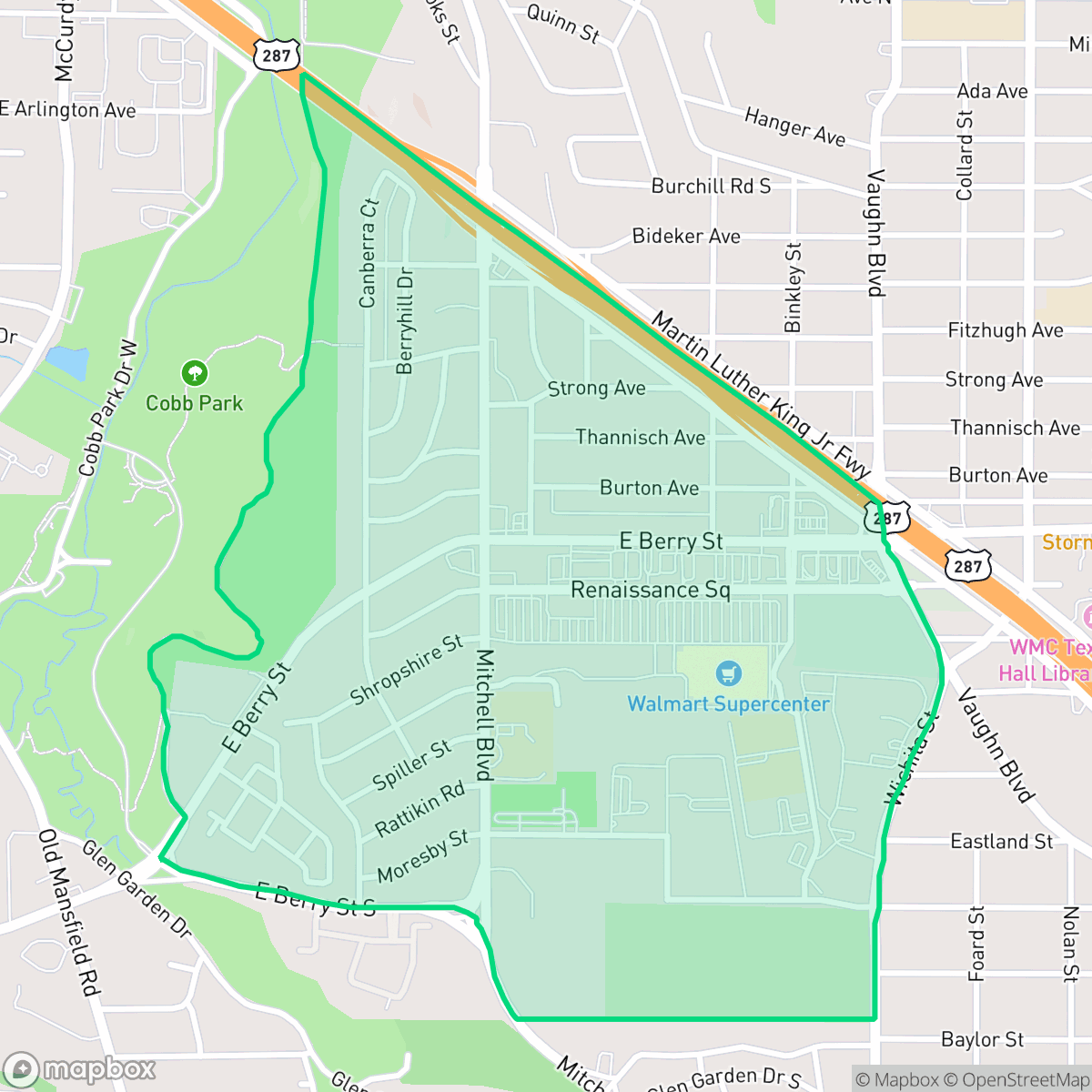
Located in southeast Fort Worth, the Mitchell Boulevard neighborhood (often referred to as New Mitchell) is a historically working-class community bounded by Cobb Park and U.S. Route 287. A key neighborhood anchor, Mitchell Boulevard Elementary School, opened in 1954 and was designed by architect Charles E. Armstrong to adapt to the area's natural topography and summer breezes. During the 1970s, the neighborhood underwent a demographic transition, becoming a predominantly Black and Hispanic community. In the early 2000s, grassroots efforts to revitalize the area led to major commercial and civic developments, including the 67-acre Columbia Renaissance Square and the establishment of the Renaissance Heights Foundation. In 2026, the neighborhood was selected for Fort Worth's Neighborhood Improvement Program, securing $4.3 million in capital funds to revitalize its infrastructure and public spaces.
The neighborhood functions as a blend of residential life and light industrial activity, anchored by community-focused developments such as Columbia Renaissance Square. Its layout reflects a suburban design that prioritizes vehicle access over pedestrian movement. Residents benefit from the presence of highly-rated local schools, though the broader school district faces significant operational challenges that may impact long-term planning for families.
Prospective residents should account for specific environmental factors, including elevated noise levels from the adjacent highway and a lack of flood mitigation infrastructure. The area maintains a distinct identity with a high ideological lean, and while it offers a quiet atmosphere, the overall pace of life is relatively subdued. It is best suited for those who prioritize proximity to major thoroughfares and community-led revitalization efforts over high-density urban amenities.
Neighborhood Scores Across 15 Qualities
Residential spacing is somewhat tight with houses positioned closely together. This level of density is roughly in line with the Fort Worth average, according to iHuus data.
Quiet streets provide a manageable environment for walking, though many areas lack dedicated sidewalks. This makes the area less walkable than the Fort Worth average according to iHuus data.
Simple rooflines and small yards characterize this area, which features lower visual variety than the Fort Worth average. Residential plots are densely packed with minimal private amenities like pools, according to iHuus data.
Large wooded park areas and residential verges provide suitable spaces for dog walking. This level of accessibility is slightly below the Fort Worth average according to iHuus data.
Frequent open land and scattered homes among fields or woodland provide a semi-rural feel that is slightly more pronounced than the Fort Worth average. According to iHuus data, some areas transition into a dense suburban grid featuring single-family homes and small commercial buildings.
Primarily characterized by light industrial units and suburban pockets, this area offers a low-density environment with fewer social hubs than the Fort Worth average. Most daily amenities and dining options are concentrated near major highways, making the neighborhood more car-dependent for errands.
Frequent auditory disturbances from nearby railroad tracks and heavy freeway traffic characterize this area. According to iHuus data, acoustic comfort is significantly lower than the Fort Worth average.
Air quality fluctuates between acceptable and unhealthy levels, posing occasional concerns for sensitive groups. According to iHuus data, conditions in this area are slightly better than the Fort Worth average.
Heavy industrial presence is minimal in this area, though some light commercial structures and highway proximity are present. According to iHuus data, the level of industrial activity is lower than the Fort Worth average.
Health insurance coverage among residents is significantly lower than the Fort Worth average. According to iHuus data, a small portion of the population maintains medical coverage.
Voting patterns and census indicators reflect a much more liberal leaning than the Fort Worth average. According to iHuus data, this area is characterized by predominant liberal political alignment.
A varied mix of young adults, families, and older residents characterizes the area. According to iHuus data, this demographic distribution is roughly in line with the Fort Worth city average.
Flood risk in this area is significantly higher than the Fort Worth average, involving hazards associated with coastal high-hazard zones. Residents should anticipate elevated or potentially prohibitive flood insurance costs according to iHuus data.
Address-Level Insights for Mitchell Boulevard


iHuus Neighborhood Intelligence Insights
Get address-level neighborhood insights for Mitchell Boulevard
- Street-level scores — see how individual blocks compare, not just neighborhood averages
- Micro-zone boundaries — identify quiet pockets, flood boundaries, and walkable clusters before you visit
- 15 dimensions in full — walkability, noise, air quality, school quality, insurance coverage, population age profile, urban/rural index, and more
- Boundary risk alerts — know if your address sits near a block boundary where scores drop, the kind of detail no listing will ever mention
- School insights — individual school ratings and insights, not just district-level data
- Compare before you commit — side-by-side data across neighborhoods, down to block precision
No credit card required
Compare with Any Neighborhood
| Dimension | Mitchell Boulevard | Alamo Heights |
|---|---|---|
| 🚶 Walkabilityavg 7.5 | ||
| 🔊 Acoustic Comfortavg 4.12 | ||
| 🤫 Privacy Indexavg 5.64 | ||
| 🎨 Visual Appealavg 6.38 | ||
| 🐕 Dog Friendlinessavg 6.57 | ||
| 🗺️ Urban-Rural Indexavg 6.92 | ||
| ✨ Neighborhood Vibeavg 4.56 | ||
| 🏥 Health Insurance Coverageavg 5.8 | ||
| 🌿 Air Qualityavg 3.68 | ||
| 🏭 Industrial Proximityavg 8.13 | ||
| 🌊 Flood Safetyavg 3.61 | ||
| 🗳️ Ideological Leanavg 5.62 | ||
| 👥 Population Age Profileavg 4.51 | ||
| 🔥 Fire Safety | ||
| 🏫 School Quality |
Mitchell Boulevard Rankings
School Districts Serving Mitchell Boulevard
School Insights for Mitchell Boulevard
Below average outcomes; significant attendance and academic challenges.
School Insights
See what's really behind every school rating near Mitchell Boulevard
- Individual school ratings — each school's own score with outcome context, not just a district average
- Enrollment & class size data — student-to-teacher ratio and how it compares to the state average
- Full demographics breakdown — ethnicity and gender composition for every school in the enrollment zone
- Every school in the district — all schools within the enrollment boundary ranked by rating, not just the closest one
- Grade levels & benchmarks — elementary through high school, with below/above state-average flags
No credit card required