Mistletoe Heights, Fort Worth
Updated · 825 residents
Mistletoe Heights is a highly walkable neighborhood known for its historic charm and proximity to the Clear Fork of the Trinity River. While residents benefit from excellent access to local amenities and high health insurance coverage, the area experiences significant noise levels due to nearby road traffic.
Key Highlights
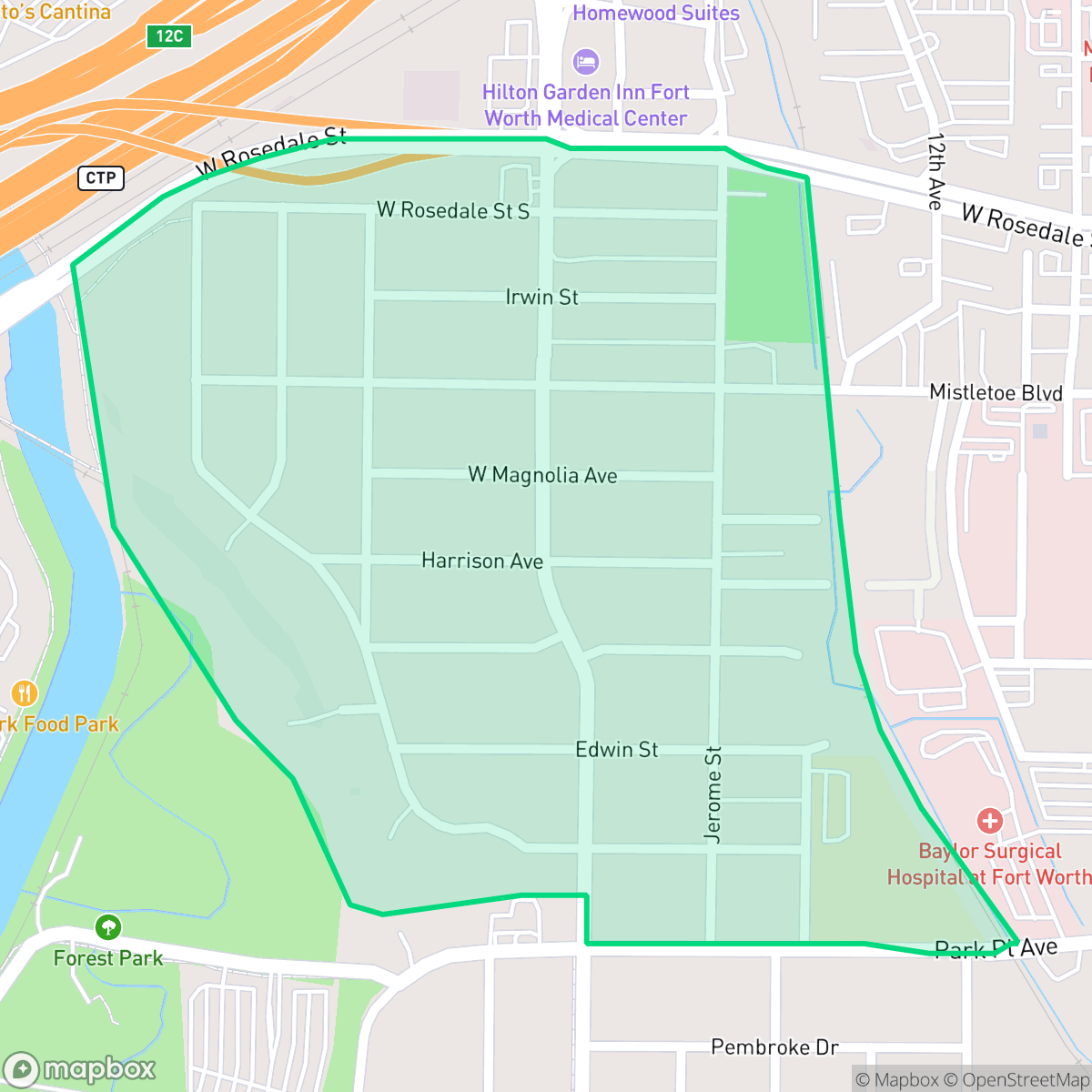
About Mistletoe Heights
Perched on bluffs overlooking the Clear Fork of the Trinity River, Mistletoe Heights is one of Fort Worth’s oldest neighborhoods, platted in 1890 by Harvie C. Lawrie and named in 1892. Though annexed by the city in 1909 and 1922, its residential boom occurred primarily after World War I, spurred by a streetcar line connecting to Texas Christian University. Designated a historic district in 2002, the neighborhood features a rich mix of Craftsman bungalows, Tudor-style homes, and a notable 1919 Prairie-style villa built for the prominent Waggoner ranching family. A central neighborhood landmark is the historic Lily B. Clayton Elementary School (originally Mistletoe Heights School). Opened in 1922, the school features a distinctive yellow-and-orange brick facade designed by architect Wiley G. Clarkson, with later expansions completed under the Public Works Administration.
The neighborhood offers a distinct urban experience with a high walkability score, allowing residents to easily access nearby parks, fitness centers, and diverse dining options along the perimeter. Its residential character is defined by quiet, tree-lined streets that contrast with the bustling activity found in adjacent commercial corridors. According to iHuus data, the community maintains a strong sense of stability, supported by high levels of health insurance coverage among its residents.
Prospective residents should consider the trade-offs associated with the area's central location. While the neighborhood provides excellent flood safety and a visually appealing environment, acoustic comfort is a notable challenge due to consistent road traffic noise. The area is well-suited for those who prioritize pedestrian access to daily services and a historic atmosphere over absolute quiet, provided they are comfortable with the ambient sounds of a vibrant city.
Neighborhood Scores Across 15 Qualities
Residential spacing offers a mix of open areas and some buffer between neighbors. This level of density is consistent with the average for Fort Worth, according to iHuus data.
Pedestrian access is excellent due to wide sidewalks and ample crossings. This neighborhood offers a more walkable environment than the Fort Worth average, according to iHuus data.
Larger residential lots and frequent upscale amenities contribute to an attractive streetscape. According to iHuus data, the visual quality of this area is notably higher than the Fort Worth average.
Connected green spaces and wide paths offer safe areas for walks away from traffic. This level of accessibility for pets is consistent with the Fort Worth average.
Residential streets and greenery are distributed in roughly equal measure. This area is slightly less urbanized than the Fort Worth average, offering a more suburban atmosphere according to iHuus data.
Frequent social activity and a concentration of dining options make this area significantly more vibrant than the Fort Worth average. Local clusters near Newby Park and various mid-rise blocks offer a diverse mix of restaurants and wellness centers, though walking access to these businesses varies by specific street.
Frequent disturbances from nearby railroad tracks and heavy freeway traffic characterize the area. This level of acoustic disruption is notably higher than the Fort Worth average, according to iHuus data.
Air quality fluctuates between acceptable and unhealthy levels, presenting occasional concerns for sensitive groups. According to iHuus data, conditions in this area are slightly worse than the Fort Worth average.
Industrial facilities and warehouses are entirely absent from this area, offering a cleaner residential environment than most of Fort Worth. According to iHuus data, the neighborhood consists of quiet streets and open green spaces with no detected hazard sites.
Health insurance accessibility is significantly higher than the Fort Worth average, according to iHuus data. Most residents in this area maintain active health coverage.
Political leanings in this area skew liberal, representing a more progressive tilt than the Fort Worth average according to iHuus data.
A balanced mix of young professionals, families, and seniors characterizes the area. This demographic variety is more pronounced here than the average found across Fort Worth, according to iHuus data.
Flood risk levels in this area are notably higher than the Fort Worth average. According to iHuus data, the precise risk level remains undetermined as a detailed federal study for this specific zone has not yet been completed.
Address-Level Insights for Mistletoe Heights


iHuus Neighborhood Intelligence Insights
Get address-level neighborhood insights for Mistletoe Heights
- Street-level scores — see how individual blocks compare, not just neighborhood averages
- Micro-zone boundaries — identify quiet pockets, flood boundaries, and walkable clusters before you visit
- 15 dimensions in full — walkability, noise, air quality, school quality, insurance coverage, population age profile, urban/rural index, and more
- Boundary risk alerts — know if your address sits near a block boundary where scores drop, the kind of detail no listing will ever mention
- School insights — individual school ratings and insights, not just district-level data
- Compare before you commit — side-by-side data across neighborhoods, down to block precision
No credit card required
Compare with Any Neighborhood
| Dimension | Mistletoe Heights | Alamo Heights |
|---|---|---|
| 🚶 Walkabilityavg 7.5 | ||
| 🔊 Acoustic Comfortavg 4.12 | ||
| 🤫 Privacy Indexavg 5.64 | ||
| 🎨 Visual Appealavg 6.38 | ||
| 🐕 Dog Friendlinessavg 6.57 | ||
| 🗺️ Urban-Rural Indexavg 6.92 | ||
| ✨ Neighborhood Vibeavg 4.56 | ||
| 🏥 Health Insurance Coverageavg 5.8 | ||
| 🌿 Air Qualityavg 3.68 | ||
| 🏭 Industrial Proximityavg 8.13 | ||
| 🌊 Flood Safetyavg 3.61 | ||
| 🗳️ Ideological Leanavg 5.62 | ||
| 👥 Population Age Profileavg 4.51 | ||
| 🔥 Fire Safety | ||
| 🏫 School Quality |
Mistletoe Heights Rankings
School Districts Serving Mistletoe Heights
School Insights for Mistletoe Heights
Below average outcomes; significant attendance and academic challenges.
School Insights
See what's really behind every school rating near Mistletoe Heights
- Individual school ratings — each school's own score with outcome context, not just a district average
- Enrollment & class size data — student-to-teacher ratio and how it compares to the state average
- Full demographics breakdown — ethnicity and gender composition for every school in the enrollment zone
- Every school in the district — all schools within the enrollment boundary ranked by rating, not just the closest one
- Grade levels & benchmarks — elementary through high school, with below/above state-average flags
No credit card required