Mira Vista, Fort Worth
Updated · 1,771 residents
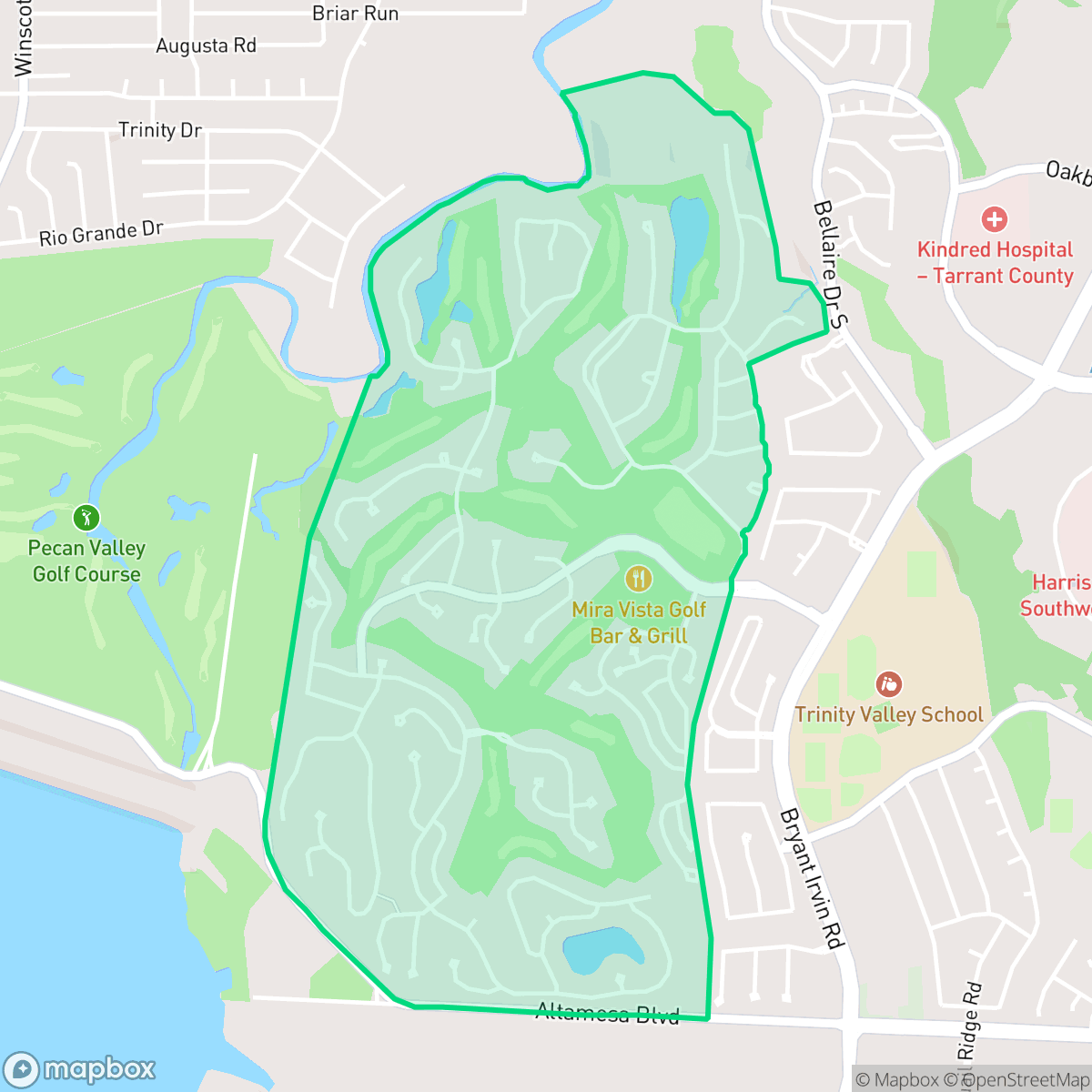
Mira Vista is an exclusive, guard-gated community in southwest Fort Worth known for its exceptional visual appeal and serene, low-density residential environment. While the area offers a quiet, rural-like atmosphere with significant green space, it lacks local commercial amenities and maintains a very low level of daily activity.
Key Highlights
About Mira Vista
Developed starting in 1985, Mira Vista is an exclusive, 24-hour guard-gated master-planned community in southwest Fort Worth. The neighborhood originated when a development group purchased 625 acres of raw ranch land, with developer Jerry L. Thomas breaking ground in 1987 to establish an upscale residential enclave. Named for its panoramic views—"Mira Vista" translates to "See the View" in Spanish—the community is built around the private Mira Vista Country Club. Its centerpiece is a par-71 championship golf course designed by professional golfer Tom Weiskopf and architect Jay Morrish, which opened in August 1987. Architecturally, the neighborhood is highly diverse, featuring luxury custom estates, Mediterranean villas, English Tudor, and Colonial-style homes winding around scenic lakes and rolling hills.
The area is defined by its expansive, quiet landscape and high level of privacy, offering residents a secluded living experience away from the urban bustle. With a focus on residential tranquility, the neighborhood features extensive open green spaces and well-maintained streets, resulting in a visual environment that stands out for its aesthetic quality. It is a predominantly residential enclave where the lack of commercial development contributes to a peaceful, if somewhat isolated, atmosphere.
Prospective residents should note that the neighborhood is best suited for those who prioritize quiet and privacy over walkability to services or vibrant local nightlife. While the area is safe from industrial interference and benefits from high health insurance coverage, it lacks immediate access to retail and dining options. The community is served by both the Crowley and Fort Worth Independent School Districts, though families should evaluate the specific academic performance of local campuses, as outcomes within these districts can vary significantly.
Neighborhood Scores Across 15 Qualities
Residential spacing offers a moderate level of separation between neighbors, providing slightly more seclusion than the Fort Worth average.
Sidewalks are available on one side of the street along with safe pedestrian crossings. This level of walkability is consistent with the Fort Worth average.
Estate-style properties with custom architecture and significant privacy buffers define the landscape here. This level of visual greenery and architectural detail is notably higher than the Fort Worth average, according to iHuus data.
Extensive parks, trails, and open spaces make this area much more dog friendly than the rest of Fort Worth. Residents have easy access to numerous outdoor spaces for walking and recreation, according to iHuus data.
Open landscapes, large greenbelts, and nearby golf courses provide a sense of space that is more suburban than urban. According to iHuus data, this area features significantly more open land and woodland than the typical Fort Worth neighborhood.
Low-density residential blocks and vast open spaces create a serene environment, but the lack of local businesses and commercial character makes the area feel less lively than the Fort Worth average.
Steady sounds from nearby busy streets are common here, though levels remain more tranquil than the Fort Worth average.
Air quality fluctuates between acceptable and unhealthy levels, though it remains slightly better than the Fort Worth average. Sensitive groups may experience occasional concern on certain days according to iHuus data.
Industrial activity is nonexistent within the neighborhood, providing a residential environment that is notably cleaner of warehouses and manufacturing facilities than the Fort Worth average. According to iHuus data, the area consists entirely of homes and recreational spaces with no detected hazard sites.
Health insurance enrollment is exceptionally high among residents, significantly surpassing the Fort Worth average according to iHuus data.
Political leanings in this area are notably more conservative than the Fort Worth average, according to iHuus data.
A varied mix of young professionals, families, and seniors characterizes the area. According to iHuus data, this demographic spread is more balanced than the typical age distribution found across Fort Worth.
Flood safety levels in Mira Vista are significantly higher than the Fort Worth average. While some residual risk exists within a 500-year floodplain, according to iHuus data, the area remains much more secure than most parts of the city.
Address-Level Insights for Mira Vista


iHuus Neighborhood Intelligence Insights
Get address-level neighborhood insights for Mira Vista
- Street-level scores — see how individual blocks compare, not just neighborhood averages
- Micro-zone boundaries — identify quiet pockets, flood boundaries, and walkable clusters before you visit
- 15 dimensions in full — walkability, noise, air quality, school quality, insurance coverage, population age profile, urban/rural index, and more
- Boundary risk alerts — know if your address sits near a block boundary where scores drop, the kind of detail no listing will ever mention
- School insights — individual school ratings and insights, not just district-level data
- Compare before you commit — side-by-side data across neighborhoods, down to block precision
No credit card required
Compare with Any Neighborhood
| Dimension | Mira Vista | Alamo Heights |
|---|---|---|
| 🚶 Walkabilityavg 7.5 | ||
| 🔊 Acoustic Comfortavg 4.12 | ||
| 🤫 Privacy Indexavg 5.64 | ||
| 🎨 Visual Appealavg 6.38 | ||
| 🐕 Dog Friendlinessavg 6.57 | ||
| 🗺️ Urban-Rural Indexavg 6.92 | ||
| ✨ Neighborhood Vibeavg 4.56 | ||
| 🏥 Health Insurance Coverageavg 5.8 | ||
| 🌿 Air Qualityavg 3.68 | ||
| 🏭 Industrial Proximityavg 8.13 | ||
| 🌊 Flood Safetyavg 3.61 | ||
| 🗳️ Ideological Leanavg 5.62 | ||
| 👥 Population Age Profileavg 4.51 | ||
| 🔥 Fire Safety | ||
| 🏫 School Quality |
Mira Vista Rankings
School Districts Serving Mira Vista
School Insights for Mira Vista
Below average outcomes; significant attendance and academic challenges.
School Insights
See what's really behind every school rating near Mira Vista
- Individual school ratings — each school's own score with outcome context, not just a district average
- Enrollment & class size data — student-to-teacher ratio and how it compares to the state average
- Full demographics breakdown — ethnicity and gender composition for every school in the enrollment zone
- Every school in the district — all schools within the enrollment boundary ranked by rating, not just the closest one
- Grade levels & benchmarks — elementary through high school, with below/above state-average flags
No credit card required