Linwood, Fort Worth
Updated · 1,166 residents
Linwood is a high-energy, dense urban enclave located just west of downtown Fort Worth. Residents benefit from high walkability and proximity to local dining, though the area is characterized by significant traffic noise and limited privacy due to its compact multi-family housing.
Key Highlights
About Linwood
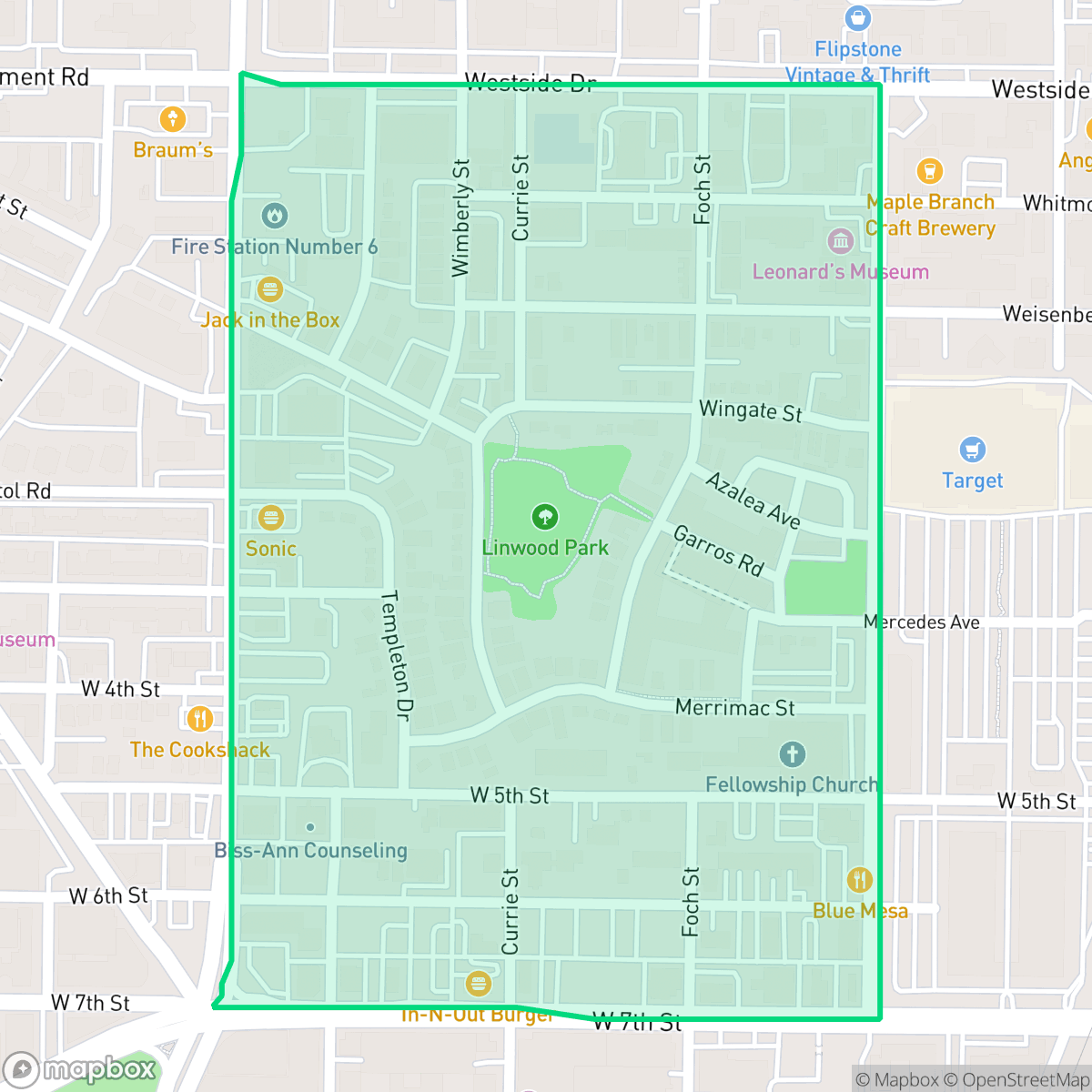
Situated just west of downtown Fort Worth in the Cultural District, the historic Linwood neighborhood was platted in the early 20th century, originally characterized by Craftsman bungalows. Linwood's history has been profoundly shaped by natural disasters; it was hit hard by the devastating 1949 Trinity River flood, and in 2000, a powerful tornado tore directly through the neighborhood, causing widespread destruction. For over a decade, much of the area remained barren, but a major redevelopment boom beginning around 2014 transformed Linwood into a dense, modern urban enclave of townhomes and apartments. A central neighborhood landmark is the ten-acre Linwood-Jesse D. Sandoval Park, established in 1957 and renamed in 2012 to honor a prominent local World War II veteran and Hispanic civil rights activist.
The neighborhood functions as a modern, high-density hub within the Fort Worth Cultural District. Its current landscape is defined by a mix of contemporary townhomes and apartment complexes that offer residents immediate access to popular local eateries and commercial corridors. This urban setting fosters a lively, active atmosphere that appeals to those who prioritize convenience and a walkable lifestyle over suburban seclusion.
Prospective residents should consider several trade-offs associated with this density. The area experiences elevated ambient noise levels from road traffic and offers limited privacy due to the close proximity of shared-wall housing. Additionally, the neighborhood faces challenges regarding flood safety and local school district performance. It is best suited for young professionals and renters who value a central location and high-energy environment over the quiet or expansive lot sizes found in neighboring areas.
Neighborhood Scores Across 15 Qualities
Shared walls in multi-family buildings and closely spaced bungalows result in lower privacy than the Fort Worth average. According to iHuus data, residents should expect less buffer between neighboring properties.
Sidewalk networks are consistent along main arterials and throughout the residential grid, making the area more walkable than the Fort Worth average. According to iHuus data, safe crossings are available for pedestrians throughout the neighborhood.
Standard urban density defines the area through boxy apartment complexes and small residential lots. This level of visual variety is slightly below the Fort Worth average.
Extensive green spaces and quiet walking paths through nearby parks and courtyards offer more pet-friendly environments than the Fort Worth average. According to iHuus data, the presence of connected landscape areas provides safe routes away from heavy traffic.
Streetscapes consist of an even balance of greenery and infrastructure. This area feels less dense and more suburban than the Fort Worth average, according to iHuus data.
A dense variety of social hubs and diverse dining destinations create a much more active environment than the Fort Worth average. Residents can access a wide array of mid-rise urban districts and lively social spots according to iHuus data.
Frequent sounds from nearby railroad tracks and heavy freeway traffic contribute to a noisier environment than most other parts of Fort Worth. Residents should expect significant acoustic disturbances according to iHuus data.
Air quality levels fluctuate between acceptable and unhealthy for sensitive groups; according to iHuus data, this is slightly better than the Fort Worth average.
Residential life remains undisturbed by heavy industry or warehouses, as the area lacks the large-scale industrial hazards found in other parts of Fort Worth. According to iHuus data, the neighborhood consists primarily of residential streets and light commercial use with no detected heavy manufacturing or chimneys.
Health insurance coverage among residents is higher than the Fort Worth average, according to iHuus data.
Political leanings in Linwood are split relatively evenly between conservative and liberal perspectives. This level of ideological diversity is slightly lower than the average seen across Fort Worth, according to iHuus data.
Residents live alongside a balanced mix of young adults, families, and older generations. This demographic spread is slightly more varied than the typical age profile seen across Fort Worth.
Significant flood risk exists here as much of the area sits within a designated floodplain. According to iHuus data, this risk level is notably higher than the Fort Worth average and typically necessitates flood insurance.
Address-Level Insights for Linwood


iHuus Neighborhood Intelligence Insights
Get address-level neighborhood insights for Linwood
- Street-level scores — see how individual blocks compare, not just neighborhood averages
- Micro-zone boundaries — identify quiet pockets, flood boundaries, and walkable clusters before you visit
- 15 dimensions in full — walkability, noise, air quality, school quality, insurance coverage, population age profile, urban/rural index, and more
- Boundary risk alerts — know if your address sits near a block boundary where scores drop, the kind of detail no listing will ever mention
- School insights — individual school ratings and insights, not just district-level data
- Compare before you commit — side-by-side data across neighborhoods, down to block precision
No credit card required
Compare with Any Neighborhood
| Dimension | Linwood | Alamo Heights |
|---|---|---|
| 🚶 Walkabilityavg 7.5 | ||
| 🔊 Acoustic Comfortavg 4.12 | ||
| 🤫 Privacy Indexavg 5.64 | ||
| 🎨 Visual Appealavg 6.38 | ||
| 🐕 Dog Friendlinessavg 6.57 | ||
| 🗺️ Urban-Rural Indexavg 6.92 | ||
| ✨ Neighborhood Vibeavg 4.56 | ||
| 🏥 Health Insurance Coverageavg 5.8 | ||
| 🌿 Air Qualityavg 3.68 | ||
| 🏭 Industrial Proximityavg 8.13 | ||
| 🌊 Flood Safetyavg 3.61 | ||
| 🗳️ Ideological Leanavg 5.62 | ||
| 👥 Population Age Profileavg 4.51 | ||
| 🔥 Fire Safety | ||
| 🏫 School Quality |
Linwood Rankings
School Districts Serving Linwood
School Insights for Linwood
Below average outcomes; significant attendance and academic challenges.
School Insights
See what's really behind every school rating near Linwood
- Individual school ratings — each school's own score with outcome context, not just a district average
- Enrollment & class size data — student-to-teacher ratio and how it compares to the state average
- Full demographics breakdown — ethnicity and gender composition for every school in the enrollment zone
- Every school in the district — all schools within the enrollment boundary ranked by rating, not just the closest one
- Grade levels & benchmarks — elementary through high school, with below/above state-average flags
No credit card required