John T White, Fort Worth
Updated · 6,015 residents
John T. White is a quiet, low-density neighborhood in east Fort Worth defined by its rural character and proximity to major highway corridors. While the area offers significant open space and a peaceful residential atmosphere, residents rely heavily on personal vehicles due to the limited number of local businesses within walking distance.
Key Highlights
About John T White
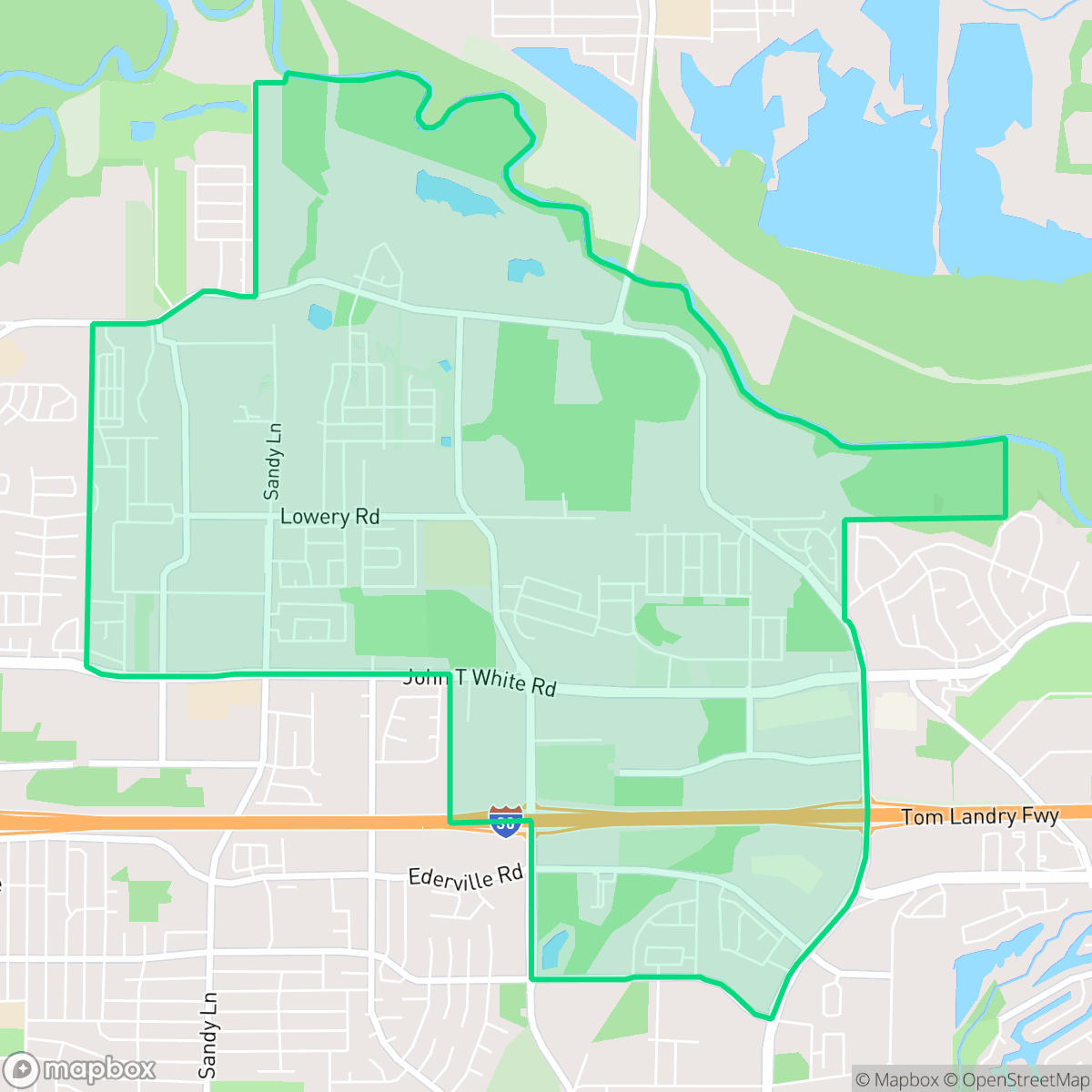
The John T. White neighborhood in east Fort Worth originated as a rural community built around the John T. White School. Established in 1927, the consolidated school district was named in honor of John Thomas White, a prominent educator and Tarrant County superintendent of schools. The surrounding country road, originally Isham Chapel Road, was officially renamed John T. White Road in 1953, though it historically leads to the 19th-century Isham Cemetery. The rural community underwent a major transition in 1955 when it was annexed by the city of Fort Worth to clear land for Interstate 30 (then the turnpike) and the Village Creek wastewater treatment plant. The local school district was subsequently annexed by Fort Worth ISD in 1959. Today, the area is a diverse suburban neighborhood anchored by the modern Leadership Academy at John T. White.
The area maintains a distinctively quiet, rural feel with vast open spaces and scattered residential structures that contrast with nearby light industrial developments. It is a car-oriented community where the landscape is dominated by greenery and wide-open tracts rather than dense commercial activity. While the neighborhood lacks a centralized business district, it provides a serene environment for those who prefer seclusion and a slower pace of life over the bustle of the city center.
Prospective residents should note that the neighborhood requires a vehicle for most daily tasks, as few amenities are reachable on foot. The area is well-suited for those seeking privacy and a lower density environment, though the proximity to industrial zones and major traffic routes influences the overall acoustic and environmental landscape. Families should consider that school options vary significantly, as the area is served by both the highly-regarded Hurst-Euless-Bedford Independent School District and the Fort Worth Independent School District.
Neighborhood Scores Across 15 Qualities
Living arrangements vary between high-density multi-family buildings and single-family homes on narrow lots. This level of residential spacing is roughly in line with the Fort Worth average, according to iHuus data.
Sidewalks are consistently present along residential streets, though a major highway creates a notable division in the area. According to iHuus data, walkability in this neighborhood is slightly higher than the Fort Worth average.
Spacious driveways and upscale amenities contribute to a visual quality that is slightly above the Fort Worth average. The area features a mix of standard suburban housing density alongside large apartment complexes and retail centers, according to iHuus data.
Large central greenbelts and connected park spaces offer excellent walking areas for pets. According to iHuus data, the availability of safe, traffic-free paths here is notably higher than the Fort Worth average.
Open land and scattered greenery define this area, offering a more semi-rural feel than the typical Fort Worth urban landscape. According to iHuus data, the environment features a mix of woodland, fields, and residential pockets alongside some denser apartment clusters.
Low density and significant open space define this area, which feels more tranquil and car-dependent than the typical Fort Worth neighborhood. Most residents will find few local businesses within walking distance, as the landscape is characterized by scattered structures and rural patches.
Continuous sound from nearby busy streets creates a moderate level of ambient noise. This acoustic environment is roughly consistent with the typical experience found across Fort Worth.
Frequent unhealthy air quality levels pose significant risks to sensitive groups, appearing notably worse than the Fort Worth average according to iHuus data.
Residential life is largely undisturbed by heavy industry, as this area maintains a higher level of quiet than the Fort Worth average. Most streets are purely residential or feature only light commercial activity with no significant industrial hazards present.
Health insurance accessibility is notably higher than the Fort Worth average, according to iHuus data. Residents in this area experience greater coverage stability than most of the city.
Political leanings in this area are notably more liberal than the Fort Worth average, featuring a majority liberal population with a modest opposing presence according to iHuus data.
A balanced mix of young adults, families, and older residents characterizes this area. This demographic spread is consistent with the average across Fort Worth.
Flood risk in this area is slightly higher than the Fort Worth average, though a lack of detailed FEMA studies means the precise level of danger remains undetermined. According to iHuus data, residents should remain cautious as the neighborhood lacks a completed flood study.
Address-Level Insights for John T White


iHuus Neighborhood Intelligence Insights
Get address-level neighborhood insights for John T White
- Street-level scores — see how individual blocks compare, not just neighborhood averages
- Micro-zone boundaries — identify quiet pockets, flood boundaries, and walkable clusters before you visit
- 15 dimensions in full — walkability, noise, air quality, school quality, insurance coverage, population age profile, urban/rural index, and more
- Boundary risk alerts — know if your address sits near a block boundary where scores drop, the kind of detail no listing will ever mention
- School insights — individual school ratings and insights, not just district-level data
- Compare before you commit — side-by-side data across neighborhoods, down to block precision
No credit card required
Compare with Any Neighborhood
| Dimension | John T White | Alamo Heights |
|---|---|---|
| 🚶 Walkabilityavg 7.5 | ||
| 🔊 Acoustic Comfortavg 4.12 | ||
| 🤫 Privacy Indexavg 5.64 | ||
| 🎨 Visual Appealavg 6.38 | ||
| 🐕 Dog Friendlinessavg 6.57 | ||
| 🗺️ Urban-Rural Indexavg 6.92 | ||
| ✨ Neighborhood Vibeavg 4.56 | ||
| 🏥 Health Insurance Coverageavg 5.8 | ||
| 🌿 Air Qualityavg 3.68 | ||
| 🏭 Industrial Proximityavg 8.13 | ||
| 🌊 Flood Safetyavg 3.61 | ||
| 🗳️ Ideological Leanavg 5.62 | ||
| 👥 Population Age Profileavg 4.51 | ||
| 🔥 Fire Safety | ||
| 🏫 School Quality |
John T White Rankings
School Districts Serving John T White
School Insights for John T White
Below average outcomes; significant attendance and academic challenges.
School Insights
See what's really behind every school rating near John T White
- Individual school ratings — each school's own score with outcome context, not just a district average
- Enrollment & class size data — student-to-teacher ratio and how it compares to the state average
- Full demographics breakdown — ethnicity and gender composition for every school in the enrollment zone
- Every school in the district — all schools within the enrollment boundary ranked by rating, not just the closest one
- Grade levels & benchmarks — elementary through high school, with below/above state-average flags
No credit card required