Jennings - May St. Louis, Fort Worth
Updated · 985 residents
Jennings-May-St. Louis is a residential enclave in Fort Worth characterized by a mix of historic homes and light industrial activity. While the area offers a calm, suburban atmosphere, residents experience notable noise from nearby road traffic and railroad activity.
Key Highlights
About Jennings - May St. Louis
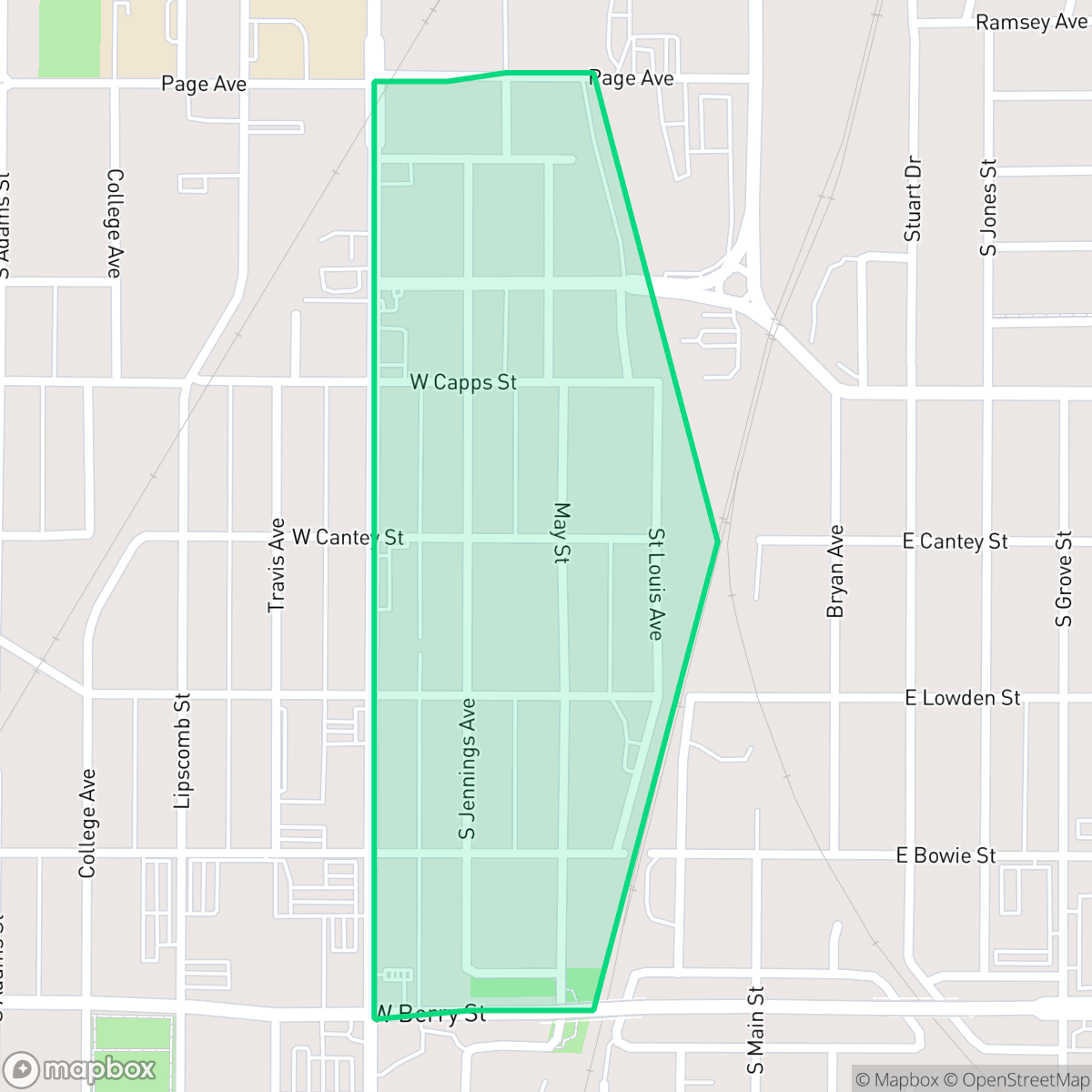
The Jennings-May-St. Louis neighborhood in Fort Worth, Texas, is a residential enclave named after its three framing streets: Jennings Avenue, May Street, and St. Louis Avenue. Featuring historic homes dating back to the 1920s, the area underwent a major community-led revitalization in the late 1990s. In 1997, it was selected to participate in the city's Model Block Program, utilizing a portion of a $1.2 million grant designed to reduce crime and beautify local neighborhoods. Through this initiative, the Jennings-May-St. Louis Neighborhood Development Corporation acquired land parcels, combining them with a tract donated by the Burlington Northern and Santa Fe Railway Company. This collaborative effort culminated in the 1999 dedication of the 0.85-acre Jennings-May-St. Louis Park, a shaded neighborhood green space situated partially beneath a bridge.
The neighborhood functions as a mixed-use environment where residential streets sit in close proximity to active commercial zones. According to iHuus data, the area maintains a moderate level of walkability, though the presence of industrial units and rail lines contributes to a higher noise profile. The area benefits from strong flood safety ratings, which provides a level of security for local property owners in this part of Fort Worth.
Potential residents should consider the trade-offs between the area's historic character and the realities of its acoustic environment. With limited local businesses within walking distance, the area is best suited for those who prioritize proximity to major city thoroughfares over a quiet, secluded lifestyle. The local school district remains in a period of transition, which is an important factor for families evaluating the neighborhood.
Neighborhood Scores Across 15 Qualities
Residential spacing provides a moderate level of separation between neighbors, which is slightly higher than the Fort Worth average according to iHuus data.
Sidewalks are available on only one side of many streets, and pedestrian connectivity is lower than the Fort Worth average. Safe crossings are present, but navigating the area on foot is less convenient than in more walkable parts of the city.
Standard tract housing characterizes this area, featuring modest yards and uniform rooflines. According to iHuus data, the visual landscape is less varied than the Fort Worth average.
Access to public parks and green verges for walking dogs is below the Fort Worth average. Pet owners may find fewer opportunities for outdoor exercise within the immediate vicinity according to iHuus data.
A mix of single-family residences and small commercial structures defines this area, which is slightly less open than the typical Fort Worth landscape according to iHuus data.
Local activity levels are slightly above the Fort Worth average, providing a balanced mix of residential streets and light industrial areas. Residents can access a variety of local dining options and community spaces, though many businesses are not within easy walking distance.
Frequent noise from nearby rail lines and major freeway traffic characterizes this area. According to iHuus data, acoustic comfort levels are lower than the Fort Worth average.
Air quality levels fluctuate between acceptable and unhealthy, which may cause occasional concern for sensitive groups. This area maintains a slightly higher level of air quality than the Fort Worth average, according to iHuus data.
Residential areas blend with light commercial zones and a prominent railway corridor featuring grain elevators on the eastern edge. This level of industrial proximity is lower than the Fort Worth average, offering a different landscape than more purely residential neighborhoods.
Health insurance accessibility is significantly lower here than in the rest of Fort Worth. According to iHuus data, a small portion of the resident population maintains active coverage.
Voting patterns and census indicators show a predominantly liberal leaning that is notably higher than the Fort Worth average, according to iHuus data.
Residents live alongside a balanced mix of young adults, families, and older individuals. This demographic distribution is largely consistent with the broader Fort Worth area, according to iHuus data.
Flood risk is notably higher than the Fort Worth average, as some areas within the neighborhood fall inside the 500-year floodplain. According to iHuus data, residents should be aware of some residual flood potential during extreme weather events.
Address-Level Insights for Jennings - May St. Louis


iHuus Neighborhood Intelligence Insights
Get address-level neighborhood insights for Jennings - May St. Louis
- Street-level scores — see how individual blocks compare, not just neighborhood averages
- Micro-zone boundaries — identify quiet pockets, flood boundaries, and walkable clusters before you visit
- 15 dimensions in full — walkability, noise, air quality, school quality, insurance coverage, population age profile, urban/rural index, and more
- Boundary risk alerts — know if your address sits near a block boundary where scores drop, the kind of detail no listing will ever mention
- School insights — individual school ratings and insights, not just district-level data
- Compare before you commit — side-by-side data across neighborhoods, down to block precision
No credit card required
Compare with Any Neighborhood
| Dimension | Jennings - May St. Louis | Alamo Heights |
|---|---|---|
| 🚶 Walkabilityavg 7.5 | ||
| 🔊 Acoustic Comfortavg 4.12 | ||
| 🤫 Privacy Indexavg 5.64 | ||
| 🎨 Visual Appealavg 6.38 | ||
| 🐕 Dog Friendlinessavg 6.57 | ||
| 🗺️ Urban-Rural Indexavg 6.92 | ||
| ✨ Neighborhood Vibeavg 4.56 | ||
| 🏥 Health Insurance Coverageavg 5.8 | ||
| 🌿 Air Qualityavg 3.68 | ||
| 🏭 Industrial Proximityavg 8.13 | ||
| 🌊 Flood Safetyavg 3.61 | ||
| 🗳️ Ideological Leanavg 5.62 | ||
| 👥 Population Age Profileavg 4.51 | ||
| 🔥 Fire Safety | ||
| 🏫 School Quality |
Jennings - May St. Louis Rankings
School Districts Serving Jennings - May St. Louis
School Insights for Jennings - May St. Louis
Below average outcomes; significant attendance and academic challenges.
School Insights
See what's really behind every school rating near Jennings - May St. Louis
- Individual school ratings — each school's own score with outcome context, not just a district average
- Enrollment & class size data — student-to-teacher ratio and how it compares to the state average
- Full demographics breakdown — ethnicity and gender composition for every school in the enrollment zone
- Every school in the district — all schools within the enrollment boundary ranked by rating, not just the closest one
- Grade levels & benchmarks — elementary through high school, with below/above state-average flags
No credit card required