Historic Southside, Fort Worth
Updated · 2,041 residents
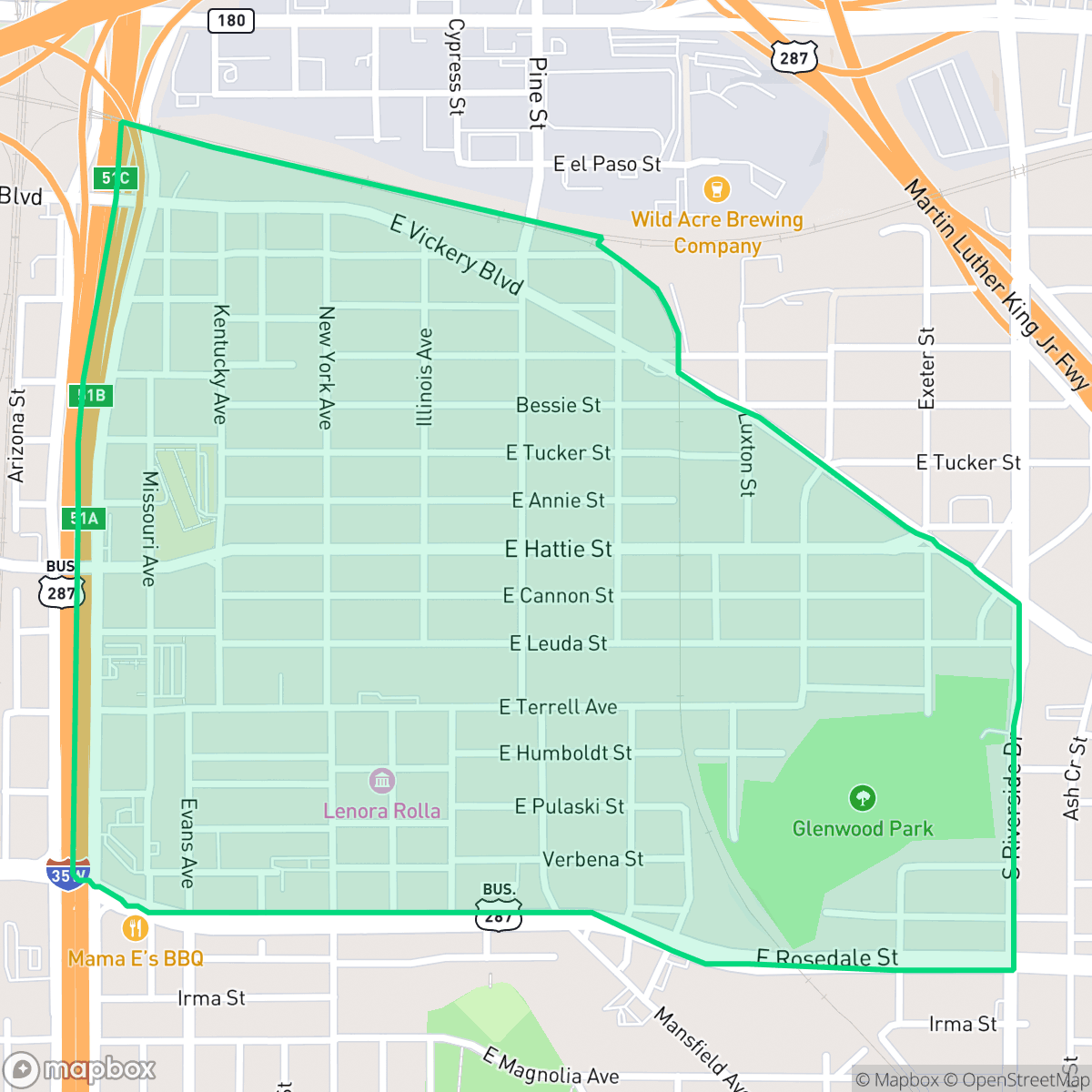
Historic Southside is a culturally significant neighborhood southeast of downtown Fort Worth that balances suburban residential life with proximity to local industry. While the area offers decent walkability and a strong sense of community, residents should be prepared for significant noise levels from nearby road traffic.
Key Highlights
About Historic Southside
Located southeast of downtown Fort Worth, the Historic Southside is one of the city’s oldest African American neighborhoods. Originally platted in the late 19th century, it developed into a thriving hub where affluent Black families and businesses flourished. The neighborhood, particularly the Terrell Heights area, became Fort Worth's first middle-class Black enclave. It was home to prominent historic figures like educator Hazel Harvey Peace and banker William "Gooseneck Bill" McDonald. Architecturally, the area features a mix of simple wood-frame homes, Craftsman bungalows, and multi-level Victorian residences. Key local landmarks along signature thoroughfares like Evans Avenue and East Rosedale Street include Evans Plaza, the Lenora Rolla Heritage Center Museum, and the site of the National Juneteenth Museum.
The area maintains a distinct character defined by its blend of residential blocks, green spaces, and light industrial activity. It serves as a central hub for various religious institutions and local businesses that provide essential services to the community. According to iHuus data, the neighborhood benefits from a relatively high level of flood safety compared to other parts of the city, providing a stable environment for its residents who value its central location and historical roots. The neighborhood is well-suited for those who prioritize community heritage and proximity to major city landmarks over quiet, secluded living environments.
Prospective residents should weigh the cultural significance of the location against its current livability trade-offs. The neighborhood experiences high levels of ambient noise primarily due to heavy road traffic, and the proximity to industrial sites may impact daily air quality. Educational options are served by the Fort Worth Independent School District, which currently faces systemic challenges such as budget deficits and enrollment declines that potential families should consider when evaluating the area.
Neighborhood Scores Across 15 Qualities
Residential spacing is mixed, providing some buffer between neighbors. This level of privacy is slightly higher than the Fort Worth average according to iHuus data.
Low street traffic makes for peaceful walks, but the lack of sidewalks makes navigating the area on foot more difficult than in much of Fort Worth.
Standard tract housing with small yards and simple rooflines characterizes the area. This level of visual variety is lower than the Fort Worth average.
Access to dedicated dog parks and wide green verges is below the Fort Worth average. Pet owners may find fewer immediate opportunities for off-leash exercise within the immediate neighborhood vicinity.
Residential areas transition between dense apartment blocks and more open, low-density pockets. This mix of urban and suburban characteristics is slightly less open than the Fort Worth average, according to iHuus data.
Rhythms of daily life here are slightly more subdued than the Fort Worth average. While certain pockets offer social hubs and dining, much of the area consists of quiet residential and industrial blocks with limited walkability to services.
Frequent noise from nearby railroad tracks and heavy freeway traffic characterizes this area. According to iHuus data, acoustic comfort is significantly lower than the Fort Worth average.
Air quality levels fluctuate between acceptable and unhealthy, which may pose occasional concerns for sensitive groups. This variability is slightly higher than the Fort Worth average, according to iHuus data.
Residential streets remain largely undisturbed by heavy industry, though some light commercial activity and intermittent loading noise occur near local service providers. This level of industrial proximity is lower than the Fort Worth average.
Health insurance coverage rates among residents are below the Fort Worth average, according to iHuus data. This indicates a higher proportion of uninsured individuals compared to much of the city.
Voting patterns and census indicators reflect a significantly more liberal political leaning than the Fort Worth average, according to iHuus data.
Residents live alongside a balanced spread of young adults, families, and older individuals. This demographic distribution is consistent with the average seen across Fort Worth.
Residual flood risk exists due to the neighborhood's location within a 500-year floodplain, though safety levels are notably higher than the Fort Worth average according to iHuus data.
Address-Level Insights for Historic Southside


iHuus Neighborhood Intelligence Insights
Get address-level neighborhood insights for Historic Southside
- Street-level scores — see how individual blocks compare, not just neighborhood averages
- Micro-zone boundaries — identify quiet pockets, flood boundaries, and walkable clusters before you visit
- 15 dimensions in full — walkability, noise, air quality, school quality, insurance coverage, population age profile, urban/rural index, and more
- Boundary risk alerts — know if your address sits near a block boundary where scores drop, the kind of detail no listing will ever mention
- School insights — individual school ratings and insights, not just district-level data
- Compare before you commit — side-by-side data across neighborhoods, down to block precision
No credit card required
Compare with Any Neighborhood
| Dimension | Historic Southside | Alamo Heights |
|---|---|---|
| 🚶 Walkabilityavg 7.5 | ||
| 🔊 Acoustic Comfortavg 4.12 | ||
| 🤫 Privacy Indexavg 5.64 | ||
| 🎨 Visual Appealavg 6.38 | ||
| 🐕 Dog Friendlinessavg 6.57 | ||
| 🗺️ Urban-Rural Indexavg 6.92 | ||
| ✨ Neighborhood Vibeavg 4.56 | ||
| 🏥 Health Insurance Coverageavg 5.8 | ||
| 🌿 Air Qualityavg 3.68 | ||
| 🏭 Industrial Proximityavg 8.13 | ||
| 🌊 Flood Safetyavg 3.61 | ||
| 🗳️ Ideological Leanavg 5.62 | ||
| 👥 Population Age Profileavg 4.51 | ||
| 🔥 Fire Safety | ||
| 🏫 School Quality |
Historic Southside Rankings
School Districts Serving Historic Southside
School Insights for Historic Southside
Below average outcomes; significant attendance and academic challenges.
School Insights
See what's really behind every school rating near Historic Southside
- Individual school ratings — each school's own score with outcome context, not just a district average
- Enrollment & class size data — student-to-teacher ratio and how it compares to the state average
- Full demographics breakdown — ethnicity and gender composition for every school in the enrollment zone
- Every school in the district — all schools within the enrollment boundary ranked by rating, not just the closest one
- Grade levels & benchmarks — elementary through high school, with below/above state-average flags
No credit card required