Highland Hills, Fort Worth
Updated · 1,996 residents
Highland Hills is a quiet, mid-century residential neighborhood in southeast Fort Worth situated near the Interstate 20 corridor. The area provides a traditional suburban layout, though residents should be aware of significant noise levels from nearby highway traffic and lower-than-average air quality.
Key Highlights
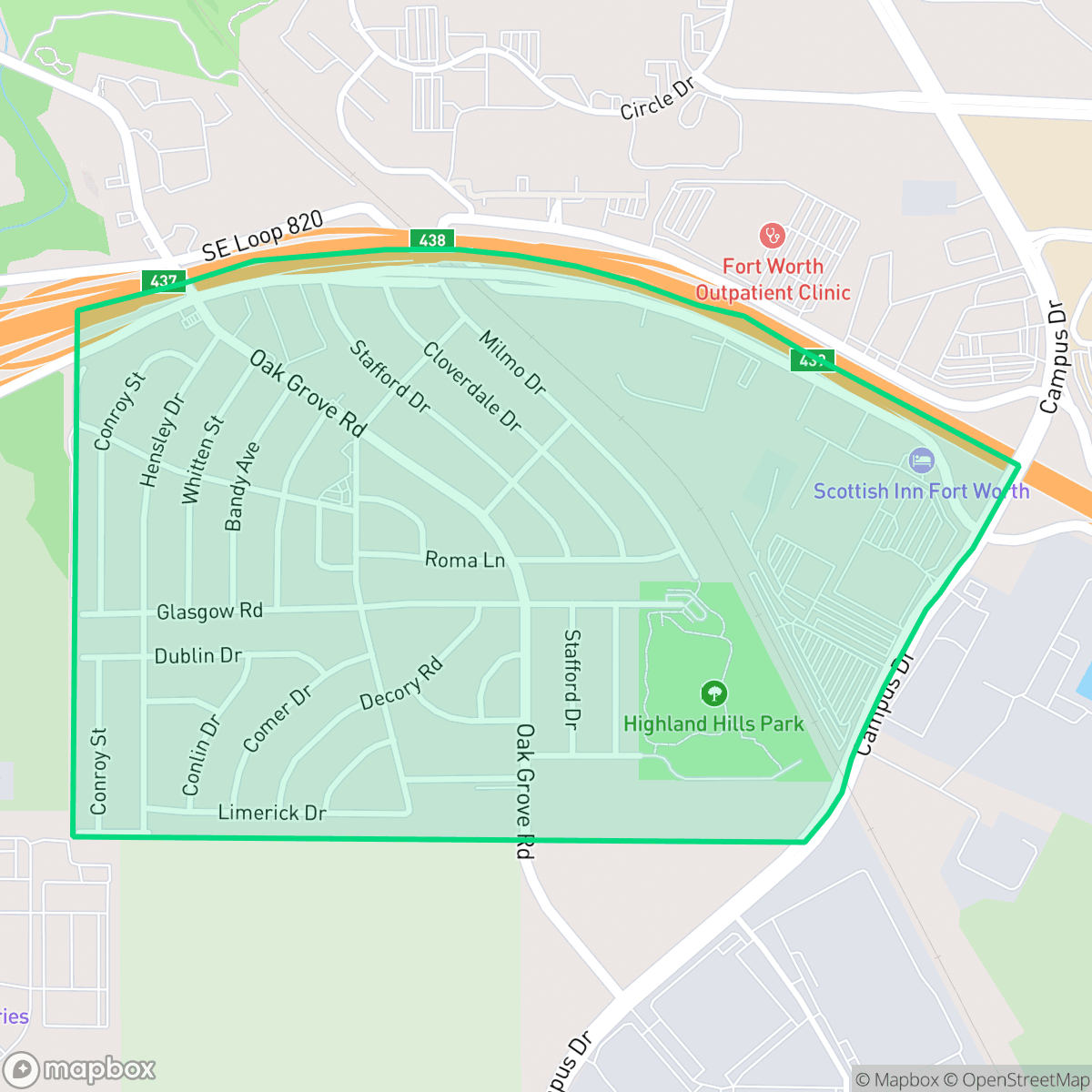
About Highland Hills
Developed in southeast Fort Worth during the late 1950s and early 1960s, the Highland Hills neighborhood is a peaceful residential community characterized by mid-century single-family homes. A central landmark of the area is the 28.9-acre Highland Hills Park, which was acquired by the city in 1968. Following years of advocacy by local residents for recreational improvements, the Highland Hills Community Center opened within the park in 1990, serving as a vital hub for youth sports, after-school programs, and community events. Today, the neighborhood maintains its established, suburban character, bounded by major thoroughfares like Interstate 20 and defined by its quiet streets and active community spaces.
Highland Hills serves as a residential enclave in southeast Fort Worth, defined by its mid-century housing stock and established suburban layout. The area is situated adjacent to Interstate 20, which provides convenient regional access but also contributes to a high ambient noise level throughout the neighborhood. The landscape is characterized by a mix of single-family homes and light industrial zones, creating a functional environment that prioritizes residential privacy over commercial density. According to local data, the area maintains a moderate level of walkability, though the overall vibe remains quiet and focused on local residential life rather than retail or entertainment activity.
Prospective residents should consider the trade-offs associated with the area, particularly regarding local infrastructure and services. Both the Everman and Fort Worth Independent School Districts currently face significant operational and academic challenges, which may impact families with school-aged children. Furthermore, the neighborhood experiences lower air quality and higher traffic-related noise compared to the city average. This community is best suited for those who value an established suburban setting and are comfortable navigating the current limitations of local school and environmental conditions.
Neighborhood Scores Across 15 Qualities
Residential spacing is mixed, providing more buffer between neighbors than the Fort Worth average. According to iHuus data, the density allows for a balance of proximity and personal distance.
Quiet streets allow for easy walking, though the lack of sidewalks makes the area less walkable than the Fort Worth average according to iHuus data.
Tract housing with modest yards defines the local landscape, which is slightly below the Fort Worth average for visual variety.
Connected green spaces and wide paths provide safe environments for walking dogs away from traffic. This level of accessibility is roughly in line with the Fort Worth average, according to iHuus data.
Open land and scattered homes characterize this area as a transition zone between suburban residential and agricultural fringes. This landscape offers a slightly more rural atmosphere than the typical Fort Worth environment, according to iHuus data.
Low density and heavy industrial presence create a subdued atmosphere that is notably less active than the Fort Worth average. According to iHuus data, the area is characterized by significant open space and few social or leisure destinations.
Frequent noise from nearby highways and rail lines makes this area significantly louder than the Fort Worth average. According to iHuus data, residents can expect consistent auditory disturbances from heavy transit traffic.
Frequent unhealthy air quality levels pose significant risks to sensitive groups. According to iHuus data, the air quality in this area is notably worse than the Fort Worth average.
Logistics hubs and a wastewater treatment facility are located near residential areas, resulting in more industrial activity than the Fort Worth average. This mix of light industrial and commercial infrastructure brings increased daytime commercial traffic to the neighborhood.
Health insurance enrollment in this area is lower than the Fort Worth average, according to iHuus data.
Voting patterns and census indicators show a much more liberal political leaning than the Fort Worth average, according to iHuus data.
A diverse mix of young adults, families, and older residents defines the area, aligning with the typical age distribution seen across Fort Worth.
Flood risk in this area is significantly higher than the Fort Worth average. Residents should anticipate substantial flood insurance costs due to the neighborhood's vulnerability to high-hazard water events.
Address-Level Insights for Highland Hills


iHuus Neighborhood Intelligence Insights
Get address-level neighborhood insights for Highland Hills
- Street-level scores — see how individual blocks compare, not just neighborhood averages
- Micro-zone boundaries — identify quiet pockets, flood boundaries, and walkable clusters before you visit
- 15 dimensions in full — walkability, noise, air quality, school quality, insurance coverage, population age profile, urban/rural index, and more
- Boundary risk alerts — know if your address sits near a block boundary where scores drop, the kind of detail no listing will ever mention
- School insights — individual school ratings and insights, not just district-level data
- Compare before you commit — side-by-side data across neighborhoods, down to block precision
No credit card required
Compare with Any Neighborhood
| Dimension | Highland Hills | Alamo Heights |
|---|---|---|
| 🚶 Walkabilityavg 7.5 | ||
| 🔊 Acoustic Comfortavg 4.12 | ||
| 🤫 Privacy Indexavg 5.64 | ||
| 🎨 Visual Appealavg 6.38 | ||
| 🐕 Dog Friendlinessavg 6.57 | ||
| 🗺️ Urban-Rural Indexavg 6.92 | ||
| ✨ Neighborhood Vibeavg 4.56 | ||
| 🏥 Health Insurance Coverageavg 5.8 | ||
| 🌿 Air Qualityavg 3.68 | ||
| 🏭 Industrial Proximityavg 8.13 | ||
| 🌊 Flood Safetyavg 3.61 | ||
| 🗳️ Ideological Leanavg 5.62 | ||
| 👥 Population Age Profileavg 4.51 | ||
| 🔥 Fire Safety | ||
| 🏫 School Quality |
Highland Hills Rankings
School Districts Serving Highland Hills
School Insights for Highland Hills
Below average outcomes; significant attendance and academic challenges.
School Insights
See what's really behind every school rating near Highland Hills
- Individual school ratings — each school's own score with outcome context, not just a district average
- Enrollment & class size data — student-to-teacher ratio and how it compares to the state average
- Full demographics breakdown — ethnicity and gender composition for every school in the enrollment zone
- Every school in the district — all schools within the enrollment boundary ranked by rating, not just the closest one
- Grade levels & benchmarks — elementary through high school, with below/above state-average flags
No credit card required