Handley, Fort Worth
Updated · 10,355 residents
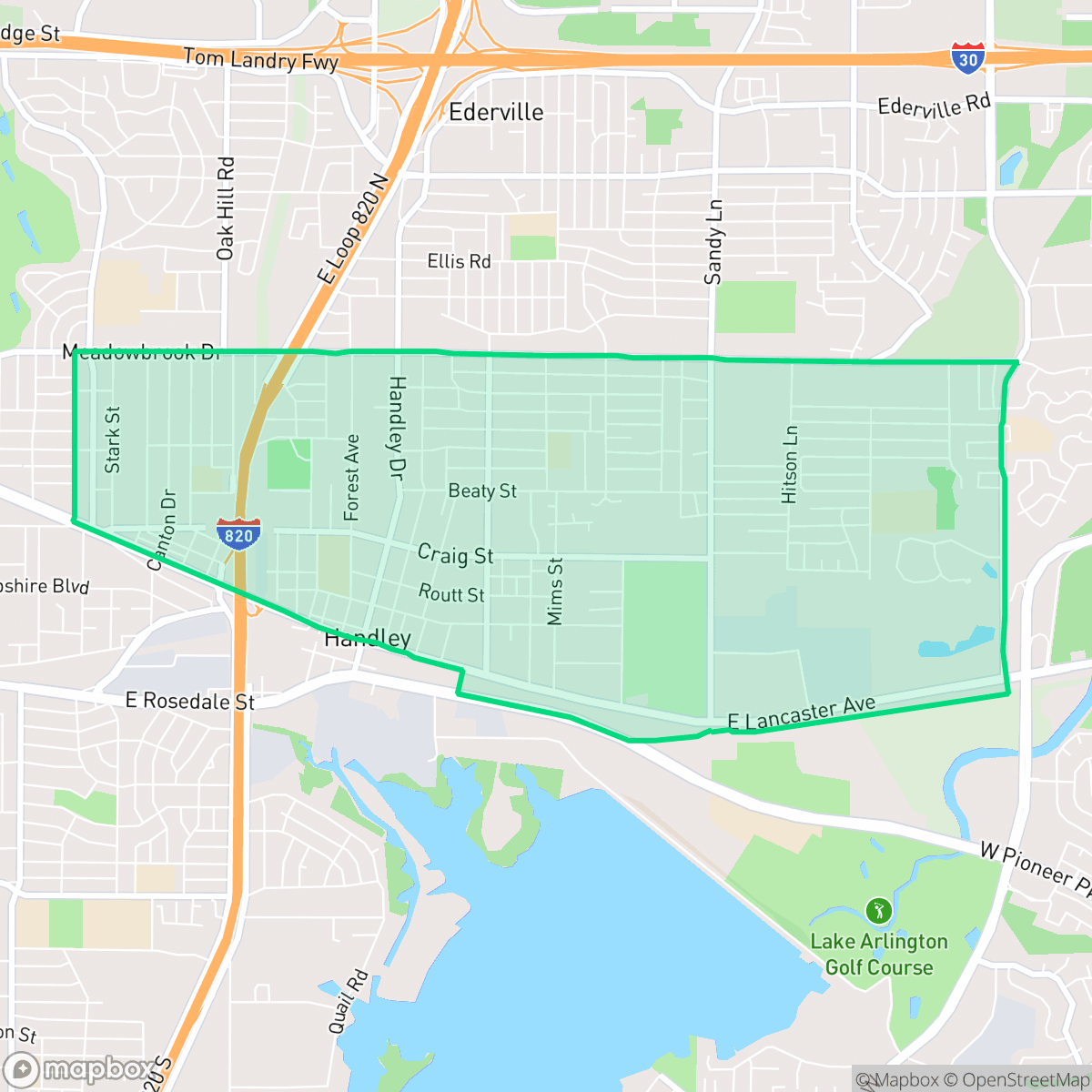
Handley is a historic Fort Worth community characterized by a blend of quiet, low-density suburban streets and pockets of industrial activity. While it offers a serene, rural-leaning atmosphere with high acoustic comfort, residents are largely car-dependent due to the limited concentration of local businesses.
Key Highlights
About Handley
Established in 1876 with the arrival of the Texas and Pacific Railway, Handley developed as a bustling railroad town named after Confederate Major James Madison Handley. The community flourished in the early 20th century following the 1902 introduction of the Northern Texas Traction Company's electric interurban streetcar line, which linked Fort Worth and Dallas. Handley became a popular regional destination thanks to the Lake Erie Trolley Park, a resort featuring a dance hall, roller rink, and pier. Though annexed by Fort Worth in 1946, the neighborhood retains its distinct identity. Its historic commercial core along East Lancaster Avenue, featuring early 20th-century storefronts and the 1928 Handley Masonic Lodge (now the Handley Cultural Center), is preserved within the Central Handley Historic District, listed on the National Register of Historic Places.
The neighborhood functions as a primarily residential area that balances suburban living with significant open green space. It maintains a distinct identity separate from the broader Fort Worth urban core, featuring a mix of quiet, low-density blocks and light industrial zones. According to iHuus data, the area benefits from high acoustic comfort, providing a peaceful environment despite its proximity to major transit corridors.
This area is best suited for those who prioritize a quiet, spacious environment over high walkability or immediate access to a dense commercial district. While the landscape is serene, residents should anticipate a car-dependent lifestyle, as most daily amenities require travel outside the immediate vicinity. Families should also note that local schools, served by the Fort Worth and Arlington districts, currently face operational and academic challenges that may influence educational planning.
Neighborhood Scores Across 15 Qualities
Standard suburban spacing provides some buffer between neighbors, offering slightly more separation than the Fort Worth average. Most properties feature backyard fencing and consistent spacing between homes.
Sidewalks are available on certain streets but are often obscured by mature tree canopy. Pedestrian connectivity is lower than the Fort Worth average, though safe crossings are present near residential areas and school campuses.
Residential streets feature uniform tract housing with modest yards and limited private amenities. This level of visual variety is consistent with the average across Fort Worth.
Large public parks and connected green corridors provide ample space for pets. According to iHuus data, the availability of shaded paths and low traffic density is slightly above the Fort Worth average.
Open land and woodland areas are frequent throughout this neighborhood, providing a slightly more rural character than the Fort Worth average. According to iHuus data, the landscape transitions from dense suburban layouts to patches of scattered homes and industrial utility zones.
A blend of quiet, low-density residential blocks and more active social hubs creates a vibe that is more lively than the Fort Worth average. While certain pockets feature steady amenities and local eateries, much of the area remains calm and car-dependent.
Acoustic levels are notably lower than the Fort Worth average, consisting mostly of infrequent trains and distant vehicle traffic. According to iHuus data, this provides a more peaceful environment for residents than most parts of the city.
Frequent unhealthy air quality levels pose a significant risk to sensitive groups. This area experiences lower air quality than the Fort Worth average, according to iHuus data.
Residential life here is free from large warehouses, industrial facilities, or hazard sites, representing a much cleaner profile than the Fort Worth average. According to iHuus data, the area consists primarily of residential and light commercial uses without visible heavy industrial activity.
Health insurance coverage among residents is lower than the Fort Worth average, according to iHuus data.
Political leanings in Handley skew significantly more liberal than the Fort Worth average, according to iHuus data.
Residents live alongside a balanced mix of young adults, families, and seniors. This age distribution is largely in line with the broader Fort Worth area, according to iHuus data.
Flood risk levels in this area are comparable to the Fort Worth average, though official FEMA studies for this specific neighborhood remain incomplete. According to iHuus data, the lack of a detailed flood study means certain areas may have undetermined risk levels.
Address-Level Insights for Handley


iHuus Neighborhood Intelligence Insights
Get address-level neighborhood insights for Handley
- Street-level scores — see how individual blocks compare, not just neighborhood averages
- Micro-zone boundaries — identify quiet pockets, flood boundaries, and walkable clusters before you visit
- 15 dimensions in full — walkability, noise, air quality, school quality, insurance coverage, population age profile, urban/rural index, and more
- Boundary risk alerts — know if your address sits near a block boundary where scores drop, the kind of detail no listing will ever mention
- School insights — individual school ratings and insights, not just district-level data
- Compare before you commit — side-by-side data across neighborhoods, down to block precision
No credit card required
Compare with Any Neighborhood
| Dimension | Handley | Alamo Heights |
|---|---|---|
| 🚶 Walkabilityavg 7.5 | ||
| 🔊 Acoustic Comfortavg 4.12 | ||
| 🤫 Privacy Indexavg 5.64 | ||
| 🎨 Visual Appealavg 6.38 | ||
| 🐕 Dog Friendlinessavg 6.57 | ||
| 🗺️ Urban-Rural Indexavg 6.92 | ||
| ✨ Neighborhood Vibeavg 4.56 | ||
| 🏥 Health Insurance Coverageavg 5.8 | ||
| 🌿 Air Qualityavg 3.68 | ||
| 🏭 Industrial Proximityavg 8.13 | ||
| 🌊 Flood Safetyavg 3.61 | ||
| 🗳️ Ideological Leanavg 5.62 | ||
| 👥 Population Age Profileavg 4.51 | ||
| 🔥 Fire Safety | ||
| 🏫 School Quality |
Handley Rankings
School Districts Serving Handley
School Insights for Handley
Below average outcomes; significant attendance and academic challenges.
School Insights
See what's really behind every school rating near Handley
- Individual school ratings — each school's own score with outcome context, not just a district average
- Enrollment & class size data — student-to-teacher ratio and how it compares to the state average
- Full demographics breakdown — ethnicity and gender composition for every school in the enrollment zone
- Every school in the district — all schools within the enrollment boundary ranked by rating, not just the closest one
- Grade levels & benchmarks — elementary through high school, with below/above state-average flags
No credit card required