Garden Acres, Fort Worth
Updated · 6,146 residents
Garden Acres offers a semi-rural residential environment characterized by open land and wooded areas on the outskirts of Fort Worth. While the neighborhood provides a quiet, car-dependent setting, residents have access to basic pedestrian infrastructure and a diverse demographic mix.
Key Highlights
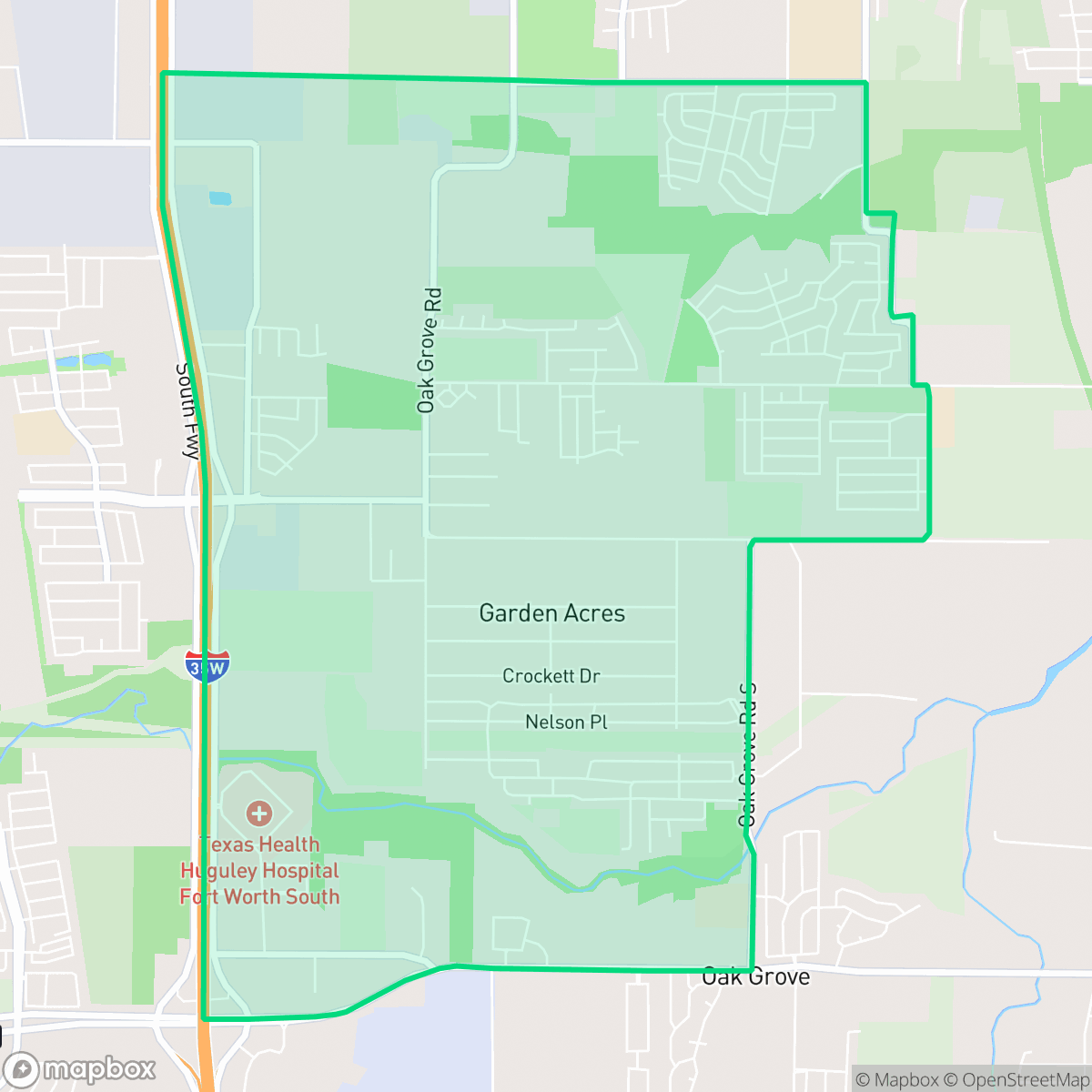
About Garden Acres
Garden Acres is a residential community in Fort Worth defined by its semi-rural character and expansive open spaces. The area features a standard suburban aesthetic with moderate spacing between homes, providing a degree of privacy that distinguishes it from more densely populated urban sections of the city. While the neighborhood lacks high-density commercial hubs, it maintains a tranquil atmosphere suitable for those who prefer a quieter lifestyle away from heavy industrial activity.
Prospective residents should be aware of the elevated flood risk associated with the local 100-year floodplain and the necessity of owning a vehicle for daily errands. The area experiences moderate traffic noise, and according to iHuus data, there are limited immediate opportunities for outdoor pet exercise. Educational options vary significantly, as the neighborhood is served by school districts ranging from high-performing institutions to those currently undergoing significant operational transitions. Access to comprehensive health insurance coverage remains a consideration for many in the local population.
Neighborhood Scores Across 15 Qualities
Residential spacing provides a moderate level of separation between neighbors, which is slightly higher than the Fort Worth average according to iHuus data.
Sidewalks are available on one side of the street alongside safe crossings. This level of pedestrian accessibility is slightly below the Fort Worth average.
Uniform housing with modest yards characterizes this area, which sits slightly below the Fort Worth average for visual variety.
Access to public parks and wide green verges for walking is below the Fort Worth average, according to iHuus data. Pet owners may find fewer immediate opportunities for outdoor exercise within the immediate vicinity.
Open land and wooded areas provide a more rural feel than the typical Fort Worth landscape. Residents will encounter a mix of expansive fields, scattered homes, and low-density industrial clusters according to iHuus data.
Low business density and a prevalence of industrial or rural landscapes make this area feel much more subdued than the Fort Worth average. Residents will find a tranquil setting with significant open space, but most daily needs will require a vehicle due to the lack of walkable commercial hubs.
Steady traffic sounds from a nearby busy street are present. This level of acoustic activity is slightly higher than the average found across Fort Worth, according to iHuus data.
Air quality in this area fluctuates between acceptable and unhealthy levels. According to iHuus data, conditions are slightly better than the Fort Worth average, though sensitive groups should remain cautious on certain days.
Primarily residential in nature, this area features only occasional light commercial activity and lacks heavy industrial zones. While some logistics hubs and warehouse-related truck traffic are present nearby, the overall industrial impact is comparable to the Fort Worth average.
Health insurance coverage among residents is below the Fort Worth average. According to iHuus data, a significant portion of the population lacks employer-sponsored or private coverage.
Political leanings in this area are split fairly evenly between conservative and liberal perspectives, mirroring the general distribution found across Fort Worth according to iHuus data.
Residents live alongside a balanced mix of young adults, families, and older individuals. This demographic spread is largely consistent with the typical age profile found across Fort Worth.
Flood risk is elevated in this area as it sits within a designated 100-year floodplain. Residents should prepare for higher-than-average flood risk levels compared to the rest of Fort Worth, which may necessitate specialized flood insurance.
Address-Level Insights for Garden Acres


iHuus Neighborhood Intelligence Insights
Get address-level neighborhood insights for Garden Acres
- Street-level scores — see how individual blocks compare, not just neighborhood averages
- Micro-zone boundaries — identify quiet pockets, flood boundaries, and walkable clusters before you visit
- 15 dimensions in full — walkability, noise, air quality, school quality, insurance coverage, population age profile, urban/rural index, and more
- Boundary risk alerts — know if your address sits near a block boundary where scores drop, the kind of detail no listing will ever mention
- School insights — individual school ratings and insights, not just district-level data
- Compare before you commit — side-by-side data across neighborhoods, down to block precision
No credit card required
Compare with Any Neighborhood
| Dimension | Garden Acres | Alamo Heights |
|---|---|---|
| 🚶 Walkabilityavg 7.5 | ||
| 🔊 Acoustic Comfortavg 4.12 | ||
| 🤫 Privacy Indexavg 5.64 | ||
| 🎨 Visual Appealavg 6.38 | ||
| 🐕 Dog Friendlinessavg 6.57 | ||
| 🗺️ Urban-Rural Indexavg 6.92 | ||
| ✨ Neighborhood Vibeavg 4.56 | ||
| 🏥 Health Insurance Coverageavg 5.8 | ||
| 🌿 Air Qualityavg 3.68 | ||
| 🏭 Industrial Proximityavg 8.13 | ||
| 🌊 Flood Safetyavg 3.61 | ||
| 🗳️ Ideological Leanavg 5.62 | ||
| 👥 Population Age Profileavg 4.51 | ||
| 🔥 Fire Safety | ||
| 🏫 School Quality |
Garden Acres Rankings
School Districts Serving Garden Acres
School Insights for Garden Acres
Below average outcomes; significant attendance and academic challenges.
School Insights
See what's really behind every school rating near Garden Acres
- Individual school ratings — each school's own score with outcome context, not just a district average
- Enrollment & class size data — student-to-teacher ratio and how it compares to the state average
- Full demographics breakdown — ethnicity and gender composition for every school in the enrollment zone
- Every school in the district — all schools within the enrollment boundary ranked by rating, not just the closest one
- Grade levels & benchmarks — elementary through high school, with below/above state-average flags
No credit card required