Frisco Heights, Fort Worth
Updated · 1,444 residents
Frisco Heights is a highly walkable enclave situated directly adjacent to the Texas Christian University campus in Fort Worth. The area features a lively, urban atmosphere with diverse local dining options, though residents should expect significant noise from road traffic and limited privacy due to high-density housing.
Key Highlights
About Frisco Heights
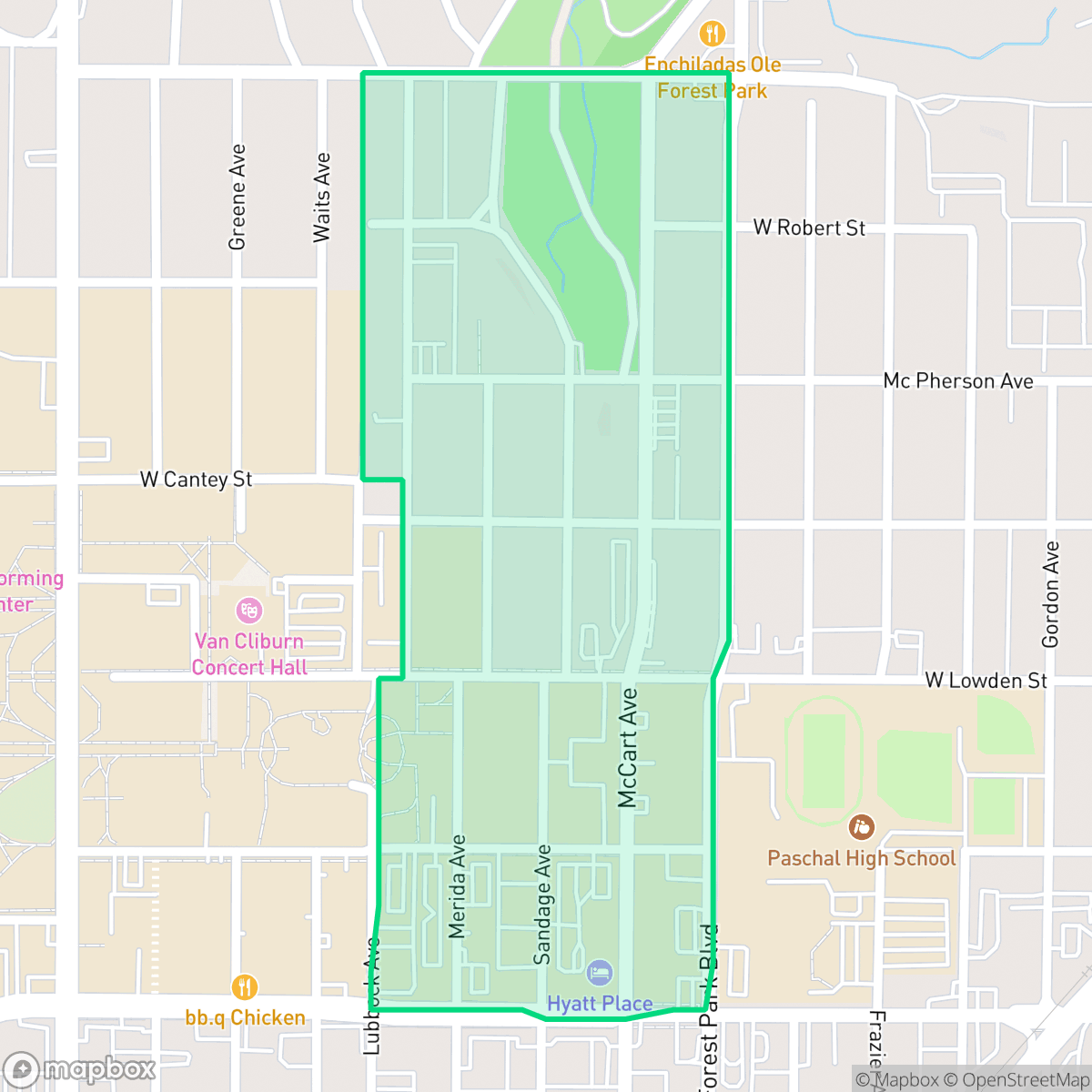
Bounded by West Berry Street, Forest Park Boulevard, and Texas Christian University (TCU), Fort Worth’s Frisco Heights neighborhood developed primarily in the 1920s and 1930s as part of the Forest Park Conservation District. Characterized by historic single-story cottages and bungalows, the neighborhood also features architectural landmarks like a 1937 Bungalow Court of four identical gabled cottages on Wayside Street and a 1963 Midcentury Modern home designed by local architect Albert S. Komatsu. In the early 2000s, Frisco Heights became the "canary in the coal mine" for local historic preservation. Its proximity to TCU made it a prime target for developers who demolished dozens of historic homes to build large multi-occupancy student rentals. This rapid transformation spurred residents to rally for the 2014 TCU Residential Overlay Ordinance to protect the neighborhood's single-family character.
The neighborhood functions as a vibrant extension of the university environment, benefiting from a high degree of pedestrian access to local amenities and campus landmarks. According to iHuus data, the area maintains a high level of visual appeal, characterized by a mix of well-maintained residential properties and institutional architecture that creates a distinct, active streetscape. The presence of nearby dining and constant movement contributes to an energetic, mid-rise urban core that remains distinct within the broader city landscape.
Prospective residents should weigh the benefits of this central location against specific livability trade-offs. The high-traffic environment results in elevated noise levels, and the close proximity of multi-unit student housing reduces overall privacy for many households. Furthermore, families considering the area should be aware that the local school district is currently experiencing financial and operational instability, which may impact educational outcomes for students.
Neighborhood Scores Across 15 Qualities
Residential lots and multi-unit housing feature narrow setbacks and shared walls, resulting in less privacy than the Fort Worth average. According to iHuus data, many structures are closely packed with limited buffer between neighbors.
Pedestrian infrastructure is extensive throughout the area, featuring wide sidewalks on both sides of most streets and clear crossings at major intersections. This network of paths, which includes the nearby university campus, is significantly more accessible for walkers than the Fort Worth average.
Larger homes and private backyard pools contribute to an area appearance that is more visually appealing than the Fort Worth average. According to iHuus data, the landscape features well-maintained mid-century residences and institutional architecture alongside newer multi-family units.
Access to large campus lawns, park trails, and sports fields provides more pet-friendly green space than the Fort Worth average. While some street-level areas lack public greenery, the neighborhood offers significant opportunities for exercise and outdoor activity.
Residential streets and green spaces exist in roughly equal measure, creating a suburban environment that is less dense than the Fort Worth average. This mix of low-density housing, university buildings, and scattered commercial clusters provides a transitional landscape between urban and open areas.
Frequent activity and a diverse mix of dining and local landmarks create a lively atmosphere that is significantly more energetic than the Fort Worth average. Residents can access a variety of much-used hubs, ranging from mid-rise urban cores to active suburban blocks near transit lines.
Local traffic from a nearby busy street creates a consistent level of noise. This acoustic environment is roughly in line with the Fort Worth average.
Air quality levels here fluctuate between acceptable and unhealthy, presenting occasional concerns for sensitive groups. According to iHuus data, the air quality in Frisco Heights is slightly better than the Fort Worth average.
Heavy industrial facilities and hazardous sites are absent from this area, making it significantly cleaner than the Fort Worth average. According to iHuus data, the landscape consists almost entirely of residential, institutional, and light commercial zones.
Health insurance accessibility is notably higher than the Fort Worth average, according to iHuus data. Most residents in this area maintain active coverage.
Political leanings in this area are roughly split between conservative and liberal residents. This represents a more even distribution of ideologies compared to the broader Fort Worth average, according to iHuus data.
Residents are predominantly young adults, representing a younger demographic than the Fort Worth average. This profile includes a modest presence of families and older individuals according to iHuus data.
Flood risk in this area is higher than the Fort Worth average; however, a detailed federal study has not yet been completed for this specific zone. According to iHuus data, the area currently carries an undetermined risk level.
Address-Level Insights for Frisco Heights


iHuus Neighborhood Intelligence Insights
Get address-level neighborhood insights for Frisco Heights
- Street-level scores — see how individual blocks compare, not just neighborhood averages
- Micro-zone boundaries — identify quiet pockets, flood boundaries, and walkable clusters before you visit
- 15 dimensions in full — walkability, noise, air quality, school quality, insurance coverage, population age profile, urban/rural index, and more
- Boundary risk alerts — know if your address sits near a block boundary where scores drop, the kind of detail no listing will ever mention
- School insights — individual school ratings and insights, not just district-level data
- Compare before you commit — side-by-side data across neighborhoods, down to block precision
No credit card required
Compare with Any Neighborhood
| Dimension | Frisco Heights | Alamo Heights |
|---|---|---|
| 🚶 Walkabilityavg 7.5 | ||
| 🔊 Acoustic Comfortavg 4.12 | ||
| 🤫 Privacy Indexavg 5.64 | ||
| 🎨 Visual Appealavg 6.38 | ||
| 🐕 Dog Friendlinessavg 6.57 | ||
| 🗺️ Urban-Rural Indexavg 6.92 | ||
| ✨ Neighborhood Vibeavg 4.56 | ||
| 🏥 Health Insurance Coverageavg 5.8 | ||
| 🌿 Air Qualityavg 3.68 | ||
| 🏭 Industrial Proximityavg 8.13 | ||
| 🌊 Flood Safetyavg 3.61 | ||
| 🗳️ Ideological Leanavg 5.62 | ||
| 👥 Population Age Profileavg 4.51 | ||
| 🔥 Fire Safety | ||
| 🏫 School Quality |
Frisco Heights Rankings
School Districts Serving Frisco Heights
School Insights for Frisco Heights
Below average outcomes; significant attendance and academic challenges.
School Insights
See what's really behind every school rating near Frisco Heights
- Individual school ratings — each school's own score with outcome context, not just a district average
- Enrollment & class size data — student-to-teacher ratio and how it compares to the state average
- Full demographics breakdown — ethnicity and gender composition for every school in the enrollment zone
- Every school in the district — all schools within the enrollment boundary ranked by rating, not just the closest one
- Grade levels & benchmarks — elementary through high school, with below/above state-average flags
No credit card required