Far Greater Northside, Fort Worth
Updated · 15,295 residents
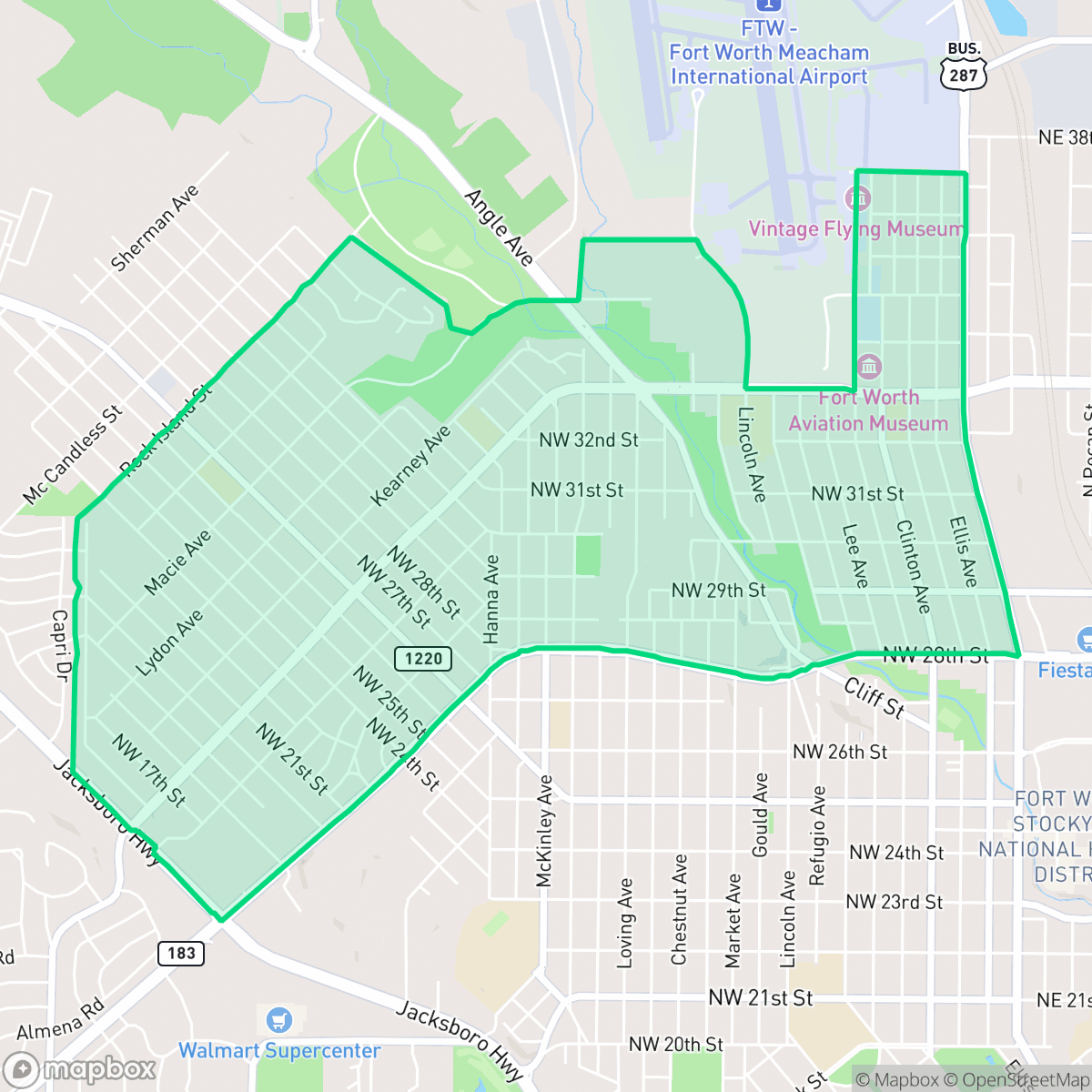
Far Greater Northside is a dense, established community in Fort Worth known for its rich Hispanic heritage and proximity to the historic Stockyards. The neighborhood features a traditional grid layout with modest mid-century homes, though residents should note the limited privacy between properties and notable road traffic noise.
Key Highlights
About Far Greater Northside
The Far Greater Northside neighborhood in Fort Worth, historically encompassing the historic Northside, grew rapidly following the 1902 incorporation of North Fort Worth and the early 20th-century meatpacking boom. Driven by the arrival of Swift & Co. and Armour & Co. near the adjacent Fort Worth Stockyards, the area quickly transformed from empty subdivisions into a bustling community. Its early civic development is anchored by Marine Park, established in 1892 as one of Tarrant County’s first municipal parks. Today, the neighborhood features well-established mid-century homes built primarily between 1940 and 1969. It retains a deeply rooted cultural identity, characterized by a vibrant Hispanic heritage that celebrates its historic connection to Mexican vaqueros and the cowboy culture of the Stockyards.
This area serves as a residential hub defined by its dense suburban grid and proximity to local light industrial zones. Social life is centered around diverse dining options and local community spots that reflect the neighborhood's deep cultural roots. While the street layout provides a consistent, navigable grid, pedestrians will find that sidewalk coverage is inconsistent across various residential blocks. According to iHuus data, the community maintains a balance between quiet residential streets and active commercial corridors, providing residents with essential services within a short distance of their homes.
Prospective residents should weigh the neighborhood's affordability and cultural vibrancy against certain livability trade-offs. The area experiences higher noise levels primarily from road traffic, and the proximity to commercial zones impacts overall air quality. Families should evaluate the local school options carefully, as the neighborhood is served by districts with varying performance levels. The tightly packed housing layout offers limited individual privacy, making this area best suited for those who prioritize community connectivity and proximity to the historic heart of Fort Worth over expansive private outdoor space.
Neighborhood Scores Across 15 Qualities
Residential spacing is relatively consistent with the city average, featuring a mix of closely packed houses and larger vacant lots. According to iHuus data, some areas feature narrow setbacks between neighbors, while other sections offer more substantial buffers.
Low traffic levels make residential streets pleasant for walking, but the lack of consistent sidewalks makes the area less walkable than the Fort Worth average. Pedestrians may frequently need to use road shoulders or dirt verges due to intermittent infrastructure.
Standard tract housing with simple rooflines and small lots defines much of the area. According to iHuus data, the visual variety and landscape amenities are below the Fort Worth average.
Varying levels of access to trails and green belts exist throughout the area, though overall pet-friendly amenities fall below the Fort Worth average. While some sections feature large central green belts and continuous sidewalk verges, other residential sectors lack dedicated public parks or wide walking paths.
Frequent open fields and wooded areas provide a semi-rural feel that is slightly less developed than the Fort Worth average. Residential pockets vary from dense suburban grids to low-density layouts interspersed with large grassy plots and industrial logistics hubs.
Active social hubs and diverse dining options create a more vibrant atmosphere than the Fort Worth average, though much of the area remains quiet and car-dependent. According to iHuus data, the landscape transitions between lively, amenity-rich blocks and more secluded industrial or rural patches.
Continuous sounds from nearby busy streets are present. This level of acoustic activity is consistent with the average found across Fort Worth.
Frequent unhealthy air quality levels pose a significant risk to sensitive groups. According to iHuus data, air quality in this area is notably worse than the Fort Worth average.
Residential life remains largely undisturbed by heavy industry, though some areas near the eastern edge and active airfield experience noise from logistics centers and warehouses. This level of industrial proximity is slightly lower than the Fort Worth average according to iHuus data.
Health insurance coverage is notably lower than the Fort Worth average, indicating a significant portion of the population lacks employer-sponsored or private coverage. According to iHuus data, this lack of coverage may present challenges for residents seeking regular medical care.
Political leanings in this area are notably more liberal than the Fort Worth average, according to iHuus data.
Residents live alongside a diverse blend of young adults, families, and older populations. This age distribution is largely consistent with the broader Fort Worth area, according to iHuus data.
Flood risk in this area is significantly higher than the Fort Worth average. Residents should prepare for elevated insurance costs and potential hazards associated with high-risk flood zones.
Address-Level Insights for Far Greater Northside


iHuus Neighborhood Intelligence Insights
Get address-level neighborhood insights for Far Greater Northside
- Street-level scores — see how individual blocks compare, not just neighborhood averages
- Micro-zone boundaries — identify quiet pockets, flood boundaries, and walkable clusters before you visit
- 15 dimensions in full — walkability, noise, air quality, school quality, insurance coverage, population age profile, urban/rural index, and more
- Boundary risk alerts — know if your address sits near a block boundary where scores drop, the kind of detail no listing will ever mention
- School insights — individual school ratings and insights, not just district-level data
- Compare before you commit — side-by-side data across neighborhoods, down to block precision
No credit card required
Compare with Any Neighborhood
| Dimension | Far Greater Northside | Alamo Heights |
|---|---|---|
| 🚶 Walkabilityavg 7.5 | ||
| 🔊 Acoustic Comfortavg 4.12 | ||
| 🤫 Privacy Indexavg 5.64 | ||
| 🎨 Visual Appealavg 6.38 | ||
| 🐕 Dog Friendlinessavg 6.57 | ||
| 🗺️ Urban-Rural Indexavg 6.92 | ||
| ✨ Neighborhood Vibeavg 4.56 | ||
| 🏥 Health Insurance Coverageavg 5.8 | ||
| 🌿 Air Qualityavg 3.68 | ||
| 🏭 Industrial Proximityavg 8.13 | ||
| 🌊 Flood Safetyavg 3.61 | ||
| 🗳️ Ideological Leanavg 5.62 | ||
| 👥 Population Age Profileavg 4.51 | ||
| 🔥 Fire Safety | ||
| 🏫 School Quality |
Far Greater Northside Rankings
School Districts Serving Far Greater Northside
School Insights for Far Greater Northside
Below average outcomes; significant attendance and academic challenges.
School Insights
See what's really behind every school rating near Far Greater Northside
- Individual school ratings — each school's own score with outcome context, not just a district average
- Enrollment & class size data — student-to-teacher ratio and how it compares to the state average
- Full demographics breakdown — ethnicity and gender composition for every school in the enrollment zone
- Every school in the district — all schools within the enrollment boundary ranked by rating, not just the closest one
- Grade levels & benchmarks — elementary through high school, with below/above state-average flags
No credit card required