Fairmount, Fort Worth
Updated · 4,421 residents
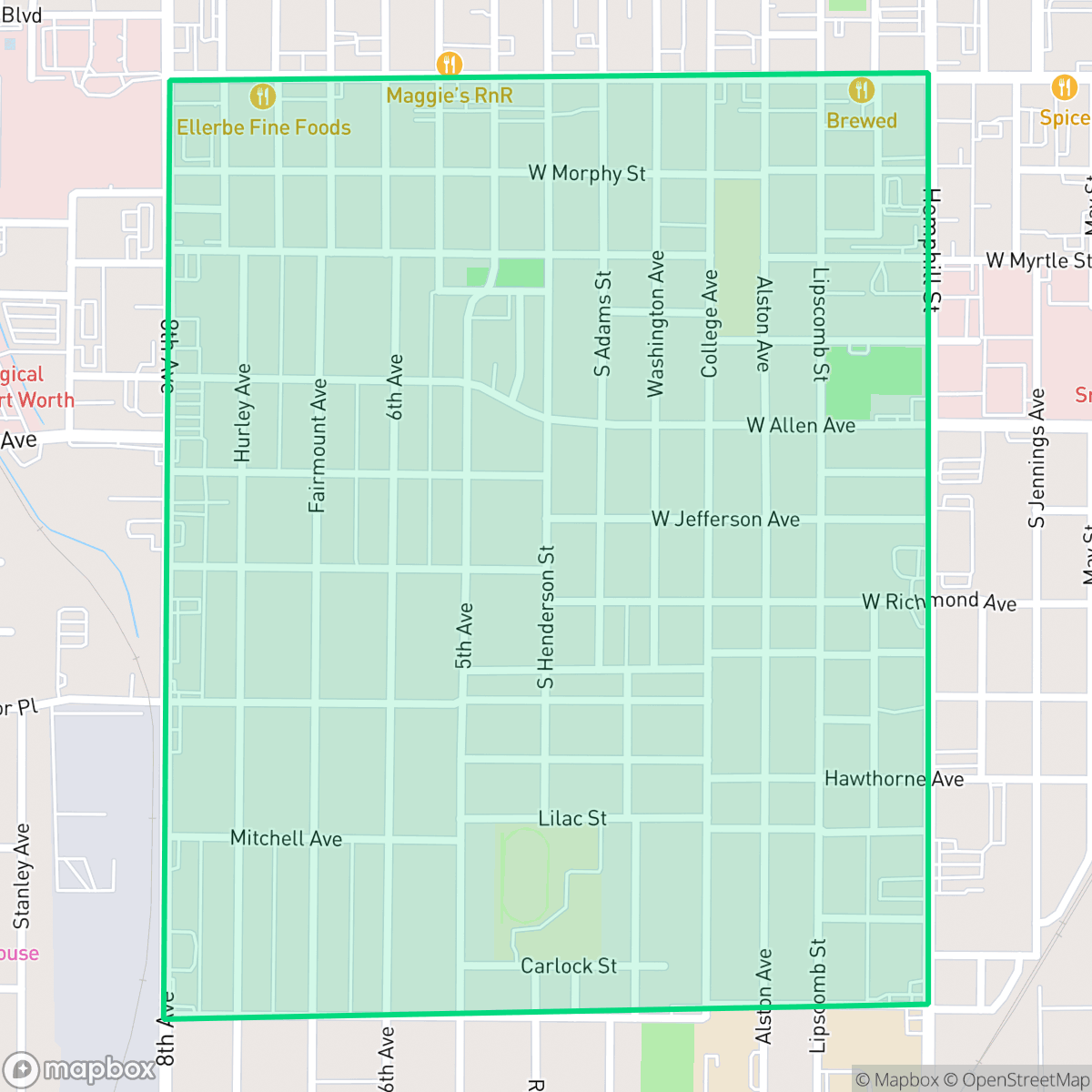
Fairmount is a dense, highly walkable community defined by its historic grid and proximity to the vibrant West Magnolia Avenue corridor. While residents enjoy easy access to local dining and social hubs, the area experiences higher noise levels from road traffic and offers limited privacy due to closely spaced homes.
Key Highlights
About Fairmount
Developed primarily between 1890 and 1938, the Fairmount-Southside Historic District in Fort Worth, Texas, is celebrated as one of the largest historic neighborhoods in the Southwestern United States. Originally established as a middle-class streetcar suburb, the neighborhood retains a remarkably intact collection of early 20th-century residential architecture. Its tree-lined grid streets are dominated by wood-frame Craftsman bungalows, Queen Anne cottages, and American Foursquares. Key historic landmarks include the Meredith Benton House and the South Side Masonic Lodge No. 1114. The neighborhood’s northern boundary runs along West Magnolia Avenue, a historic streetcar route that has transformed into a vibrant, walkable commercial corridor defined by local shops, restaurants, and restored brick storefronts.
The neighborhood functions as a lively urban enclave where residential streets blend into a commercial perimeter. The area maintains a strong sense of community, supported by diverse local dining options and accessible green spaces. Residents benefit from high flood safety and strong health insurance coverage, though the local school district presents a mixed landscape, ranging from high-performing elementary options like De Zavala Elementary to more challenging middle school environments. Prospective residents should note that the neighborhood is characterized by a dense, low-rise urban layout. Acoustic comfort is a notable trade-off, as road traffic contributes to higher noise levels across the grid. The area is well-suited for those who prioritize walkability and proximity to commercial activity over suburban seclusion, as the tight spacing between homes and active daytime traffic create a distinctly urban atmosphere.
Neighborhood Scores Across 15 Qualities
Homes in certain parts of the neighborhood sit closely together on narrow lots, resulting in less personal buffer between neighbors than is typical for Fort Worth. According to iHuus data, the area features a mix of spacing that offers less seclusion than the city average.
Pedestrian travel is efficient due to a dense street grid with sidewalks on both sides of most streets and clearly marked crosswalks. This level of walkability is notably higher than the Fort Worth average, according to iHuus data.
Standard tract housing and uniform rooflines define the streetscapes here; according to iHuus data, visual variety is slightly below the Fort Worth average.
Green verges and small local parks provide some walking opportunities, but overall access to dedicated pet areas is below the Fort Worth average according to iHuus data.
Developed street layouts and a mix of single-family homes and apartments define the area, providing a more urban density than the Fort Worth average according to iHuus data.
A variety of local dining, fitness centers, and social spots create a level of activity that is notably higher than the Fort Worth average. According to iHuus data, the area features concentrated pockets of energy around diverse eateries and community gathering points.
Frequent acoustic disturbances from nearby railroad lines and major freeway traffic characterize this area. According to iHuus data, noise levels in Fairmount are higher than the Fort Worth average.
Air quality fluctuates between acceptable and unhealthy levels, presenting occasional concerns for sensitive groups. According to iHuus data, the atmosphere in Fairmount is slightly better than the Fort Worth average.
Residential streets and green spaces dominate the area with very little heavy industry nearby. While large grain silos and a railway corridor are visible on the eastern edge, the overall lack of industrial activity is slightly better than the Fort Worth average according to iHuus data.
Health insurance accessibility is notably higher than the Fort Worth average, according to iHuus data.
Political leanings in this area are notably more liberal than the Fort Worth average. Residents will find a community with a strong progressive majority and a modest presence of opposing views.
Residents live alongside a balanced mix of young professionals, families, and seniors. This demographic spread is slightly more varied than the typical Fort Worth profile, according to iHuus data.
Flood risk in this area is higher than the Fort Worth average, though official FEMA studies for this specific location remain incomplete. According to iHuus data, the area carries a moderate level of uncertainty regarding potential flood susceptibility.
Address-Level Insights for Fairmount


iHuus Neighborhood Intelligence Insights
Get address-level neighborhood insights for Fairmount
- Street-level scores — see how individual blocks compare, not just neighborhood averages
- Micro-zone boundaries — identify quiet pockets, flood boundaries, and walkable clusters before you visit
- 15 dimensions in full — walkability, noise, air quality, school quality, insurance coverage, population age profile, urban/rural index, and more
- Boundary risk alerts — know if your address sits near a block boundary where scores drop, the kind of detail no listing will ever mention
- School insights — individual school ratings and insights, not just district-level data
- Compare before you commit — side-by-side data across neighborhoods, down to block precision
No credit card required
Compare with Any Neighborhood
| Dimension | Fairmount | Alamo Heights |
|---|---|---|
| 🚶 Walkabilityavg 7.5 | ||
| 🔊 Acoustic Comfortavg 4.12 | ||
| 🤫 Privacy Indexavg 5.64 | ||
| 🎨 Visual Appealavg 6.38 | ||
| 🐕 Dog Friendlinessavg 6.57 | ||
| 🗺️ Urban-Rural Indexavg 6.92 | ||
| ✨ Neighborhood Vibeavg 4.56 | ||
| 🏥 Health Insurance Coverageavg 5.8 | ||
| 🌿 Air Qualityavg 3.68 | ||
| 🏭 Industrial Proximityavg 8.13 | ||
| 🌊 Flood Safetyavg 3.61 | ||
| 🗳️ Ideological Leanavg 5.62 | ||
| 👥 Population Age Profileavg 4.51 | ||
| 🔥 Fire Safety | ||
| 🏫 School Quality |
Fairmount Rankings
School Districts Serving Fairmount
School Insights for Fairmount
Below average outcomes; significant attendance and academic challenges.
School Insights
See what's really behind every school rating near Fairmount
- Individual school ratings — each school's own score with outcome context, not just a district average
- Enrollment & class size data — student-to-teacher ratio and how it compares to the state average
- Full demographics breakdown — ethnicity and gender composition for every school in the enrollment zone
- Every school in the district — all schools within the enrollment boundary ranked by rating, not just the closest one
- Grade levels & benchmarks — elementary through high school, with below/above state-average flags
No credit card required