El Poly Pyramid, Fort Worth
Updated · 415 residents
El Poly Pyramid is a quiet, highly walkable enclave in southeast Fort Worth that offers a unique rural-leaning atmosphere despite its urban location. While the area excels in pet accessibility, residents should be prepared for significant road traffic noise and limited visual aesthetics.
Key Highlights
About El Poly Pyramid
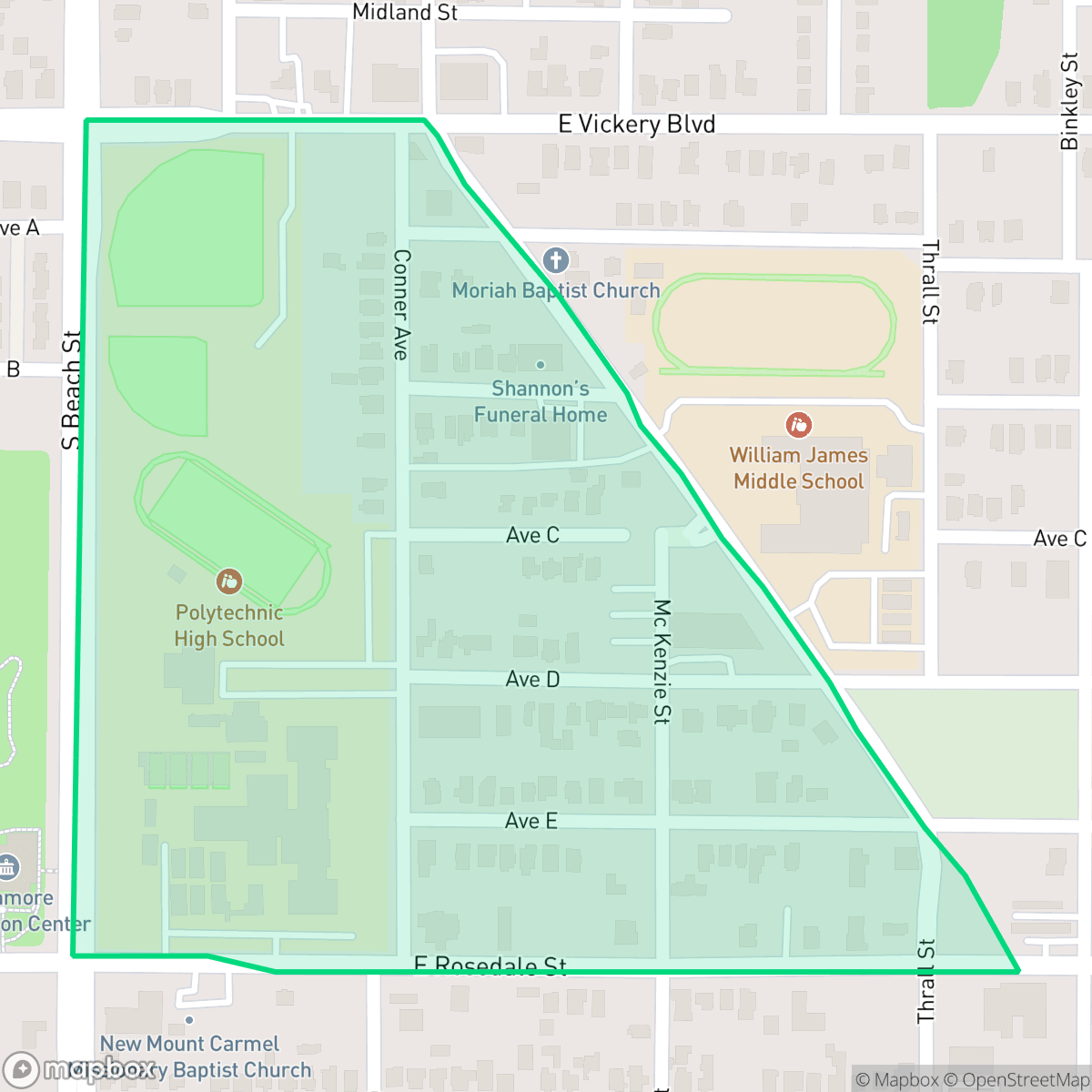
El Poly Pyramid is a historic enclave within the broader Polytechnic Heights neighborhood of southeast Fort Worth, Texas. Originally settled in the 1850s by pioneering families Arch Hall and Roger Tandy, the area grew significantly after land was donated to establish Polytechnic College (now Texas Wesleyan University) in 1890. The neighborhood incorporated as an independent city in 1910 before being annexed by Fort Worth in 1922. Following mid-century demographic shifts and white flight, El Poly Pyramid evolved into a culturally rich, predominantly Hispanic neighborhood. In the early 21st century, local organizer Ramon Romero helped establish the formal "El Poly Pyramid" neighborhood association to advocate for municipal resources. The neighborhood features a mix of mid-century single-family homes and historic brick-paved corridors along East Rosedale Street.
The current character of the neighborhood is defined by its low-density, quiet environment that blends residential life with scattered light industrial units. It stands out for its exceptional walkability, which is among the highest in the region, allowing residents to reach local services and amenities on foot with ease. The area maintains a distinct ideological character and a strong sense of community advocacy, which has helped shape its identity as a close-knit, culturally rich pocket within the broader Polytechnic area.
Prospective residents should consider several trade-offs when evaluating this location. The acoustic environment is dominated by road traffic, resulting in higher-than-average noise levels throughout the day. Additionally, the area faces specific challenges regarding flood safety and air quality, and families should be aware of the ongoing operational shifts within the local school district. It is best suited for individuals who prioritize high walkability and dog-friendly spaces over pristine visual appeal or absolute quiet, and who value the community-driven spirit fostered by local neighborhood associations.
Neighborhood Scores Across 15 Qualities
Housing density is moderate with varying distances between properties, though some areas feature homes situated very close to one another. According to iHuus data, this level of privacy is slightly below the Fort Worth average.
A grid layout with sidewalks on many streets and safe crossings makes much of the area accessible on foot. This level of walkability is slightly above the Fort Worth average according to iHuus data.
Visual interest is limited by small, functional homes and numerous vacant lots. This area lacks the lush greenery and high-end amenities found more frequently throughout Fort Worth.
Abundant wooded green belts and a large adjacent park provide significant space for pet exercise. According to iHuus data, these connected green spaces and wide paths offer a higher level of dog friendliness than the Fort Worth average.
Frequent open land and scattered homes characterize this area, which features a slightly higher degree of semi-rural openness than the Fort Worth average. According to iHuus data, the landscape consists of a mix of dense suburban pockets and larger institutional buildings surrounded by fields or woodland.
Low-density residential streets and light industrial areas provide a subdued atmosphere that is slightly less active than the Fort Worth average. Local amenities and social hubs are accessible via walkable paths, though the area lacks the high-density energy found in more central urban settings.
Steady traffic noise from nearby busy streets is a common feature here. According to iHuus data, acoustic comfort levels are slightly lower than the Fort Worth average.
Air quality levels fluctuate between acceptable and unhealthy, presenting occasional concerns for sensitive groups. According to iHuus data, the atmosphere in this area is slightly better than the Fort Worth average.
Minimal industrial activity defines most of the area, though some residents may encounter noise or dust from nearby warehouses and construction sites. This level of industrial proximity is slightly higher than the Fort Worth average according to iHuus data.
Health insurance access is notably lower than the Fort Worth average. Residents may face higher challenges regarding medical affordability according to iHuus data.
Voting patterns and census indicators show a distinctly liberal political leaning, which is significantly more pronounced here than the Fort Worth average.
Residents live alongside a varied demographic of young adults, families, and older individuals. This population distribution is slightly more concentrated in certain age groups than the Fort Worth average, according to iHuus data.
Significant flood hazards exist in this area, which is substantially higher than the Fort Worth average. Residents should anticipate elevated or potentially prohibitive flood insurance costs according to iHuus data.
Address-Level Insights for El Poly Pyramid


iHuus Neighborhood Intelligence Insights
Get address-level neighborhood insights for El Poly Pyramid
- Street-level scores — see how individual blocks compare, not just neighborhood averages
- Micro-zone boundaries — identify quiet pockets, flood boundaries, and walkable clusters before you visit
- 15 dimensions in full — walkability, noise, air quality, school quality, insurance coverage, population age profile, urban/rural index, and more
- Boundary risk alerts — know if your address sits near a block boundary where scores drop, the kind of detail no listing will ever mention
- School insights — individual school ratings and insights, not just district-level data
- Compare before you commit — side-by-side data across neighborhoods, down to block precision
No credit card required
Compare with Any Neighborhood
| Dimension | El Poly Pyramid | Alamo Heights |
|---|---|---|
| 🚶 Walkabilityavg 7.5 | ||
| 🔊 Acoustic Comfortavg 4.12 | ||
| 🤫 Privacy Indexavg 5.64 | ||
| 🎨 Visual Appealavg 6.38 | ||
| 🐕 Dog Friendlinessavg 6.57 | ||
| 🗺️ Urban-Rural Indexavg 6.92 | ||
| ✨ Neighborhood Vibeavg 4.56 | ||
| 🏥 Health Insurance Coverageavg 5.8 | ||
| 🌿 Air Qualityavg 3.68 | ||
| 🏭 Industrial Proximityavg 8.13 | ||
| 🌊 Flood Safetyavg 3.61 | ||
| 🗳️ Ideological Leanavg 5.62 | ||
| 👥 Population Age Profileavg 4.51 | ||
| 🔥 Fire Safety | ||
| 🏫 School Quality |
El Poly Pyramid Rankings
School Districts Serving El Poly Pyramid
School Insights for El Poly Pyramid
Below average outcomes; significant attendance and academic challenges.
School Insights
See what's really behind every school rating near El Poly Pyramid
- Individual school ratings — each school's own score with outcome context, not just a district average
- Enrollment & class size data — student-to-teacher ratio and how it compares to the state average
- Full demographics breakdown — ethnicity and gender composition for every school in the enrollment zone
- Every school in the district — all schools within the enrollment boundary ranked by rating, not just the closest one
- Grade levels & benchmarks — elementary through high school, with below/above state-average flags
No credit card required