Eastern Hills, Fort Worth
Updated · 2,551 residents
Eastern Hills is a Fort Worth neighborhood defined by its mid-century suburban layout and proximity to major highway infrastructure. While the area offers a calm, residential atmosphere, residents should be prepared for significant road noise and limited walkability.
Key Highlights
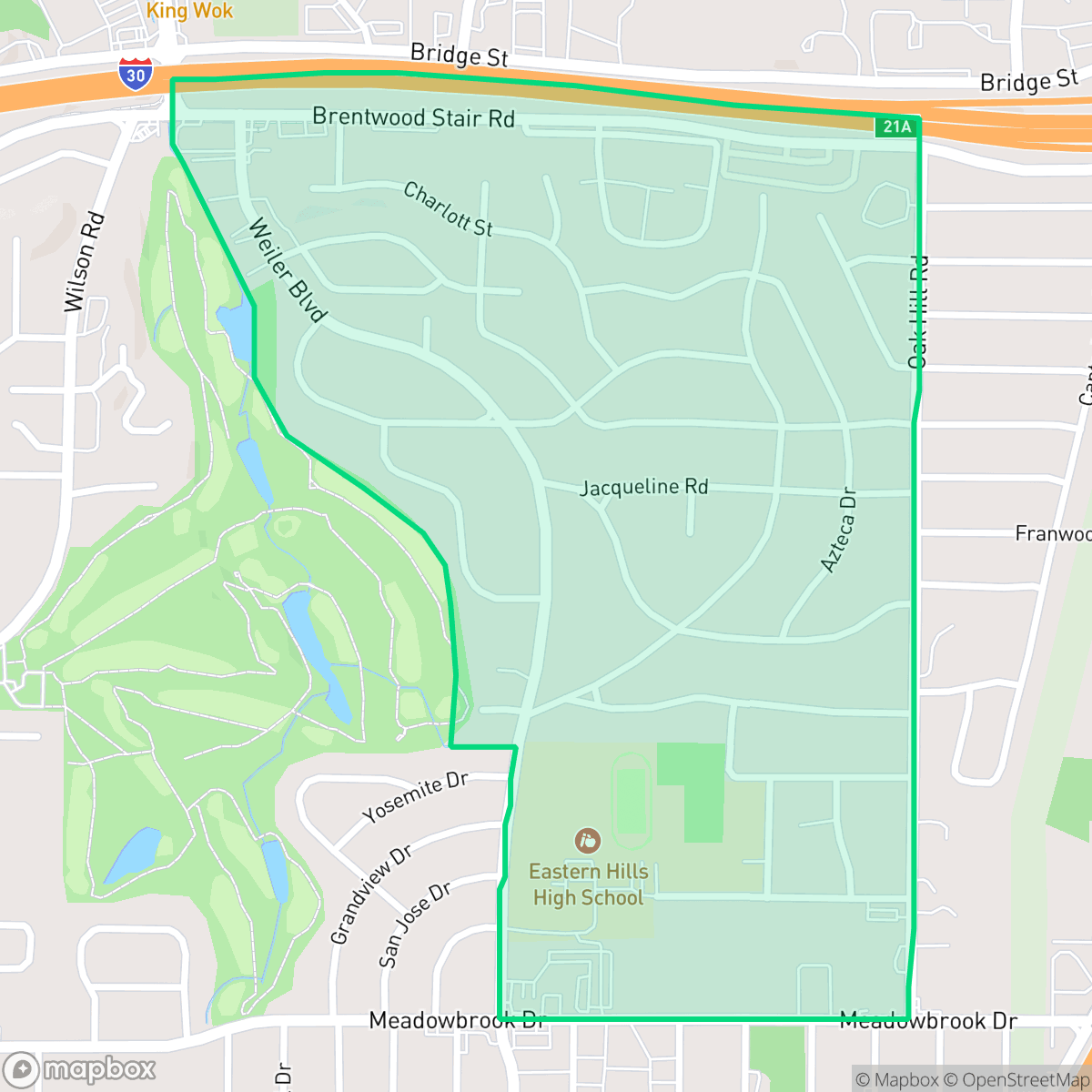
About Eastern Hills
Located on the eastside of Fort Worth, Eastern Hills developed rapidly during the post-World War II boom of the late 1950s. The neighborhood is characterized by spacious, tree-lined lots featuring mid-century modern and ranch-style residences. A notable architectural highlight is a 1967 mid-century modern home overlooking the Meadowbrook Golf Course, designed by prominent local architect Lee Roy Hahnfeld for George and Mary Childs Brandt. To serve the growing population, Eastern Hills Elementary School opened in 1958 with an International-influenced, staggered-level design by Hedrick and Stanley, alongside Eastern Hills High School, which opened in 1957. In 1981, the city established the three-acre Eastern Hills Park adjacent to these schools through a joint development agreement with the school district.
The neighborhood functions as a classic suburban enclave, featuring a mix of single-family homes and apartment complexes. According to iHuus data, the area maintains a steady rhythm of residential life, balancing quiet streets with access to essential civic services. The layout is primarily car-dependent, as the community is bisected by high-traffic highway corridors that impact both the acoustic environment and pedestrian connectivity throughout the area.
Prospective residents should weigh the benefits of a stable, established suburban environment against notable livability trade-offs. The area experiences elevated noise levels due to its proximity to major roads, and air quality metrics reflect these industrial and transit-related pressures. Families should also be aware that the local schools within the Fort Worth Independent School District are currently navigating significant financial and operational challenges, which may influence the overall educational experience for students in the neighborhood.
Neighborhood Scores Across 15 Qualities
Standard suburban spacing and backyard fencing provide a moderate level of separation between neighbors. This level of privacy is slightly higher than the average for Fort Worth.
Sidewalks are available on some residential streets, but pedestrian movement is occasionally hindered by heavy highway traffic and tree cover. According to iHuus data, walkability in this area is below the Fort Worth average.
Residential streets feature standard middle-class housing with uniform yards and occasional shared amenities. According to iHuus data, the visual landscape is slightly more varied than the Fort Worth average.
Abundant green corridors and large public parks offer excellent walking opportunities for pets. This level of accessibility to open space is higher than the Fort Worth average, according to iHuus data.
Open land and scattered homes provide a sense of space that is slightly less dense than the Fort Worth average. Residents can expect a landscape characterized by a mix of woodland, fields, and suburban housing layouts.
Balanced pockets of residential life and social hubs provide a more active atmosphere than the Fort Worth average. While the area features a steady rhythm of local amenities and restaurants, many of these services are best accessed by car.
Frequent disturbances from nearby railroad tracks and heavy freeway traffic characterize this area. According to iHuus data, acoustic comfort is lower than the Fort Worth average.
Frequent unhealthy air quality levels pose significant risks to sensitive groups, as levels are notably worse than the Fort Worth average according to iHuus data.
Industrial presence is minimal within the neighborhood, which is significantly lower than the Fort Worth average. According to iHuus data, the area is composed mainly of residential, educational, and light commercial uses without large warehouses or heavy industrial hazards.
Health insurance access is significantly lower here than the Fort Worth average, according to iHuus data. Residents may face greater challenges accessing employer-sponsored or private medical coverage within the area.
Voting patterns and census indicators show a predominantly liberal leaning, which is notably more liberal than the Fort Worth average according to iHuus data.
Residents live alongside a diverse range of age demographics, including young adults, families, and seniors. According to iHuus data, this age distribution is slightly more varied than the Fort Worth average.
Flood risk in this area is higher than the Fort Worth average, though official assessments remain undetermined due to incomplete federal studies. Residents should exercise caution during heavy rain events as precise flood maps for this specific location are not yet finalized.
Address-Level Insights for Eastern Hills


iHuus Neighborhood Intelligence Insights
Get address-level neighborhood insights for Eastern Hills
- Street-level scores — see how individual blocks compare, not just neighborhood averages
- Micro-zone boundaries — identify quiet pockets, flood boundaries, and walkable clusters before you visit
- 15 dimensions in full — walkability, noise, air quality, school quality, insurance coverage, population age profile, urban/rural index, and more
- Boundary risk alerts — know if your address sits near a block boundary where scores drop, the kind of detail no listing will ever mention
- School insights — individual school ratings and insights, not just district-level data
- Compare before you commit — side-by-side data across neighborhoods, down to block precision
No credit card required
Compare with Any Neighborhood
| Dimension | Eastern Hills | Alamo Heights |
|---|---|---|
| 🚶 Walkabilityavg 7.5 | ||
| 🔊 Acoustic Comfortavg 4.12 | ||
| 🤫 Privacy Indexavg 5.64 | ||
| 🎨 Visual Appealavg 6.38 | ||
| 🐕 Dog Friendlinessavg 6.57 | ||
| 🗺️ Urban-Rural Indexavg 6.92 | ||
| ✨ Neighborhood Vibeavg 4.56 | ||
| 🏥 Health Insurance Coverageavg 5.8 | ||
| 🌿 Air Qualityavg 3.68 | ||
| 🏭 Industrial Proximityavg 8.13 | ||
| 🌊 Flood Safetyavg 3.61 | ||
| 🗳️ Ideological Leanavg 5.62 | ||
| 👥 Population Age Profileavg 4.51 | ||
| 🔥 Fire Safety | ||
| 🏫 School Quality |
Eastern Hills Rankings
School Districts Serving Eastern Hills
School Insights for Eastern Hills
Below average outcomes; significant attendance and academic challenges.
School Insights
See what's really behind every school rating near Eastern Hills
- Individual school ratings — each school's own score with outcome context, not just a district average
- Enrollment & class size data — student-to-teacher ratio and how it compares to the state average
- Full demographics breakdown — ethnicity and gender composition for every school in the enrollment zone
- Every school in the district — all schools within the enrollment boundary ranked by rating, not just the closest one
- Grade levels & benchmarks — elementary through high school, with below/above state-average flags
No credit card required