Downtown Fort Worth, Fort Worth
Updated · 3,233 residents
Downtown Fort Worth is a highly walkable urban district characterized by its density, historic architecture, and vibrant social scene. While it offers convenient access to diverse dining and cultural amenities, the area is notably loud due to proximity to major highways and industrial transit corridors.
Key Highlights
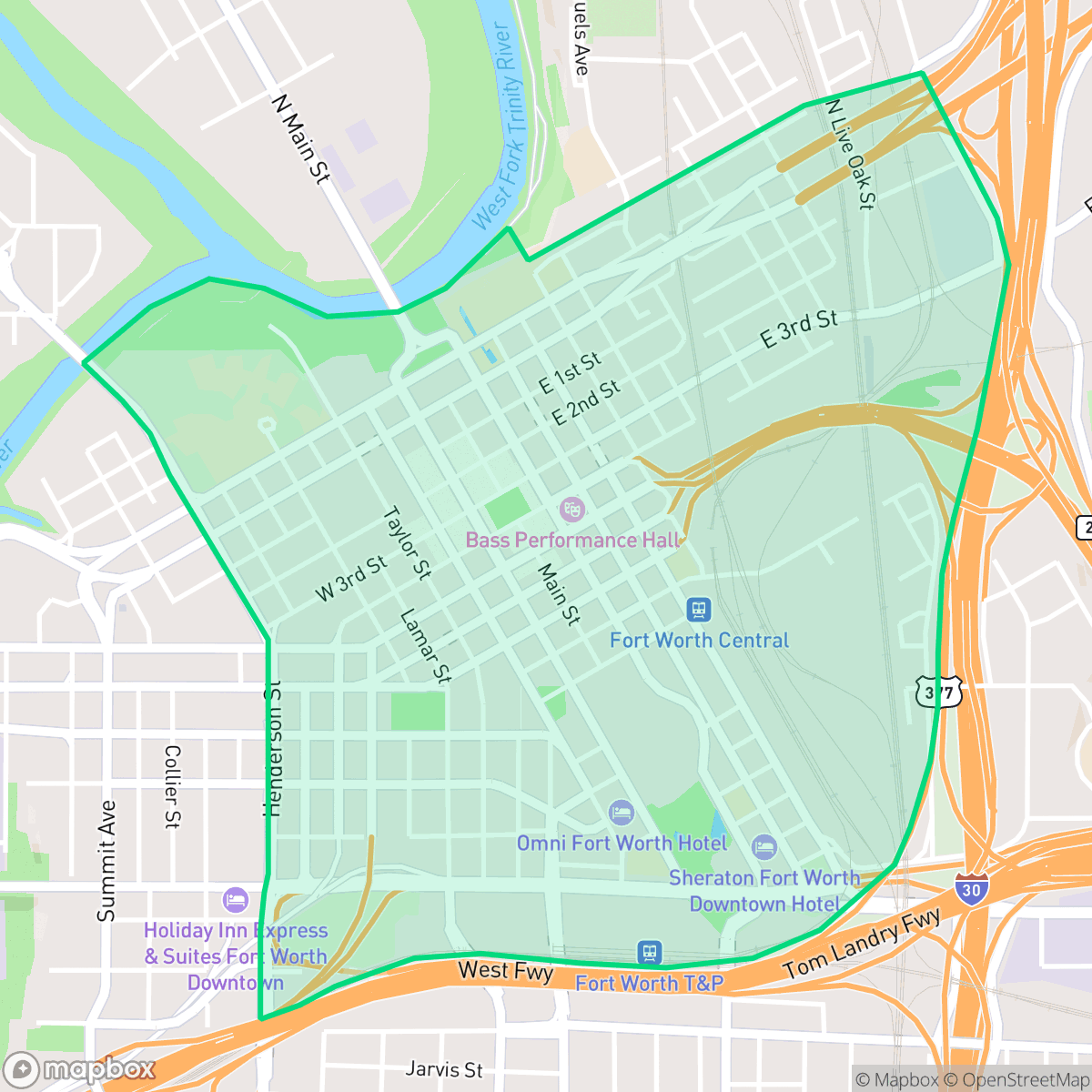
About Downtown Fort Worth
Downtown Fort Worth originated in the 1870s as a vital stop along the Chisholm Trail. Its southern end was dominated by "Hell's Half Acre," a notorious red-light district frequented by outlaws like the Sundance Kid, which later transitioned into a prominent Black business district before being cleared during mid-20th-century urban renewal. The neighborhood boasts a rich architectural legacy, anchored by the pink-granite 1895 Beaux-Arts Tarrant County Courthouse, the 1907 Flatiron Building, and the 1930 Art Deco Sinclair Building. Facing decline in the late 1970s, the area was revitalized when the Bass family spearheaded the development of Sundance Square. Today, this 35-block pedestrian-friendly district seamlessly blends meticulously restored Victorian and early 20th-century brick facades with modern cultural landmarks like the Bass Performance Hall.
The neighborhood functions as the primary commercial and civic hub of the city, featuring a dense landscape of high-rise office buildings, modern residential units, and manicured public spaces. According to iHuus data, the area maintains a high walkability score, allowing residents to navigate between retail destinations, restaurants, and local landmarks with ease. The visual character is defined by a mix of preserved early 20th-century brick structures and contemporary corporate architecture, creating a distinct aesthetic that balances the city's heritage with ongoing urban development. Residents often frequent local establishments like 61 Osteria or the various social hubs surrounding the central parkland.
Living in this district involves specific trade-offs, particularly regarding acoustic comfort and educational infrastructure. The area experiences an average noise level of 64 decibels, driven largely by road traffic and nearby rail activity. While the local school district faces significant operational challenges, including budget deficits and enrollment declines, families may find access to specialized institutions like the Texas Academy of Biomedical Sciences. This neighborhood is best suited for professionals and individuals who prioritize proximity to the urban core and high-energy environments over the quiet, low-density atmosphere of suburban living.
Neighborhood Scores Across 15 Qualities
High visibility and public activity create a lack of seclusion, which is lower than the typical privacy levels found across Fort Worth. While buildings are spaced with some buffers, the highly public nature of the area reduces overall privacy according to iHuus data.
Dense sidewalk networks, pedestrian bridges, and clear crosswalks facilitate easy movement between urban buildings and nearby parks. This level of pedestrian connectivity is notably higher than the Fort Worth average, according to iHuus data.
Modern architecture and high-end landscaping create a visually refined environment that sits slightly above the city average for visual appeal. Large corporate structures and well-maintained civic spaces characterize this affluent district according to iHuus data.
Large public parks with trails and riverbanks provide significant space for pets, making the area's dog friendliness consistent with the city average.
High concentrations of heavy infrastructure, highways, and commercial warehouses create a significantly more urban environment than the Fort Worth average. This area features a dense mix of high-rise buildings and transit infrastructure, according to iHuus data.
High-energy social hubs and a diverse concentration of dining options make this area significantly more active than the Fort Worth average. While much of the landscape is dominated by high-rises and industrial elements, the density of local establishments creates a noticeably lively atmosphere.
Frequent noise from nearby railroad tracks and busy freeways creates a much louder environment than the Fort Worth average. Residents should expect significant acoustic disruptions due to the proximity of major transit corridors.
Air quality levels in this area fluctuate between acceptable and unhealthy, presenting occasional concerns for sensitive groups. According to iHuus data, the air quality is slightly better than the Fort Worth city average.
Low levels of heavy industry define much of the area, though some residents may encounter intermittent noise or truck activity near local breweries and logistics corridors. This concentration of industrial activity is notably lower than the Fort Worth average.
Health insurance accessibility is significantly lower than the Fort Worth average, according to iHuus data. Residents may face higher risks related to medical costs due to the limited proportion of the population with coverage.
Political leanings in this area are balanced between conservative and liberal perspectives; this reflects a slightly more diverse ideological split than the Fort Worth average, according to iHuus data.
Residents live alongside a balanced mix of young professionals, families, and older adults. According to iHuus data, this age distribution is slightly more varied than the typical profile found elsewhere in Fort Worth.
Flood risk in this area is slightly higher than the city average, though a lack of detailed federal studies makes the exact level of danger difficult to determine. Residents should remain cautious as official assessments for this specific zone are currently incomplete according to iHuus data.
Address-Level Insights for Downtown Fort Worth


iHuus Neighborhood Intelligence Insights
Get address-level neighborhood insights for Downtown Fort Worth
- Street-level scores — see how individual blocks compare, not just neighborhood averages
- Micro-zone boundaries — identify quiet pockets, flood boundaries, and walkable clusters before you visit
- 15 dimensions in full — walkability, noise, air quality, school quality, insurance coverage, population age profile, urban/rural index, and more
- Boundary risk alerts — know if your address sits near a block boundary where scores drop, the kind of detail no listing will ever mention
- School insights — individual school ratings and insights, not just district-level data
- Compare before you commit — side-by-side data across neighborhoods, down to block precision
No credit card required
Compare with Any Neighborhood
| Dimension | Downtown Fort Worth | Alamo Heights |
|---|---|---|
| 🚶 Walkabilityavg 7.5 | ||
| 🔊 Acoustic Comfortavg 4.12 | ||
| 🤫 Privacy Indexavg 5.64 | ||
| 🎨 Visual Appealavg 6.38 | ||
| 🐕 Dog Friendlinessavg 6.57 | ||
| 🗺️ Urban-Rural Indexavg 6.92 | ||
| ✨ Neighborhood Vibeavg 4.56 | ||
| 🏥 Health Insurance Coverageavg 5.8 | ||
| 🌿 Air Qualityavg 3.68 | ||
| 🏭 Industrial Proximityavg 8.13 | ||
| 🌊 Flood Safetyavg 3.61 | ||
| 🗳️ Ideological Leanavg 5.62 | ||
| 👥 Population Age Profileavg 4.51 | ||
| 🔥 Fire Safety | ||
| 🏫 School Quality |
Downtown Fort Worth Rankings
School Districts Serving Downtown Fort Worth
School Insights for Downtown Fort Worth
Below average outcomes; significant attendance and academic challenges.
School Insights
See what's really behind every school rating near Downtown Fort Worth
- Individual school ratings — each school's own score with outcome context, not just a district average
- Enrollment & class size data — student-to-teacher ratio and how it compares to the state average
- Full demographics breakdown — ethnicity and gender composition for every school in the enrollment zone
- Every school in the district — all schools within the enrollment boundary ranked by rating, not just the closest one
- Grade levels & benchmarks — elementary through high school, with below/above state-average flags
No credit card required