Diamond Hill - Jarvis, Fort Worth
Updated · 18,093 residents
Diamond Hill - Jarvis is a historic, working-class community in Fort Worth defined by its dense residential grid and proximity to major industrial and logistics infrastructure. While the area offers authentic local dining and a strong cultural identity, residents often navigate challenges related to industrial noise, air quality, and limited privacy due to closely packed housing.
Key Highlights
About Diamond Hill - Jarvis
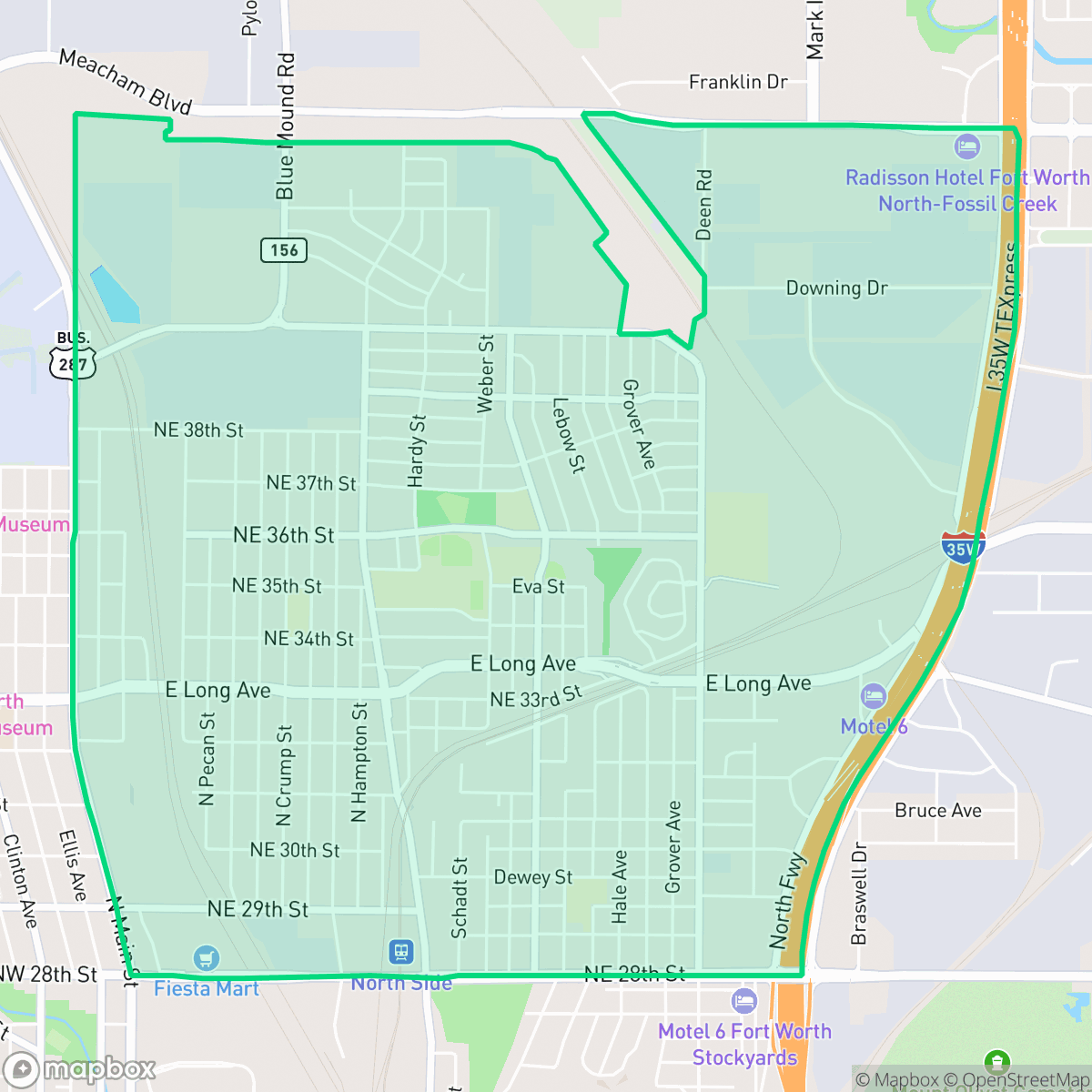
Located in Fort Worth’s historic North Side, the Diamond Hill-Jarvis neighborhood originated from land owned by prominent 19th-century pioneer James Jones Jarvis. The community grew rapidly in the early 1900s, housing workers employed by the nearby Fort Worth Stockyards, railroads, and local oil refineries. Originally established as an independent community with its own school opening in 1904, Diamond Hill was annexed by Fort Worth in 1922 during a period of aggressive municipal expansion. The neighborhood’s educational and cultural anchor, Diamond Hill-Jarvis High School, was established in 1952 as part of a post-war school expansion program. Today, the neighborhood is a vibrant, predominantly Hispanic working-class enclave, centered around local landmarks like the historic Diamond Hill Park and its newly expanded community center.
The neighborhood maintains a distinct character shaped by its industrial heritage and its role as a predominantly Hispanic enclave within Fort Worth. The landscape is a dense mix of suburban residential blocks and heavy logistics infrastructure, including rail yards and large-scale warehouses. Local social life centers on community landmarks and diverse dining spots, such as Gorditas El Rey and Panchitos Taqueria, which contribute to the area's unique local flavor. According to iHuus data, the area functions as a car-dependent environment where the grid street pattern provides some connectivity, though the presence of industrial corridors and freight traffic significantly influences the daily atmosphere.
Living in this area involves navigating specific trade-offs, particularly regarding environmental and acoustic comfort. The proximity to rail lines and logistics hubs results in elevated noise levels and lower air quality scores compared to the city average. Families in the area are served by a mix of schools, including Cesar Chavez Primary, which holds a higher rating, and the neighborhood-anchored Diamond Hill-Jarvis High School. Prospective residents should consider that while the neighborhood offers a cohesive community feel and accessible local amenities, the combination of industrial activity and high-density housing makes it most suitable for those prioritizing proximity to major employment centers over suburban seclusion.
Neighborhood Scores Across 15 Qualities
Residential lots feature a mix of spacing with houses often situated closely together on a consistent grid. This level of density is roughly comparable to the average seen across Fort Worth.
Low traffic volumes on residential streets allow for safe walking, but the lack of continuous sidewalks makes the area less walkable than the Fort Worth average. According to iHuus data, the grid layout provides good connectivity despite some sections transitioning to dirt shoulders or being interrupted by rail lines.
Simple rooflines and small yards characterize this area, which offers less visual variety than the Fort Worth average. Most properties consist of standard tract housing and functional lot layouts without many luxury amenities.
Public walking options for pets are somewhat restricted due to narrow street verges and a lack of sidewalks in many residential blocks. While some areas benefit from proximity to school fields and a central creek corridor, overall accessibility to public dog walking spaces is below the Fort Worth average.
A mix of residential blocks and large-scale logistics warehouses defines the landscape, creating a character similar to the broader Fort Worth area. Residents will find a landscape of suburban grids interspersed with significant rail infrastructure and industrial hubs.
Industrial surroundings and warehouses dominate the landscape, making the area feel more remote and less active than much of Fort Worth. While scattered dining spots and local churches exist, most daily activities require a vehicle due to the lack of a concentrated commercial center.
Local traffic from nearby busy streets creates a consistent level of ambient noise. This acoustic environment is typical for the wider Fort Worth area according to iHuus data.
Frequent unhealthy air quality levels present significant risks to sensitive groups. According to iHuus data, the air quality in this area is notably worse than the Fort Worth average.
Active rail corridors, logistics hubs, and large warehouses are prevalent throughout the area, resulting in higher levels of industrial activity than the Fort Worth average. Residents may experience moderate noise and heavy truck traffic near the eastern and southern edges of the neighborhood.
Health insurance coverage is significantly lower here than the Fort Worth average, which may impact ease of access to medical services. According to iHuus data, a small portion of the resident population is covered by health insurance plans.
Political leanings in this area trend significantly more liberal than the Fort Worth average, according to iHuus data.
Residents will find a varied demographic spread consisting of young adults, families, and seniors. This population distribution is roughly in line with the broader Fort Worth area according to iHuus data.
Significant flood risk exists here as portions of the area sit within a designated floodplain. This level of vulnerability is notably higher than the average for Fort Worth, meaning flood insurance is typically a necessity for residents.
Address-Level Insights for Diamond Hill - Jarvis


iHuus Neighborhood Intelligence Insights
Get address-level neighborhood insights for Diamond Hill - Jarvis
- Street-level scores — see how individual blocks compare, not just neighborhood averages
- Micro-zone boundaries — identify quiet pockets, flood boundaries, and walkable clusters before you visit
- 15 dimensions in full — walkability, noise, air quality, school quality, insurance coverage, population age profile, urban/rural index, and more
- Boundary risk alerts — know if your address sits near a block boundary where scores drop, the kind of detail no listing will ever mention
- School insights — individual school ratings and insights, not just district-level data
- Compare before you commit — side-by-side data across neighborhoods, down to block precision
No credit card required
Compare with Any Neighborhood
| Dimension | Diamond Hill - Jarvis | Alamo Heights |
|---|---|---|
| 🚶 Walkabilityavg 7.5 | ||
| 🔊 Acoustic Comfortavg 4.12 | ||
| 🤫 Privacy Indexavg 5.64 | ||
| 🎨 Visual Appealavg 6.38 | ||
| 🐕 Dog Friendlinessavg 6.57 | ||
| 🗺️ Urban-Rural Indexavg 6.92 | ||
| ✨ Neighborhood Vibeavg 4.56 | ||
| 🏥 Health Insurance Coverageavg 5.8 | ||
| 🌿 Air Qualityavg 3.68 | ||
| 🏭 Industrial Proximityavg 8.13 | ||
| 🌊 Flood Safetyavg 3.61 | ||
| 🗳️ Ideological Leanavg 5.62 | ||
| 👥 Population Age Profileavg 4.51 | ||
| 🔥 Fire Safety | ||
| 🏫 School Quality |
Diamond Hill - Jarvis Rankings
School Districts Serving Diamond Hill - Jarvis
School Insights for Diamond Hill - Jarvis
Below average outcomes; significant attendance and academic challenges.
School Insights
See what's really behind every school rating near Diamond Hill - Jarvis
- Individual school ratings — each school's own score with outcome context, not just a district average
- Enrollment & class size data — student-to-teacher ratio and how it compares to the state average
- Full demographics breakdown — ethnicity and gender composition for every school in the enrollment zone
- Every school in the district — all schools within the enrollment boundary ranked by rating, not just the closest one
- Grade levels & benchmarks — elementary through high school, with below/above state-average flags
No credit card required