Crestwood, Fort Worth
Updated · 965 residents
Crestwood is a quiet, visually appealing residential enclave in northwest Fort Worth, defined by its mature oak trees and direct access to the Trinity Trails. While the area offers exceptional dog-friendliness and a peaceful atmosphere, residents should be aware of moderate road traffic noise and limited walkability to commercial amenities.
Key Highlights
About Crestwood
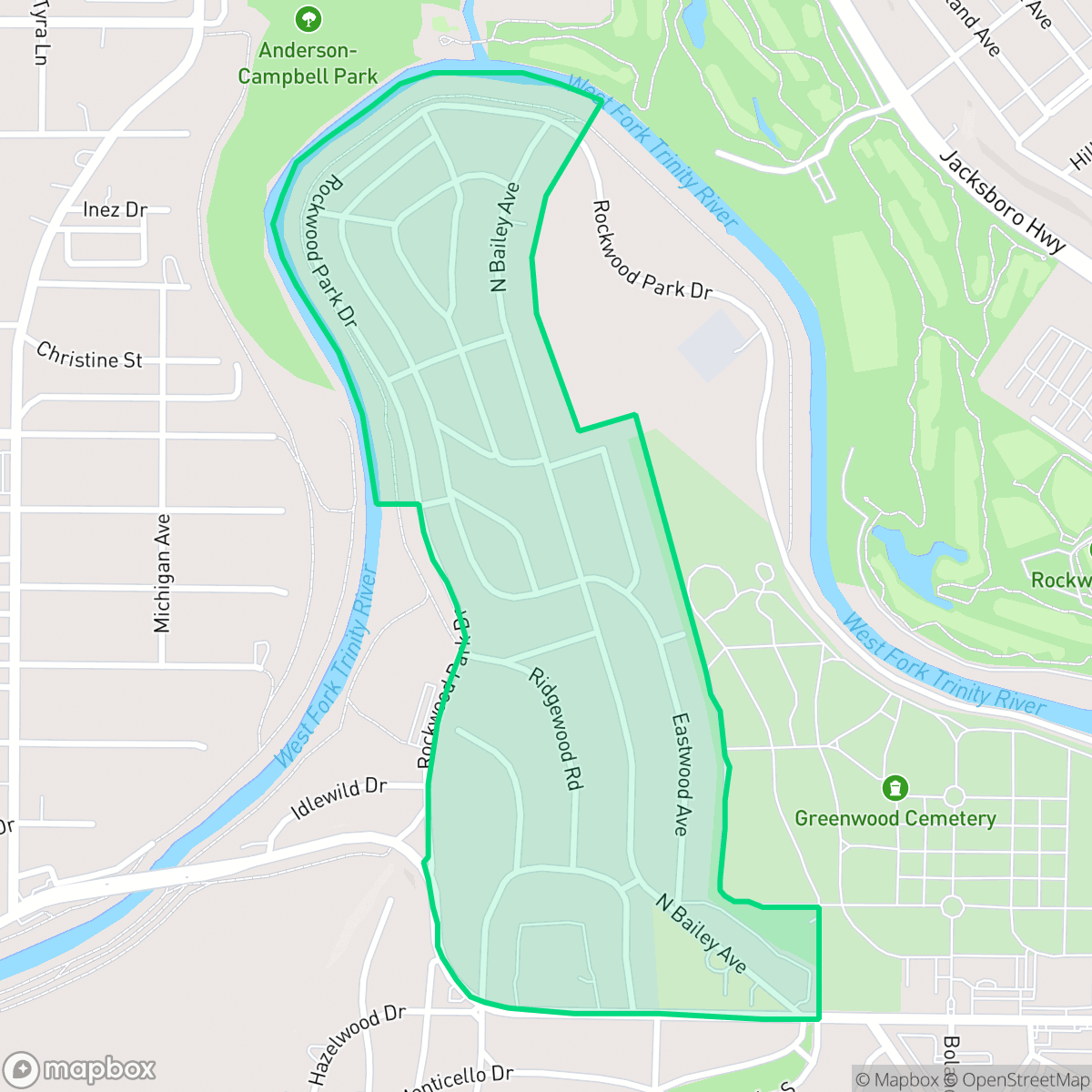
Bounded on three sides by the West Fork of the Trinity River in northwest Fort Worth, Crestwood evolved from 19th-century farm and ranch land into a quiet, secluded residential enclave. In 1930, William Bailey sold acreage to Charles Daggett and Mary Pratt, who later partnered with developers Luther and Loffland Realtors to establish the Crestwood Addition. Initial construction began in the late 1930s and expanded rapidly after World War II to accommodate returning soldiers. A notable architectural landmark is the 1940 Crestwood Place Apartments, a Georgian Revival red-brick complex built with defense housing funds. Today, the neighborhood's character is defined by its mature oak trees, a mixture of mid-century manor-style homes, bungalows, and modern builds, and its direct access to the scenic Trinity Trails.
The neighborhood maintains a distinct, low-density character that prioritizes residential privacy and access to natural landscapes. Its high visual appeal stems from a blend of mid-century manor-style homes and modern construction, all nestled within a landscape of mature trees. Residents benefit from significant proximity to the Trinity River and its associated trail system, which serves as a primary outdoor recreation hub for the community. According to iHuus data, the area is notably free from industrial disruption, contributing to its status as a stable, quiet residential retreat.
Living here requires balancing the benefits of a secluded, dog-friendly environment with the realities of urban proximity. While the area is largely peaceful, it experiences moderate noise levels originating from adjacent road traffic. Those seeking a highly walkable, high-energy urban lifestyle may find the area quiet, as social and commercial options are limited. The neighborhood is well-suited for families and individuals who prioritize outdoor access and a stable residential setting over immediate access to city-center entertainment.
Neighborhood Scores Across 15 Qualities
Residential spacing offers some buffer between neighbors, providing a slightly higher level of privacy than the Fort Worth average. According to iHuus data, the density remains moderate with a mix of varying distances between adjacent properties.
Sidewalks are available on one side of many streets with safe crossings provided for pedestrians. This level of accessibility is slightly below the Fort Worth average.
Tract housing with uniform rooflines and modest yards defines the local landscape. This visual environment is slightly less varied than the Fort Worth average, according to iHuus data.
Extensive parklands, trails, and open spaces provide ample area for pets. This level of accessibility for dogs is significantly higher than the Fort Worth average, according to iHuus data.
Open land and scattered homes among wooded areas characterize this area, which offers a landscape very similar to the Fort Worth average.
Residential streets offer a serene, low-density atmosphere with significant green space and minimal commercial activity. This area is notably calmer and less active than the Fort Worth average, making it a practical choice for those seeking a quiet, car-oriented lifestyle.
Steady sounds from nearby busy streets characterize the area, making the acoustic environment slightly noisier than the Fort Worth average.
Frequent unhealthy air quality levels pose a significant risk to sensitive groups. According to iHuus data, the air quality in Crestwood is lower than the Fort Worth average.
Industrial activity is virtually nonexistent here, providing a cleaner environment than the Fort Worth average. Residents can expect a landscape free from warehouses, factories, or heavy industrial facilities according to iHuus data.
Health insurance access is relatively average for the area, sitting slightly below the Fort Worth city average according to iHuus data.
Political leanings in Crestwood are notably more conservative than the Fort Worth average. According to iHuus data, the area contains a conservative majority with a modest opposing presence.
A balanced mix of young adults, families, and older residents characterizes the area. According to iHuus data, this age distribution is slightly more varied than the average seen across Fort Worth.
Flood risk in this area is slightly higher than the Fort Worth average, though a lack of detailed FEMA studies makes the exact level of danger difficult to determine. According to iHuus data, residents should remain cautious as official studies for this specific area are currently incomplete.
Address-Level Insights for Crestwood


iHuus Neighborhood Intelligence Insights
Get address-level neighborhood insights for Crestwood
- Street-level scores — see how individual blocks compare, not just neighborhood averages
- Micro-zone boundaries — identify quiet pockets, flood boundaries, and walkable clusters before you visit
- 15 dimensions in full — walkability, noise, air quality, school quality, insurance coverage, population age profile, urban/rural index, and more
- Boundary risk alerts — know if your address sits near a block boundary where scores drop, the kind of detail no listing will ever mention
- School insights — individual school ratings and insights, not just district-level data
- Compare before you commit — side-by-side data across neighborhoods, down to block precision
No credit card required
Compare with Any Neighborhood
| Dimension | Crestwood | Alamo Heights |
|---|---|---|
| 🚶 Walkabilityavg 7.5 | ||
| 🔊 Acoustic Comfortavg 4.12 | ||
| 🤫 Privacy Indexavg 5.64 | ||
| 🎨 Visual Appealavg 6.38 | ||
| 🐕 Dog Friendlinessavg 6.57 | ||
| 🗺️ Urban-Rural Indexavg 6.92 | ||
| ✨ Neighborhood Vibeavg 4.56 | ||
| 🏥 Health Insurance Coverageavg 5.8 | ||
| 🌿 Air Qualityavg 3.68 | ||
| 🏭 Industrial Proximityavg 8.13 | ||
| 🌊 Flood Safetyavg 3.61 | ||
| 🗳️ Ideological Leanavg 5.62 | ||
| 👥 Population Age Profileavg 4.51 | ||
| 🔥 Fire Safety | ||
| 🏫 School Quality |
Crestwood Rankings
School Districts Serving Crestwood
School Insights for Crestwood
Below average outcomes; significant attendance and academic challenges.
School Insights
See what's really behind every school rating near Crestwood
- Individual school ratings — each school's own score with outcome context, not just a district average
- Enrollment & class size data — student-to-teacher ratio and how it compares to the state average
- Full demographics breakdown — ethnicity and gender composition for every school in the enrollment zone
- Every school in the district — all schools within the enrollment boundary ranked by rating, not just the closest one
- Grade levels & benchmarks — elementary through high school, with below/above state-average flags
No credit card required