Crestline Area, Fort Worth
Updated · 2,281 residents
The Crestline Area is a historic residential enclave defined by its mature canopy and proximity to the Trinity River. It is exceptionally walkable with high visual appeal, though residents should expect notable noise levels from nearby road traffic.
Key Highlights
About Crestline Area
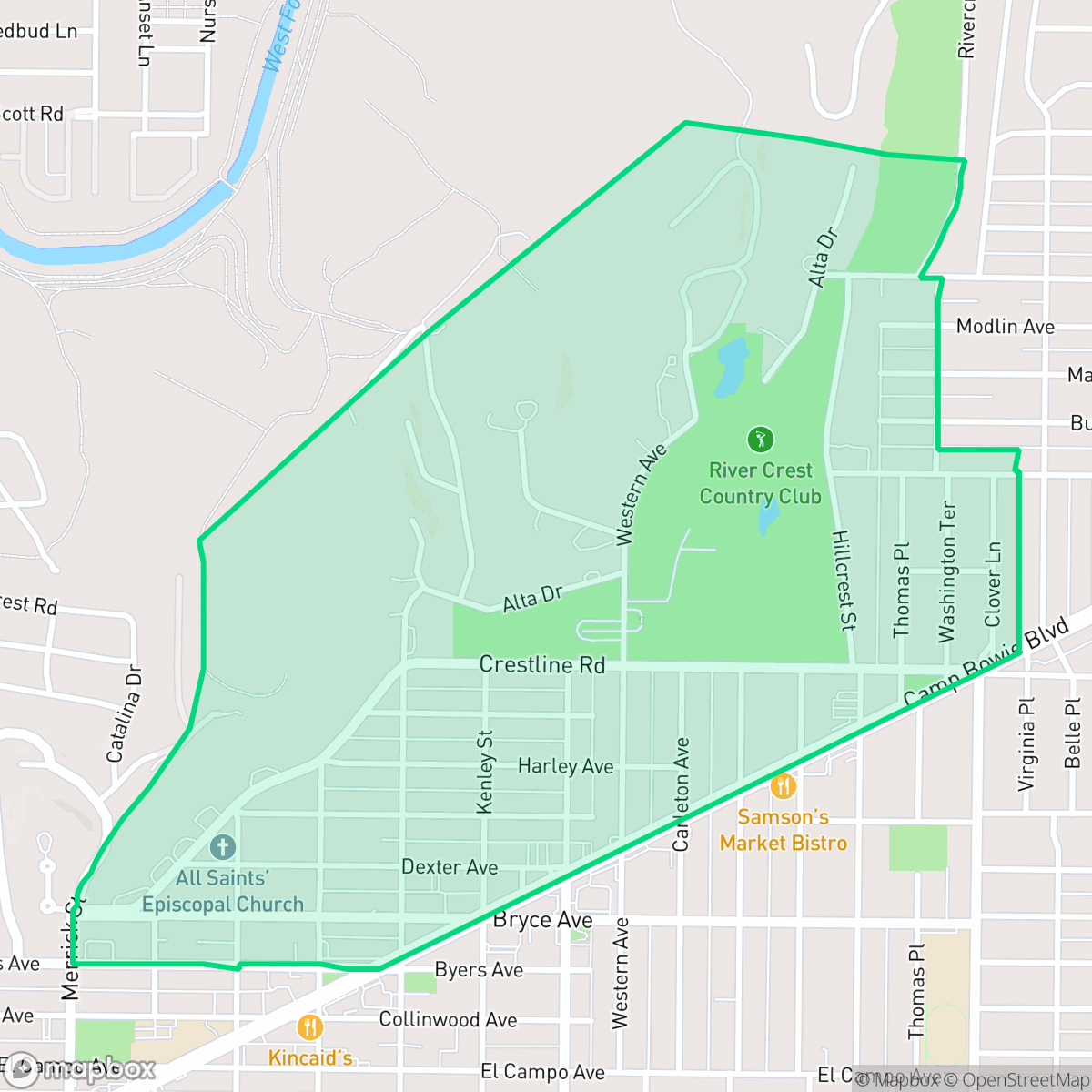
Located atop the scenic bluffs overlooking the Trinity River, Fort Worth’s Crestline Area developed in the early 20th century as an exclusive, fashionable subdivision. Anchored to the north by the historic River Crest Country Club (founded in 1911), the neighborhood features its signature boulevard, Crestline Road, which is lined with mature oaks and grand estates. The area's architectural stock showcases Tudor, Mediterranean, and Colonial Revival styles built primarily in the 1920s and 1930s. Notable local landmarks include the 1906 Smith-Burnett Home—historically tied to banker Ben O. Smith and cattle baron Tom Burnett—and the 1909 Henry M. Williams Home. Additionally, the historic circa-1850s Khleber Miller Van Zandt homestead was historically associated with a massive farmstead along Crestline Road. Today, the neighborhood's distinct historic character is preserved by an active neighborhood association.
The neighborhood serves as a quiet, architecturally significant residential pocket in Fort Worth. Beyond its historic estates, the area offers a high degree of walkability, allowing residents easy access to local amenities like Blue Bonnet Bakery and Kincaid's Hamburgers. According to iHuus data, the area maintains a strong sense of community and aesthetic charm, supported by active preservation efforts and well-maintained green spaces.
Prospective residents should weigh the aesthetic and social benefits against specific environmental factors. The area experiences significant road noise, which may impact acoustic comfort for those sensitive to sound. While the neighborhood boasts high health insurance coverage and a stable population profile, families should carefully consider the current state of the Fort Worth Independent School District, which faces ongoing financial and operational challenges. It is best suited for those who prioritize architectural character and walkability over absolute quiet.
Neighborhood Scores Across 15 Qualities
Residential spacing provides a modest amount of separation between neighbors, offering slightly more privacy than the average Fort Worth area. According to iHuus data, the neighborhood features a mix of building densities that allow for some buffering between adjacent properties.
Pedestrian infrastructure is robust, featuring wide sidewalks on both sides of the street and frequent crossings. According to iHuus data, this area offers significantly better accessibility for walkers than the Fort Worth average.
Large residential properties and frequent high-end amenities characterize the area. According to iHuus data, the visual quality of the surroundings is significantly higher than the Fort Worth average.
Connected green spaces and wide, traffic-safe paths make this area significantly more dog friendly than the Fort Worth average, according to iHuus data.
Frequent open land and scattered homes amidst woodland characterize this area, mirroring the typical urban-rural balance found across Fort Worth.
Local eateries and community landmarks provide a noticeable social presence that is more active than the Fort Worth average. While many social spots are present, the neighborhood layout remains largely car-dependent.
Persistent noise from nearby rail lines and major freeways defines the acoustic environment here. This level of disturbance is notably higher than the Fort Worth average, according to iHuus data.
Air quality in this area fluctuates between acceptable and unhealthy levels, presenting occasional concerns for sensitive groups. According to iHuus data, the air quality is slightly lower than the Fort Worth average.
No warehouses, industrial facilities, or hazard sites are present within this area. According to iHuus data, this lack of industrial proximity is significantly better than the Fort Worth average.
Health insurance accessibility is significantly higher than the Fort Worth average, according to iHuus data. Residents in this area benefit from much more widespread coverage compared to the rest of the city.
Conservative values represent the clear majority of the local population, showing a much more conservative lean than the Fort Worth average according to iHuus data.
Residents will find a diverse demographic spread consisting of young adults, families, and seniors. This demographic variety is more balanced than the typical age distribution found across Fort Worth, according to iHuus data.
Flood risk in this area is notably higher than the Fort Worth average, though the specific level of danger remains undetermined due to incomplete federal studies. Residents should remain cautious as official assessments for this portion of Crestline are currently unavailable.
Address-Level Insights for Crestline Area


iHuus Neighborhood Intelligence Insights
Get address-level neighborhood insights for Crestline Area
- Street-level scores — see how individual blocks compare, not just neighborhood averages
- Micro-zone boundaries — identify quiet pockets, flood boundaries, and walkable clusters before you visit
- 15 dimensions in full — walkability, noise, air quality, school quality, insurance coverage, population age profile, urban/rural index, and more
- Boundary risk alerts — know if your address sits near a block boundary where scores drop, the kind of detail no listing will ever mention
- School insights — individual school ratings and insights, not just district-level data
- Compare before you commit — side-by-side data across neighborhoods, down to block precision
No credit card required
Compare with Any Neighborhood
| Dimension | Crestline Area | Alamo Heights |
|---|---|---|
| 🚶 Walkabilityavg 7.5 | ||
| 🔊 Acoustic Comfortavg 4.12 | ||
| 🤫 Privacy Indexavg 5.64 | ||
| 🎨 Visual Appealavg 6.38 | ||
| 🐕 Dog Friendlinessavg 6.57 | ||
| 🗺️ Urban-Rural Indexavg 6.92 | ||
| ✨ Neighborhood Vibeavg 4.56 | ||
| 🏥 Health Insurance Coverageavg 5.8 | ||
| 🌿 Air Qualityavg 3.68 | ||
| 🏭 Industrial Proximityavg 8.13 | ||
| 🌊 Flood Safetyavg 3.61 | ||
| 🗳️ Ideological Leanavg 5.62 | ||
| 👥 Population Age Profileavg 4.51 | ||
| 🔥 Fire Safety | ||
| 🏫 School Quality |
Crestline Area Rankings
School Districts Serving Crestline Area
School Insights for Crestline Area
Below average outcomes; significant attendance and academic challenges.
School Insights
See what's really behind every school rating near Crestline Area
- Individual school ratings — each school's own score with outcome context, not just a district average
- Enrollment & class size data — student-to-teacher ratio and how it compares to the state average
- Full demographics breakdown — ethnicity and gender composition for every school in the enrollment zone
- Every school in the district — all schools within the enrollment boundary ranked by rating, not just the closest one
- Grade levels & benchmarks — elementary through high school, with below/above state-average flags
No credit card required