Coventry Hills, Fort Worth
Updated · 1,157 residents
Coventry Hills is a dense, upscale suburban neighborhood in Fort Worth characterized by large, architecturally detailed homes and a strong sense of community. The area offers high walkability and excellent access to local amenities, though residents should expect moderate noise levels from nearby road traffic.
Key Highlights
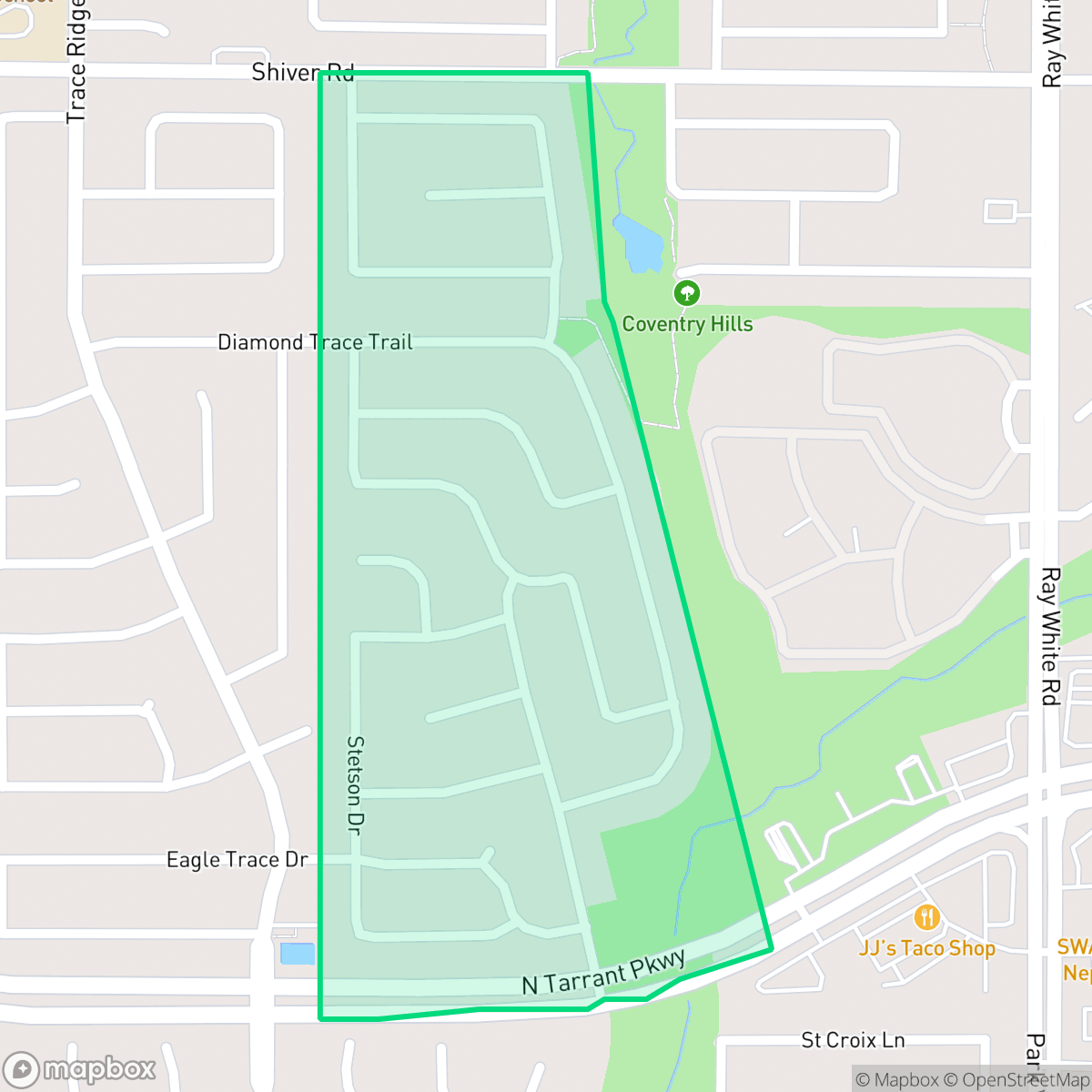
About Coventry Hills
Coventry Hills features a well-developed suburban landscape defined by its visual appeal, featuring complex home rooflines and private backyard pools that reflect the area's affluent character. The neighborhood is highly walkable, with continuous sidewalks connecting residential streets to a variety of local dining options, including seafood, pizza, and international cuisine. A central green belt provides residents with dedicated space for outdoor activities, making the area particularly attractive for dog owners and those who value an active, pedestrian-friendly environment.
While the neighborhood offers significant benefits, including top-tier health insurance coverage and a lack of industrial hazards, there are notable trade-offs to consider. The residential density results in closely packed homes with limited private yard space, and the area experiences higher than average noise levels due to road traffic. The community is served by the Keller Independent School District, which provides strong academic programs despite ongoing fiscal and administrative challenges. It is best suited for families and professionals who prioritize neighborhood aesthetics and convenience over absolute acoustic privacy.
Neighborhood Scores Across 15 Qualities
Residential spacing is typical for the area, featuring closely packed homes with small private yards and some denser apartment clusters. According to iHuus data, this level of density is roughly in line with the Fort Worth average.
Continuous sidewalks and a dedicated greenbelt trail provide excellent pedestrian access throughout the community. According to iHuus data, the connectivity and safety of the street network are significantly higher than the Fort Worth average.
Manicured lawns, large homes with complex rooflines, and frequent private backyard pools create a highly polished landscape. This level of visual appeal is notably higher than the Fort Worth average, according to iHuus data.
Extensive greenbelts and winding trail systems provide ample space for walking dogs away from main roads. According to iHuus data, the availability of connected park spaces and wide grass verges makes this area significantly more dog friendly than the Fort Worth average.
Primarily composed of dense suburban development, this area features single-family homes and retail centers that feel slightly more urban than the Fort Worth average. According to iHuus data, the landscape is defined by established residential tracts and community hubs rather than open fields or woodland.
Residential streets and green spaces provide a steady but low-key atmosphere, featuring a slightly more active mix of dining and services than the Fort Worth average. While local eateries like Sushi Nomi and Krab Kingz are available, most commercial amenities require a short drive.
Local traffic from nearby busy streets creates a persistent level of noise that is slightly higher than the Fort Worth average, according to iHuus data.
Frequent unhealthy air quality levels pose significant risks to sensitive groups. According to iHuus data, conditions in this area are notably worse than the Fort Worth average.
Industrial activity and heavy warehouses are absent from this area, providing a cleaner environment than much of Fort Worth. According to iHuus data, the neighborhood consists of residential streets and light retail without the presence of industrial hazards.
Health insurance access is significantly higher than the Fort Worth average. Residents in this area benefit from much more widespread coverage compared to the rest of the city, according to iHuus data.
Political demographics in this area lean significantly conservative compared to the Fort Worth average. According to iHuus data, the neighborhood maintains a conservative majority with a modest opposing presence.
A balanced demographic of young adults, families, and older residents characterizes this area, aligning closely with the Fort Worth average. According to iHuus data, the population lacks a heavy concentration of any single age bracket.
Residual flood risk exists within certain parts of the area due to its location in a 500-year floodplain. According to iHuus data, the safety level in Coventry Hills is notably higher than the Fort Worth city average.
Address-Level Insights for Coventry Hills


iHuus Neighborhood Intelligence Insights
Get address-level neighborhood insights for Coventry Hills
- Street-level scores — see how individual blocks compare, not just neighborhood averages
- Micro-zone boundaries — identify quiet pockets, flood boundaries, and walkable clusters before you visit
- 15 dimensions in full — walkability, noise, air quality, school quality, insurance coverage, population age profile, urban/rural index, and more
- Boundary risk alerts — know if your address sits near a block boundary where scores drop, the kind of detail no listing will ever mention
- School insights — individual school ratings and insights, not just district-level data
- Compare before you commit — side-by-side data across neighborhoods, down to block precision
No credit card required
Compare with Any Neighborhood
| Dimension | Coventry Hills | Alamo Heights |
|---|---|---|
| 🚶 Walkabilityavg 7.5 | ||
| 🔊 Acoustic Comfortavg 4.12 | ||
| 🤫 Privacy Indexavg 5.64 | ||
| 🎨 Visual Appealavg 6.38 | ||
| 🐕 Dog Friendlinessavg 6.57 | ||
| 🗺️ Urban-Rural Indexavg 6.92 | ||
| ✨ Neighborhood Vibeavg 4.56 | ||
| 🏥 Health Insurance Coverageavg 5.8 | ||
| 🌿 Air Qualityavg 3.68 | ||
| 🏭 Industrial Proximityavg 8.13 | ||
| 🌊 Flood Safetyavg 3.61 | ||
| 🗳️ Ideological Leanavg 5.62 | ||
| 👥 Population Age Profileavg 4.51 | ||
| 🔥 Fire Safety | ||
| 🏫 School Quality |
Coventry Hills Rankings
School Districts Serving Coventry Hills
School Insights for Coventry Hills
Below average outcomes; significant attendance and academic challenges.
School Insights
See what's really behind every school rating near Coventry Hills
- Individual school ratings — each school's own score with outcome context, not just a district average
- Enrollment & class size data — student-to-teacher ratio and how it compares to the state average
- Full demographics breakdown — ethnicity and gender composition for every school in the enrollment zone
- Every school in the district — all schools within the enrollment boundary ranked by rating, not just the closest one
- Grade levels & benchmarks — elementary through high school, with below/above state-average flags
No credit card required