Cookes Meadow, Fort Worth
Updated · 1,582 residents
Cookes Meadow is a quiet, low-density residential enclave defined by its mature tree canopy and traditional brick ranch-style homes. Residents enjoy a highly walkable environment with continuous sidewalk networks and a complete absence of industrial activity, making it a peaceful suburban choice.
Key Highlights
About Cookes Meadow
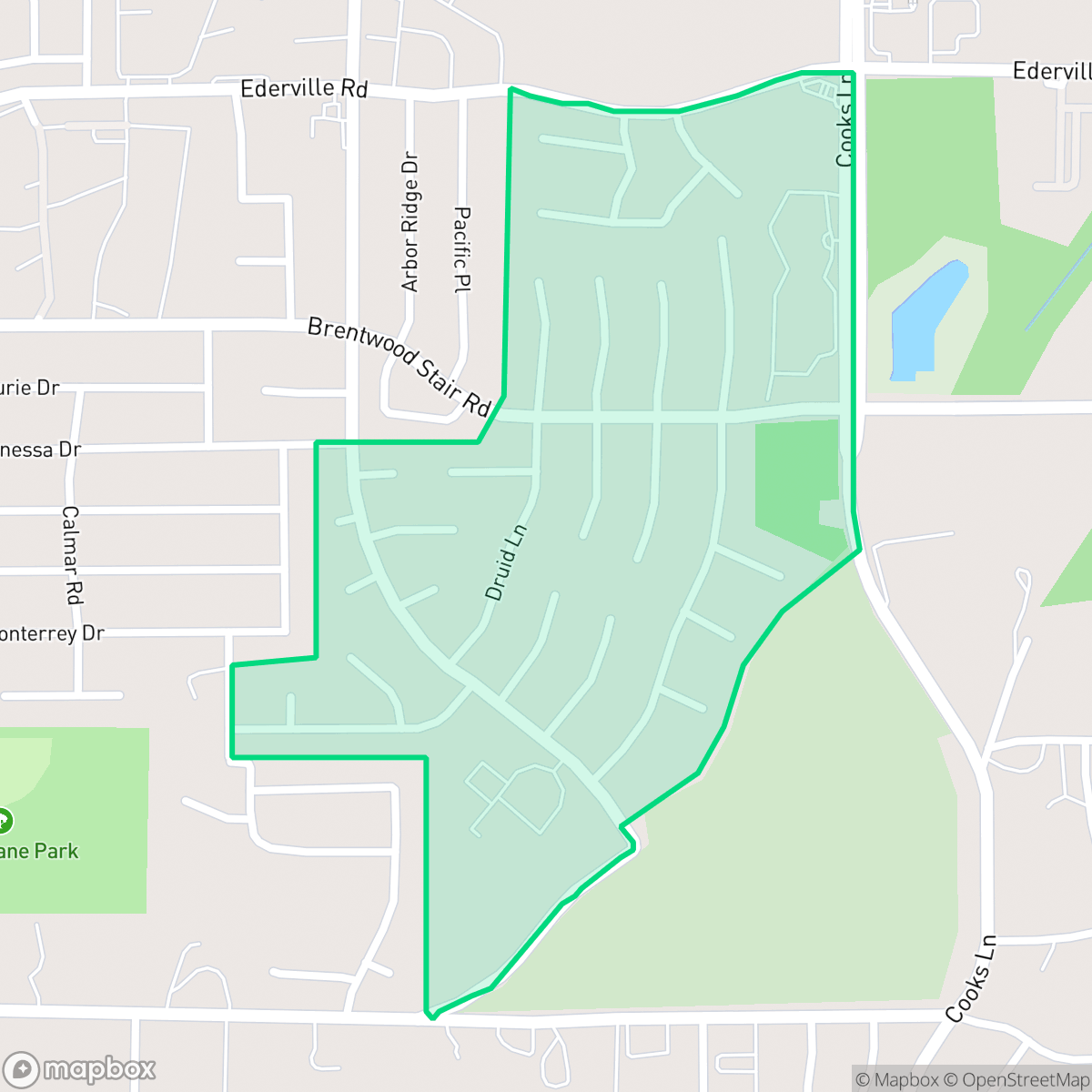
Located eight and a half miles east of downtown Fort Worth, the Cookes Meadow neighborhood lies within the historic 1873 C.P. Madden and 1878 Enoch S. Johnson surveys. The neighborhood and its eastern boundary, Cooke’s Lane, are named after Jacob Cooke, who operated a late-1870s campground and trading post for travelers arriving from Johnson’s Station (now Arlington). Originally rural land, the area began its modern transformation in 1974 when the Cooke’s Meadow Development Company purchased the acreage for residential subdivision. Today, the neighborhood is characterized by its mature tree canopy and a housing stock dominated by traditional, low-pitched brick ranch-style homes, interspersed with occasional Tudor and contemporary designs.
The area offers a distinct visual appeal characterized by spacious lots, multi-car driveways, and private backyard pools. According to iHuus data, the neighborhood maintains a strong residential focus with minimal commercial intrusion, preserving a calm atmosphere that is well-suited for those seeking privacy. The layout favors pedestrian activity, as low-traffic cul-de-sacs and connected sidewalks create a safe environment for residents to walk throughout the community.
While the neighborhood provides a serene living experience, prospective residents should consider the broader context of the Fort Worth Independent School District. The district currently faces significant financial and operational challenges that may impact long-term educational stability. Additionally, while the area is quiet, residents may experience moderate noise from local road traffic. Those prioritizing a stable and aesthetically consistent suburban environment will find the area attractive, provided they are comfortable navigating the current landscape of the local school system.
Neighborhood Scores Across 15 Qualities
Homes in this area feature moderate spacing with decent yards, providing slightly more separation between neighbors than the Fort Worth average according to iHuus data.
Pedestrian access is easy due to continuous sidewalk networks and safe crossings, making this area slightly more walkable than the Fort Worth average. Many residential streets feature low-traffic cul-de-sacs that are well-suited for walking.
Large home footprints, private pools, and expansive driveways contribute to a landscape that is more visually polished than the Fort Worth average. According to iHuus data, the area features frequent upscale amenities and significant greenery.
Large adjacent wooded areas and consistent sidewalk verges provide reliable spaces for pet walking. According to iHuus data, the neighborhood offers higher levels of connectivity to green spaces and safer walking paths than the Fort Worth average.
Expansive open land and a significant tree canopy provide a more rural atmosphere than the typical Fort Worth suburb. According to iHuus data, the area features low-density residential layouts with scattered homes situated among fields and woodland.
Low commercial density and vast open spaces create a tranquil, low-activity environment. This level of activity is roughly in line with the average for Fort Worth.
A steady hum of local traffic from a nearby busy street characterizes the area. According to iHuus data, acoustic levels in Cookes Meadow are notably higher than the Fort Worth city average.
Frequent unhealthy air quality levels pose significant risks to sensitive groups. According to iHuus data, the air quality in Cookes Meadow is notably worse than the Fort Worth average.
Industrial presence is nonexistent in this area, consisting solely of residential and light commercial zones. This lack of warehouses or hazard sites is significantly better than the Fort Worth average, according to iHuus data.
Health insurance access is widespread among residents, appearing significantly higher than the Fort Worth average according to iHuus data.
Voting patterns and census indicators show a significantly more liberal political leaning than the Fort Worth average, according to iHuus data.
Residents live alongside a balanced mix of young adults, families, and older populations. This demographic distribution aligns closely with the average profile seen across Fort Worth.
Residual flood risk exists within this area due to its location in a 500-year floodplain; however, safety levels remain notably higher than the Fort Worth city average, according to iHuus data.
Address-Level Insights for Cookes Meadow


iHuus Neighborhood Intelligence Insights
Get address-level neighborhood insights for Cookes Meadow
- Street-level scores — see how individual blocks compare, not just neighborhood averages
- Micro-zone boundaries — identify quiet pockets, flood boundaries, and walkable clusters before you visit
- 15 dimensions in full — walkability, noise, air quality, school quality, insurance coverage, population age profile, urban/rural index, and more
- Boundary risk alerts — know if your address sits near a block boundary where scores drop, the kind of detail no listing will ever mention
- School insights — individual school ratings and insights, not just district-level data
- Compare before you commit — side-by-side data across neighborhoods, down to block precision
No credit card required
Compare with Any Neighborhood
| Dimension | Cookes Meadow | Alamo Heights |
|---|---|---|
| 🚶 Walkabilityavg 7.5 | ||
| 🔊 Acoustic Comfortavg 4.12 | ||
| 🤫 Privacy Indexavg 5.64 | ||
| 🎨 Visual Appealavg 6.38 | ||
| 🐕 Dog Friendlinessavg 6.57 | ||
| 🗺️ Urban-Rural Indexavg 6.92 | ||
| ✨ Neighborhood Vibeavg 4.56 | ||
| 🏥 Health Insurance Coverageavg 5.8 | ||
| 🌿 Air Qualityavg 3.68 | ||
| 🏭 Industrial Proximityavg 8.13 | ||
| 🌊 Flood Safetyavg 3.61 | ||
| 🗳️ Ideological Leanavg 5.62 | ||
| 👥 Population Age Profileavg 4.51 | ||
| 🔥 Fire Safety | ||
| 🏫 School Quality |
Cookes Meadow Rankings
School Districts Serving Cookes Meadow
School Insights for Cookes Meadow
Below average outcomes; significant attendance and academic challenges.
School Insights
See what's really behind every school rating near Cookes Meadow
- Individual school ratings — each school's own score with outcome context, not just a district average
- Enrollment & class size data — student-to-teacher ratio and how it compares to the state average
- Full demographics breakdown — ethnicity and gender composition for every school in the enrollment zone
- Every school in the district — all schools within the enrollment boundary ranked by rating, not just the closest one
- Grade levels & benchmarks — elementary through high school, with below/above state-average flags
No credit card required