Como, Fort Worth
Updated · 5,322 residents
Como is a historic, tight-knit community on the west side of Fort Worth characterized by a dense residential grid and accessible local dining. While the area offers a walkable environment with frequent green spaces, residents should be aware of elevated noise levels from nearby road traffic and the presence of light industrial infrastructure.
Key Highlights
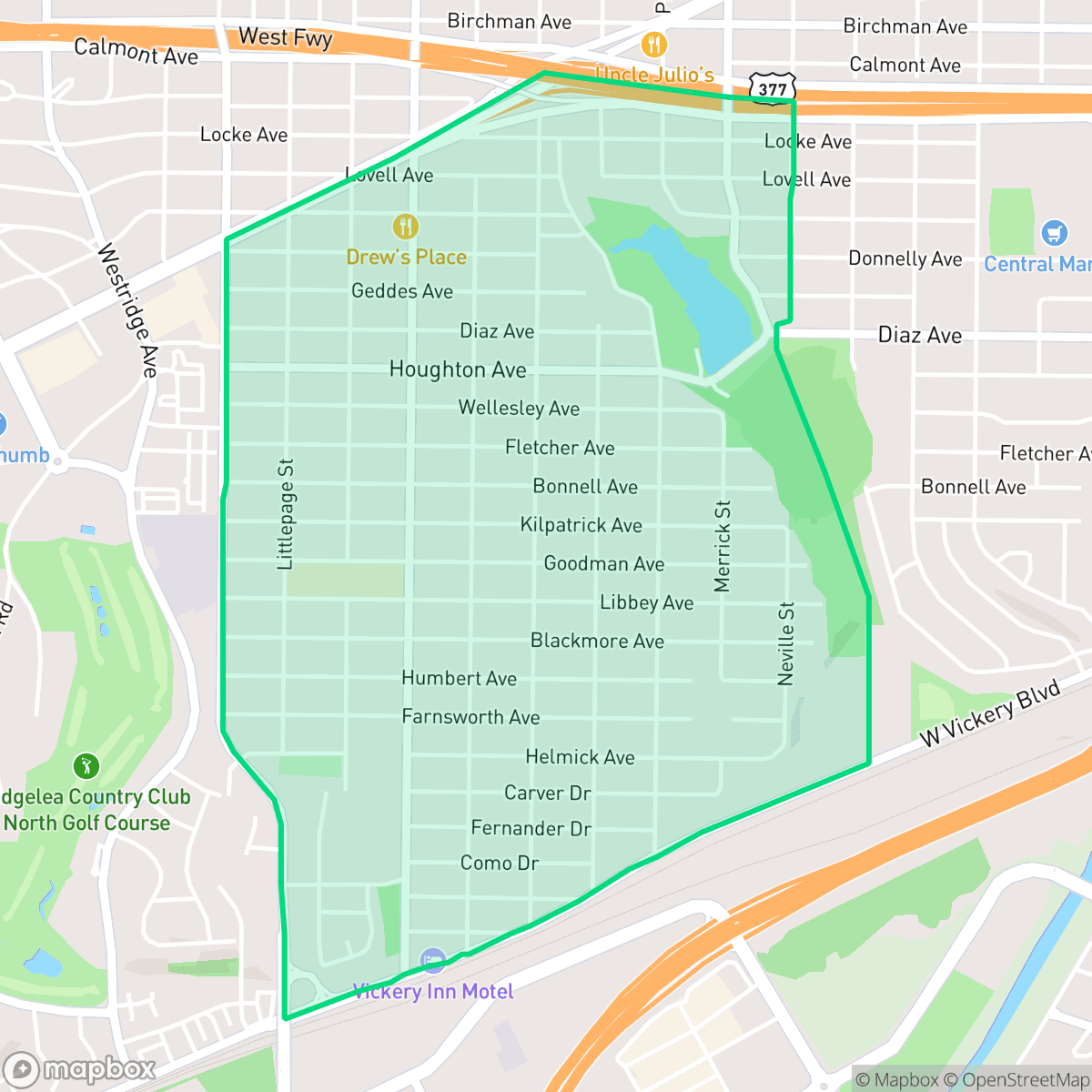
About Como
Established on Fort Worth’s west side, the historic Black neighborhood of Como originated in 1889 around Lake Como, a man-made body of water initially intended for a luxury resort. After the Panic of 1893 halted development, property values dropped, allowing African American domestic workers to purchase affordable land. By the early 20th century, Como grew into a self-sufficient, tight-knit community despite the segregation era’s systemic disinvestment and physical barriers like a dividing brick wall. Local activist Viola Pitts, affectionately dubbed the “Mayor of Como,” championed neighborhood improvements and school funding. Today, the community’s rich heritage is preserved through landmarks like the 1919 Zion Missionary Baptist Church, Lake Como Park, and the annual ComoFest and Fourth of July Parade, alongside long-standing businesses like Drew’s Place.
The neighborhood functions as a dense suburban-urban hybrid, blending single-family homes with mid-sized apartment complexes. According to iHuus data, the area maintains a high walkability score, supported by a consistent grid layout and pedestrian-scale crossings that connect residents to local services and community hubs. The landscape is marked by grassy verges and proximity to significant green space, including Lake Como, which provides a natural anchor for the community. Residents benefit from a variety of local dining options that contribute to the neighborhood's distinct social character.
Prospective residents should consider the specific trade-offs of living in this location. The area experiences higher noise levels due to road traffic and proximity to rail infrastructure, and it faces notable challenges regarding flood safety and air quality. While it offers a strong sense of community and deep cultural roots, the surrounding school district is currently navigating significant financial and operational instability. This area is best suited for those who prioritize a established neighborhood identity and proximity to local landmarks over modern architectural amenities.
Neighborhood Scores Across 15 Qualities
Residential spacing is varied with some buffer between homes, providing slightly more privacy than the Fort Worth average. According to iHuus data, houses are typically separated by small distances and include some denser multi-family units near the center.
Pedestrian access is easy due to a consistent grid system and visible sidewalks on most streets. According to iHuus data, the level of walkability here is on par with the rest of Fort Worth.
Typical tract housing and mid-sized apartment complexes define the local scenery. According to iHuus data, the visual environment is slightly below the Fort Worth average due to a prevalence of boxy rooflines and modest yard spaces.
Large wooded parks and wide, grassy street verges provide ample space for pets. This level of accessibility to green space is roughly in line with the Fort Worth average.
Open land and scattered homes are common throughout this area, though the density is slightly lower than the Fort Worth average. Residents will find a mix of woodland or field settings alongside a more traditional suburban grid.
A mix of quiet suburban streets and lively dining corridors provides a level of activity that is higher than the Fort Worth average. While some blocks offer serene green spaces, other areas feature a diverse selection of restaurants and amenities accessible near major transit routes.
Frequent sounds from nearby railroad tracks and major freeways create a noisier environment than most of Fort Worth. According to iHuus data, residents can expect higher levels of ambient acoustic disturbance compared to the city average.
Air quality levels fluctuate between acceptable and unhealthy ranges, though conditions are slightly better than the Fort Worth average. Sensitive groups may experience occasional concern during certain periods according to iHuus data.
Largely residential and light commercial areas define the neighborhood, though a major rail yard and logistics warehouse in the southeast corner introduce notable noise and traffic. This level of industrial proximity is consistent with the Fort Worth average.
Health insurance access among residents is slightly below the Fort Worth average. According to iHuus data, fewer than half of the local population maintains coverage.
Political leanings in this area trend significantly more liberal than the Fort Worth average. This ideological tilt is reflected in the local community landscape according to iHuus data.
Residents live alongside a balanced mix of young adults, families, and older populations. According to iHuus data, this age distribution is slightly more varied than the Fort Worth average.
Located within a known floodplain, this area faces significantly higher flood risks than the Fort Worth average. Residents should expect a higher likelihood of inundation and should prepare for potential flood insurance requirements.
Address-Level Insights for Como


iHuus Neighborhood Intelligence Insights
Get address-level neighborhood insights for Como
- Street-level scores — see how individual blocks compare, not just neighborhood averages
- Micro-zone boundaries — identify quiet pockets, flood boundaries, and walkable clusters before you visit
- 15 dimensions in full — walkability, noise, air quality, school quality, insurance coverage, population age profile, urban/rural index, and more
- Boundary risk alerts — know if your address sits near a block boundary where scores drop, the kind of detail no listing will ever mention
- School insights — individual school ratings and insights, not just district-level data
- Compare before you commit — side-by-side data across neighborhoods, down to block precision
No credit card required
Compare with Any Neighborhood
| Dimension | Como | Alamo Heights |
|---|---|---|
| 🚶 Walkabilityavg 7.5 | ||
| 🔊 Acoustic Comfortavg 4.12 | ||
| 🤫 Privacy Indexavg 5.64 | ||
| 🎨 Visual Appealavg 6.38 | ||
| 🐕 Dog Friendlinessavg 6.57 | ||
| 🗺️ Urban-Rural Indexavg 6.92 | ||
| ✨ Neighborhood Vibeavg 4.56 | ||
| 🏥 Health Insurance Coverageavg 5.8 | ||
| 🌿 Air Qualityavg 3.68 | ||
| 🏭 Industrial Proximityavg 8.13 | ||
| 🌊 Flood Safetyavg 3.61 | ||
| 🗳️ Ideological Leanavg 5.62 | ||
| 👥 Population Age Profileavg 4.51 | ||
| 🔥 Fire Safety | ||
| 🏫 School Quality |
Como Rankings
School Districts Serving Como
School Insights for Como
Below average outcomes; significant attendance and academic challenges.
School Insights
See what's really behind every school rating near Como
- Individual school ratings — each school's own score with outcome context, not just a district average
- Enrollment & class size data — student-to-teacher ratio and how it compares to the state average
- Full demographics breakdown — ethnicity and gender composition for every school in the enrollment zone
- Every school in the district — all schools within the enrollment boundary ranked by rating, not just the closest one
- Grade levels & benchmarks — elementary through high school, with below/above state-average flags
No credit card required