Colonial Hills, Fort Worth
Updated · 1,932 residents
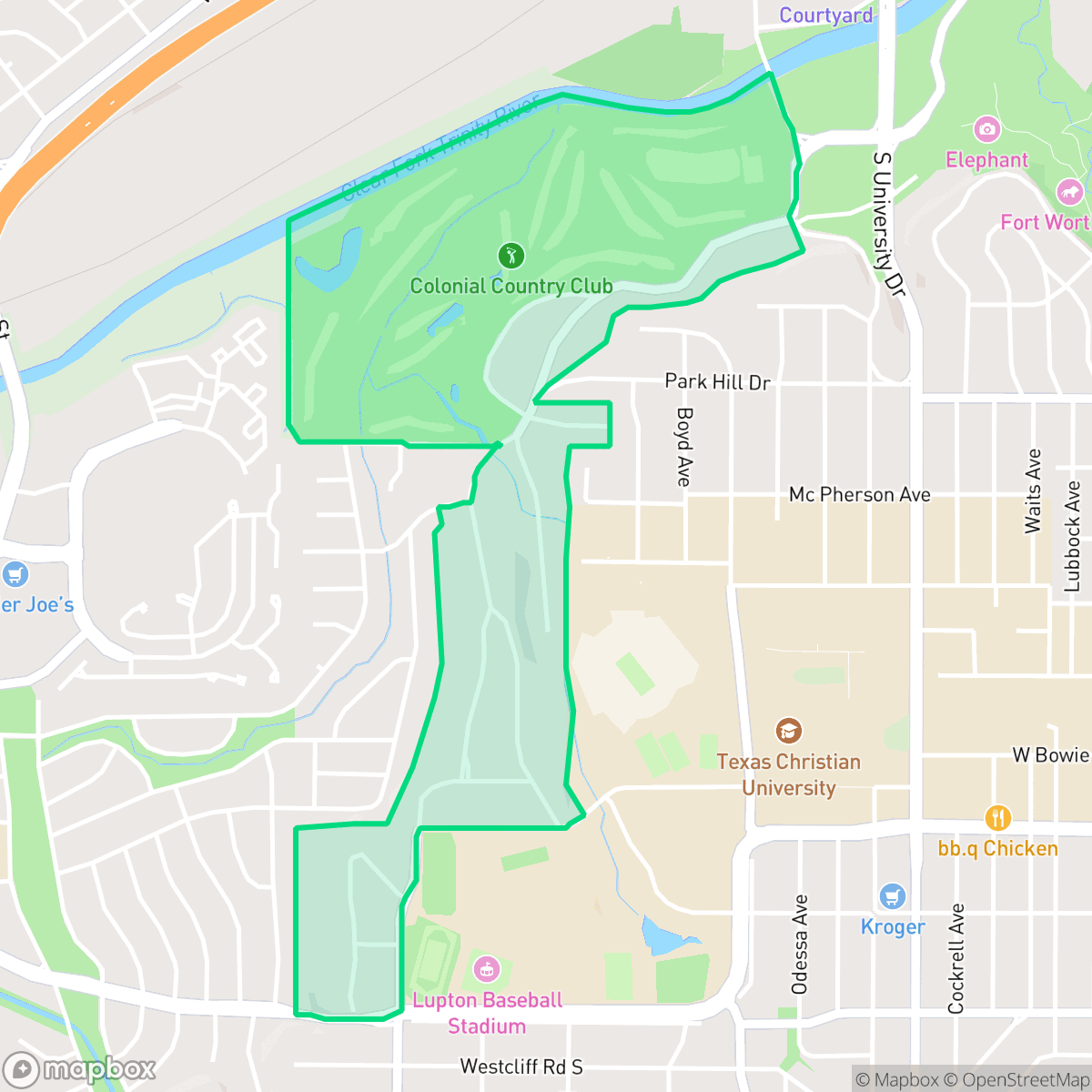
Colonial Hills is a quiet, visually striking neighborhood in southwest Fort Worth, defined by its mature tree canopy and park-like atmosphere. Residents enjoy exceptional acoustic comfort and strong walkability, with convenient proximity to the Fort Worth Zoo and Texas Christian University.
Key Highlights
About Colonial Hills
Platted in 1935, the Colonial Hills neighborhood in southwest Fort Worth was developed by Marvin Leonard, the prominent local businessman behind the Leonard Brothers Department Store and the adjacent Colonial Country Club. Designed by the renowned Kansas City landscape architecture firm Hare & Hare, the neighborhood is celebrated for its gently curving streets, mature tree canopy, and park-like lots. Architectural styles in Colonial Hills range from classic 1930s Tudor and Southern Colonial Revival homes to mid-century ranch-style properties. Notably, architect M.M. Moseley designed one of the enclave's earliest estates on Simondale Drive in 1939. Today, the neighborhood maintains its quiet, historic character while sitting within walking distance of Texas Christian University, the Fort Worth Zoo, and the iconic golf course that shares its name.
The area offers a distinct sense of tranquility, with low noise levels that distinguish it from busier parts of the city. According to iHuus data, the neighborhood maintains high visual appeal, supported by its lush landscaping and well-preserved residential character. Its location provides residents with a rare combination of privacy and connectivity, placing major educational and recreational landmarks within a short distance of the quiet, tree-lined streets. This environment is particularly well-suited for those who prioritize a serene, aesthetically pleasing home life without sacrificing access to urban amenities. While the environment is highly desirable for its aesthetics and peace, prospective residents should consider the broader regional context. The local school district faces significant financial and operational challenges, which may influence long-term planning for families. Additionally, the area has a low flood safety score, making it important for buyers to review specific property elevation and insurance requirements before committing to the neighborhood.
Neighborhood Scores Across 15 Qualities
Residential spacing provides a fair amount of buffer between neighbors, sitting slightly above the Fort Worth average for privacy. According to iHuus data, the neighborhood features a mixed density that avoids both extreme overcrowding and total isolation.
Pedestrian movement is supported by sidewalks on one side of many streets and safe crossings. This level of walkability is notably higher than the Fort Worth average, according to iHuus data.
Large residential properties and frequent high-end amenities create a landscape that is significantly more aesthetically pleasing than the Fort Worth average. According to iHuus data, the area features spacious driveways and well-maintained estates.
Expansive green spaces and wide, low-traffic paths make this an ideal area for walking dogs. According to iHuus data, these features provide significantly more opportunities for pet exercise than the Fort Worth average.
Open land and scattered residential pockets provide a more semi-rural feel than the typical Fort Worth landscape. This area features a diverse mix of greenery, including a golf course and wooded patches, alongside industrial rail yards.
Residential life here moves at a steady, subdued pace with a mix of green spaces and scattered service hubs. This level of activity is slightly below the Fort Worth average, as the area features more quiet, low-density pockets and car-dependent corridors than the city center.
Steady traffic hum from nearby busy streets defines the local soundscape. This level of acoustic activity is slightly higher than the Fort Worth average, according to iHuus data.
Air quality levels in Colonial Hills fluctuate between acceptable and unhealthy, presenting occasional concerns for sensitive groups. This condition is slightly higher than the Fort Worth average, according to iHuus data.
Industrial activity is virtually nonexistent here, providing a residential environment that is significantly cleaner of warehouses and heavy facilities than the Fort Worth average. According to iHuus data, the area is free from detected hazard sites or large-scale manufacturing plants.
Health insurance enrollment among residents is significantly higher than the Fort Worth average, according to iHuus data. This high level of coverage provides residents with much greater access to medical services and financial protection against healthcare costs.
Conservative views represent the majority of the population in Colonial Hills, marking a notable departure from the more politically balanced distribution seen across Fort Worth.
A balanced mix of young adults, families, and older residents characterizes the local demographic. This population distribution is slightly lower than the Fort Worth average according to iHuus data.
Residual flood risk exists within this area due to its location in a 500-year floodplain, though safety levels remain notably higher than the Fort Worth average according to iHuus data.
Address-Level Insights for Colonial Hills


iHuus Neighborhood Intelligence Insights
Get address-level neighborhood insights for Colonial Hills
- Street-level scores — see how individual blocks compare, not just neighborhood averages
- Micro-zone boundaries — identify quiet pockets, flood boundaries, and walkable clusters before you visit
- 15 dimensions in full — walkability, noise, air quality, school quality, insurance coverage, population age profile, urban/rural index, and more
- Boundary risk alerts — know if your address sits near a block boundary where scores drop, the kind of detail no listing will ever mention
- School insights — individual school ratings and insights, not just district-level data
- Compare before you commit — side-by-side data across neighborhoods, down to block precision
No credit card required
Compare with Any Neighborhood
| Dimension | Colonial Hills | Alamo Heights |
|---|---|---|
| 🚶 Walkabilityavg 7.5 | ||
| 🔊 Acoustic Comfortavg 4.12 | ||
| 🤫 Privacy Indexavg 5.64 | ||
| 🎨 Visual Appealavg 6.38 | ||
| 🐕 Dog Friendlinessavg 6.57 | ||
| 🗺️ Urban-Rural Indexavg 6.92 | ||
| ✨ Neighborhood Vibeavg 4.56 | ||
| 🏥 Health Insurance Coverageavg 5.8 | ||
| 🌿 Air Qualityavg 3.68 | ||
| 🏭 Industrial Proximityavg 8.13 | ||
| 🌊 Flood Safetyavg 3.61 | ||
| 🗳️ Ideological Leanavg 5.62 | ||
| 👥 Population Age Profileavg 4.51 | ||
| 🔥 Fire Safety | ||
| 🏫 School Quality |
Colonial Hills Rankings
School Districts Serving Colonial Hills
School Insights for Colonial Hills
Below average outcomes; significant attendance and academic challenges.
School Insights
See what's really behind every school rating near Colonial Hills
- Individual school ratings — each school's own score with outcome context, not just a district average
- Enrollment & class size data — student-to-teacher ratio and how it compares to the state average
- Full demographics breakdown — ethnicity and gender composition for every school in the enrollment zone
- Every school in the district — all schools within the enrollment boundary ranked by rating, not just the closest one
- Grade levels & benchmarks — elementary through high school, with below/above state-average flags
No credit card required