Central Meadowbrook, Fort Worth
Updated · 6,646 residents
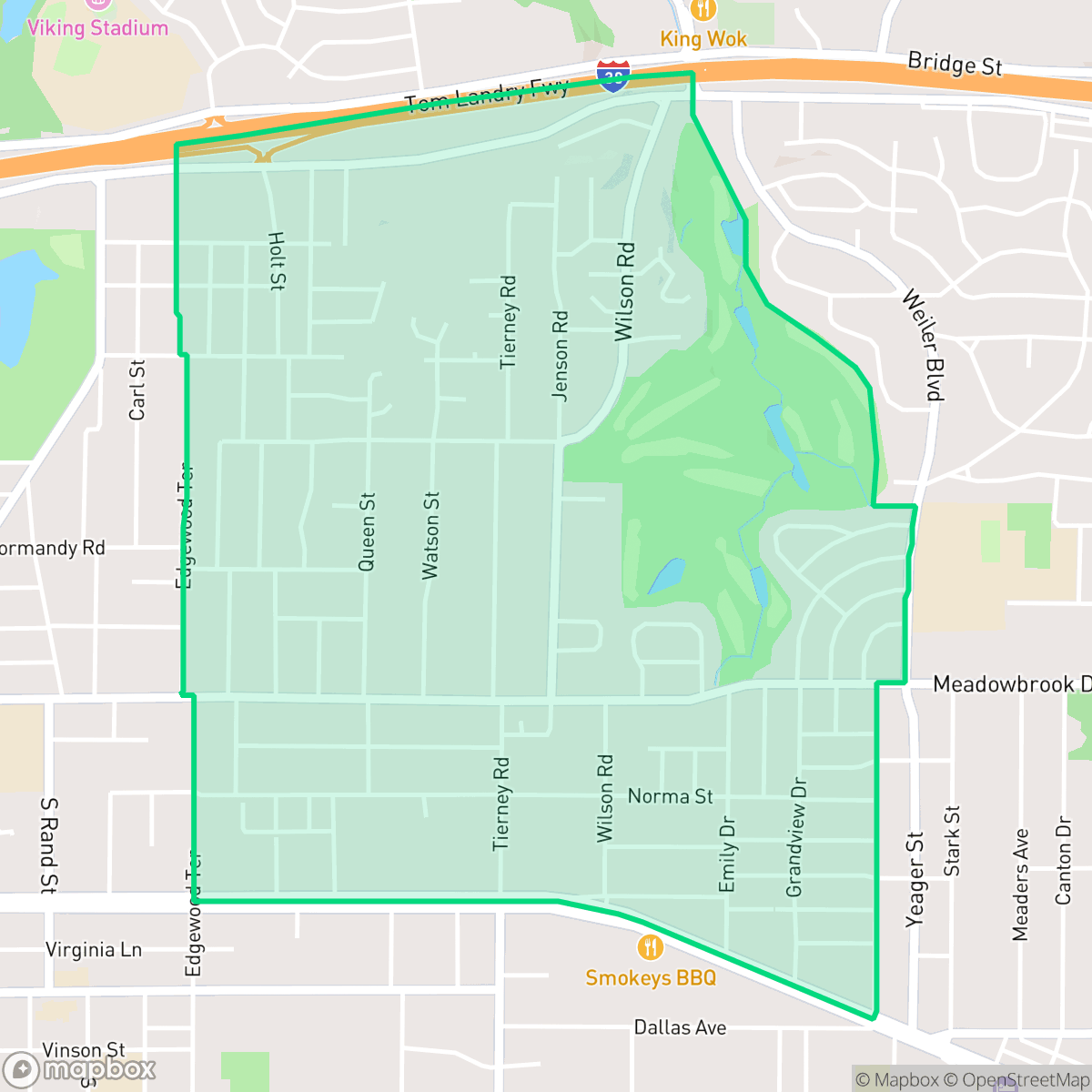
Central Meadowbrook is a quiet, tree-lined residential area in eastern Fort Worth defined by its historic architectural mix and proximity to the Meadowbrook Golf Course. The neighborhood offers a traditional suburban environment with moderate privacy and ample green space for dog owners, though it lacks significant local commercial density. According to iHuus data, the area maintains a peaceful atmosphere with low noise levels, making it a stable choice for those seeking a quiet suburban lifestyle.
Key Highlights
About Central Meadowbrook
Dating back to 1854, the Central Meadowbrook neighborhood in eastern Fort Worth was originally part of a sprawling ranch owned by pioneer Roger J. Tandy. In the early 20th century, Tandy’s son George platted and developed the area. Today, this heavily wooded, historic neighborhood is characterized by a mix of early Craftsman bungalows and 1950s to 1960s mid-century modern ranch-style homes. A central landmark is the Meadowbrook Golf Course, an 18-hole public facility originally designed in 1924 by John Bredemus, the legendary pioneer often called the "Father of Texas Golf". Another prominent local outdoor space is Oakland Lake Park, featuring walking trails and scenic views.
The area functions as a low-density suburban enclave characterized by its mature canopy and residential focus. Residents benefit from a lack of industrial activity and a quiet acoustic environment, which provides a reprieve from the bustle of the broader city. While the neighborhood lacks a high concentration of local businesses or nightlife, the presence of Oakland Lake Park and various green corridors provides accessible outdoor recreation. The housing stock remains largely consistent with mid-century suburban development, offering a predictable and uniform aesthetic that appeals to those prioritizing a settled, quiet atmosphere over urban convenience.
Prospective residents should consider the trade-offs associated with this location. The local school district faces significant operational challenges, and the area has a low flood safety rating, which are important factors for long-term planning. Additionally, the neighborhood is not highly walkable, as many sidewalks are obscured by mature trees and local services are often reached by vehicle. For those who prioritize community stability and established green space over proximity to commercial hubs, the neighborhood offers a distinct, albeit quiet, residential experience.
Neighborhood Scores Across 15 Qualities
Standard suburban spacing provides some buffer between properties, offering slightly more privacy than the Fort Worth average. Backyard fencing is common throughout the area, helping to define individual lot boundaries.
Low-traffic residential streets and large school campuses provide a quiet environment for walking, though a lack of consistent sidewalk visibility makes navigation less convenient than the city average.
Standard middle-class tract housing defines the area, featuring uniform rooflines and modest yards that are consistent with the city average. Very few private pools are visible from aerial views according to iHuus data.
Green corridors and a large public park with expansive fields provide ample space for pets. This neighborhood offers similar levels of pet-friendly infrastructure to the rest of Fort Worth.
Residential layouts here consist of dense suburban pockets with single-family homes and local commercial zones. This balance of developed areas and open space is consistent with the Fort Worth average.
A balanced mix of residential streets and greenery provides a steady rhythm of activity that aligns with the Fort Worth average. While some pockets near major highways offer diverse dining options, much of the area remains quiet and relies on car travel for most errands.
Frequent sounds from nearby railroad tracks and heavy freeway traffic characterize this area. According to iHuus data, acoustic comfort in Central Meadowbrook is lower than the Fort Worth average.
Frequent unhealthy air quality levels pose a significant risk to sensitive groups. According to iHuus data, air quality in Central Meadowbrook is slightly lower than the Fort Worth average.
Residential life is undisturbed by warehouses or heavy industrial facilities, making this area cleaner and quieter than the Fort Worth average. According to iHuus data, the neighborhood consists of purely residential, educational, and light commercial uses with no detectable industrial hazards.
Health insurance access is significantly lower here than the Fort Worth average. According to iHuus data, a small portion of the population maintains medical coverage.
Political leanings in this area are notably more liberal than the Fort Worth average, according to iHuus data.
Residents live alongside a balanced variety of young adults, families, and older individuals. This demographic distribution is slightly more varied than the average seen across Fort Worth.
Properties in this area are situated within a designated floodplain, meaning residents may face a higher risk of flooding and likely need to carry flood insurance. According to iHuus data, the flood risk in Central Meadowbrook is higher than the Fort Worth city average.
Address-Level Insights for Central Meadowbrook


iHuus Neighborhood Intelligence Insights
Get address-level neighborhood insights for Central Meadowbrook
- Street-level scores — see how individual blocks compare, not just neighborhood averages
- Micro-zone boundaries — identify quiet pockets, flood boundaries, and walkable clusters before you visit
- 15 dimensions in full — walkability, noise, air quality, school quality, insurance coverage, population age profile, urban/rural index, and more
- Boundary risk alerts — know if your address sits near a block boundary where scores drop, the kind of detail no listing will ever mention
- School insights — individual school ratings and insights, not just district-level data
- Compare before you commit — side-by-side data across neighborhoods, down to block precision
No credit card required
Compare with Any Neighborhood
| Dimension | Central Meadowbrook | Alamo Heights |
|---|---|---|
| 🚶 Walkabilityavg 7.5 | ||
| 🔊 Acoustic Comfortavg 4.12 | ||
| 🤫 Privacy Indexavg 5.64 | ||
| 🎨 Visual Appealavg 6.38 | ||
| 🐕 Dog Friendlinessavg 6.57 | ||
| 🗺️ Urban-Rural Indexavg 6.92 | ||
| ✨ Neighborhood Vibeavg 4.56 | ||
| 🏥 Health Insurance Coverageavg 5.8 | ||
| 🌿 Air Qualityavg 3.68 | ||
| 🏭 Industrial Proximityavg 8.13 | ||
| 🌊 Flood Safetyavg 3.61 | ||
| 🗳️ Ideological Leanavg 5.62 | ||
| 👥 Population Age Profileavg 4.51 | ||
| 🔥 Fire Safety | ||
| 🏫 School Quality |
Central Meadowbrook Rankings
School Districts Serving Central Meadowbrook
School Insights for Central Meadowbrook
Below average outcomes; significant attendance and academic challenges.
School Insights
See what's really behind every school rating near Central Meadowbrook
- Individual school ratings — each school's own score with outcome context, not just a district average
- Enrollment & class size data — student-to-teacher ratio and how it compares to the state average
- Full demographics breakdown — ethnicity and gender composition for every school in the enrollment zone
- Every school in the district — all schools within the enrollment boundary ranked by rating, not just the closest one
- Grade levels & benchmarks — elementary through high school, with below/above state-average flags
No credit card required