Carter Riverside, Fort Worth
Updated · 4,725 residents
Carter Riverside is a lively, car-dependent neighborhood characterized by its historic residential streets and proximity to local dining hubs. While the area offers a strong sense of community near Sylvania Park, residents should note the neighborhood experiences moderate noise from road traffic and has limited walkability due to missing sidewalk infrastructure.
Key Highlights
About Carter Riverside
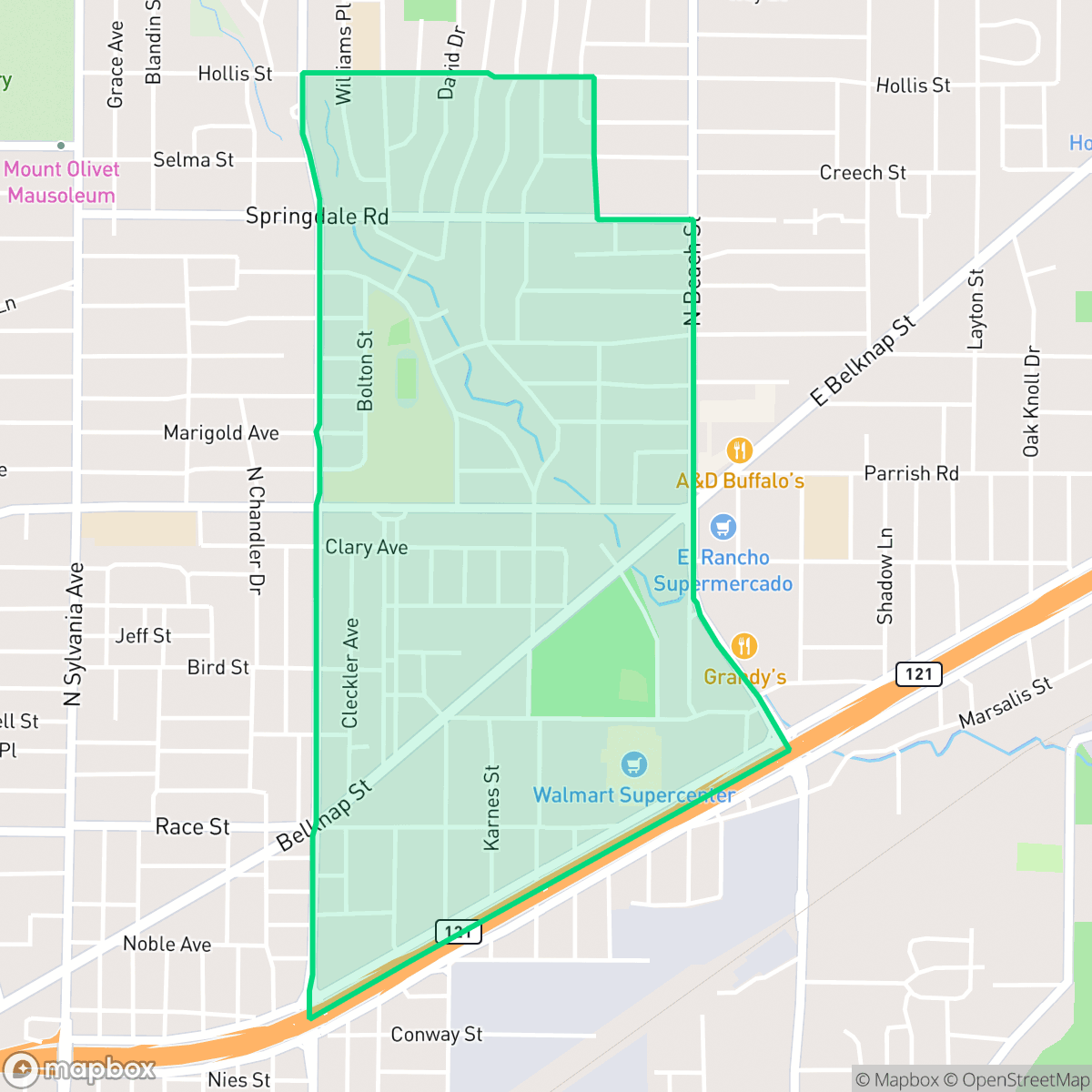
Originally settled in 1876 as Trinity Bend, the historic Carter Riverside neighborhood in Fort Worth was renamed Riverside in 1899 before its annexation by the city in 1922. It was later renamed Carter Riverside to honor local philanthropist Amon G. Carter. Developed as a middle-class streetcar suburb, the neighborhood is bounded by Riverside Drive, Beach Street, and Belknap Street, with Sylvania Park serving as its primary green space. Carter Riverside is characterized by its 1920s-era Craftsman-style homes. Its most prominent architectural landmark is the Amon Carter Riverside High School, a striking neoclassical limestone structure designed by renowned architect Wyatt C. Hedrick and Herman Koeppe, which opened in 1936.
The area functions as a low-density suburban environment that balances residential life with light industrial activity. According to iHuus data, the neighborhood maintains a vibrant social scene centered around local establishments like Race Street Coffee, Taco Casa, and the Blue Mound Cafe. Residents benefit from accessible green spaces such as Sylvania Park, which provides a necessary outdoor outlet in an otherwise car-reliant landscape.
Prospective residents should consider the trade-offs regarding infrastructure and environmental factors. While the neighborhood offers a distinct identity, it faces challenges including limited sidewalk connectivity, moderate road noise, and low flood safety ratings. The local school district, Fort Worth ISD, is currently navigating significant operational and financial difficulties, which may impact educational planning for families. Overall, the area is best suited for those seeking an established, community-focused environment who are comfortable with a car-dependent lifestyle.
Neighborhood Scores Across 15 Qualities
Homes in this area offer a moderate level of privacy with defined backyards and consistent separation between neighbors. According to iHuus data, this density provides slightly more separation between structures than the average area in Fort Worth.
Low traffic volumes and a grid layout facilitate easy movement, although sidewalk availability is less consistent here than across the rest of Fort Worth. While some residential streets feature dedicated paths, others may lack formal sidewalks due to dense tree canopy or street design.
Standard single-family homes feature simple rooflines and small yards with very few luxury amenities. This visual landscape is less varied than the Fort Worth city average.
Minimal sidewalk verges and a lack of street-side greenery make it harder to walk dogs compared to the Fort Worth average. Most available space for pets is restricted to private backyards or nearby public sports fields.
Residential layouts feature a mix of single-family homes and mature tree canopies, offering a more developed feel than the surrounding semi-rural areas in Fort Worth. This transition zone provides a balance of established neighborhood grids and pockets of urban fringe development.
Local social hubs and dining options provide a notable level of activity that is higher than the Fort Worth average. While the area contains various community spots and small businesses, the layout remains car-dependent and lacks high walkability.
Frequent noise from nearby railroad tracks and heavy freeway traffic persists in this area. According to iHuus data, acoustic comfort is lower than the Fort Worth average.
Frequent unhealthy air quality levels present significant risks to sensitive groups. This area experiences lower air quality than the Fort Worth average, according to iHuus data.
Industrial presence is minimal throughout most of the area, though small warehouses and commercial plots exist along the southern and eastern edges. Residents may encounter light commercial traffic and occasional utility odors near local service stations, making the industrial footprint slightly higher than the Fort Worth average.
Health insurance access is significantly lower than the Fort Worth average, which may present challenges for residents seeking medical coverage. According to iHuus data, a small portion of the population is currently insured.
Political leanings in this area trend more liberal than the Fort Worth average, featuring a liberal majority with a modest opposing presence according to iHuus data.
A balanced mix of young adults, families, and older residents characterizes the area. This demographic variety is largely consistent with the broader Fort Worth population, according to iHuus data.
Flood risk in this area is notably higher than the Fort Worth average because parts of the neighborhood sit within a designated floodplain. Residents should be aware that flood insurance is typically required for properties in this zone according to iHuus data.
Address-Level Insights for Carter Riverside


iHuus Neighborhood Intelligence Insights
Get address-level neighborhood insights for Carter Riverside
- Street-level scores — see how individual blocks compare, not just neighborhood averages
- Micro-zone boundaries — identify quiet pockets, flood boundaries, and walkable clusters before you visit
- 15 dimensions in full — walkability, noise, air quality, school quality, insurance coverage, population age profile, urban/rural index, and more
- Boundary risk alerts — know if your address sits near a block boundary where scores drop, the kind of detail no listing will ever mention
- School insights — individual school ratings and insights, not just district-level data
- Compare before you commit — side-by-side data across neighborhoods, down to block precision
No credit card required
Compare with Any Neighborhood
| Dimension | Carter Riverside | Alamo Heights |
|---|---|---|
| 🚶 Walkabilityavg 7.5 | ||
| 🔊 Acoustic Comfortavg 4.12 | ||
| 🤫 Privacy Indexavg 5.64 | ||
| 🎨 Visual Appealavg 6.38 | ||
| 🐕 Dog Friendlinessavg 6.57 | ||
| 🗺️ Urban-Rural Indexavg 6.92 | ||
| ✨ Neighborhood Vibeavg 4.56 | ||
| 🏥 Health Insurance Coverageavg 5.8 | ||
| 🌿 Air Qualityavg 3.68 | ||
| 🏭 Industrial Proximityavg 8.13 | ||
| 🌊 Flood Safetyavg 3.61 | ||
| 🗳️ Ideological Leanavg 5.62 | ||
| 👥 Population Age Profileavg 4.51 | ||
| 🔥 Fire Safety | ||
| 🏫 School Quality |
Carter Riverside Rankings
School Districts Serving Carter Riverside
School Insights for Carter Riverside
Below average outcomes; significant attendance and academic challenges.
School Insights
See what's really behind every school rating near Carter Riverside
- Individual school ratings — each school's own score with outcome context, not just a district average
- Enrollment & class size data — student-to-teacher ratio and how it compares to the state average
- Full demographics breakdown — ethnicity and gender composition for every school in the enrollment zone
- Every school in the district — all schools within the enrollment boundary ranked by rating, not just the closest one
- Grade levels & benchmarks — elementary through high school, with below/above state-average flags
No credit card required