Carter Park, Fort Worth
Updated · 3,084 residents
Carter Park is a low-density residential area defined by its namesake linear park and a strong sense of community. The neighborhood offers a quiet, suburban atmosphere with significant green space, making it well-suited for dog owners and those who prefer a natural, wooded environment.
Key Highlights
About Carter Park
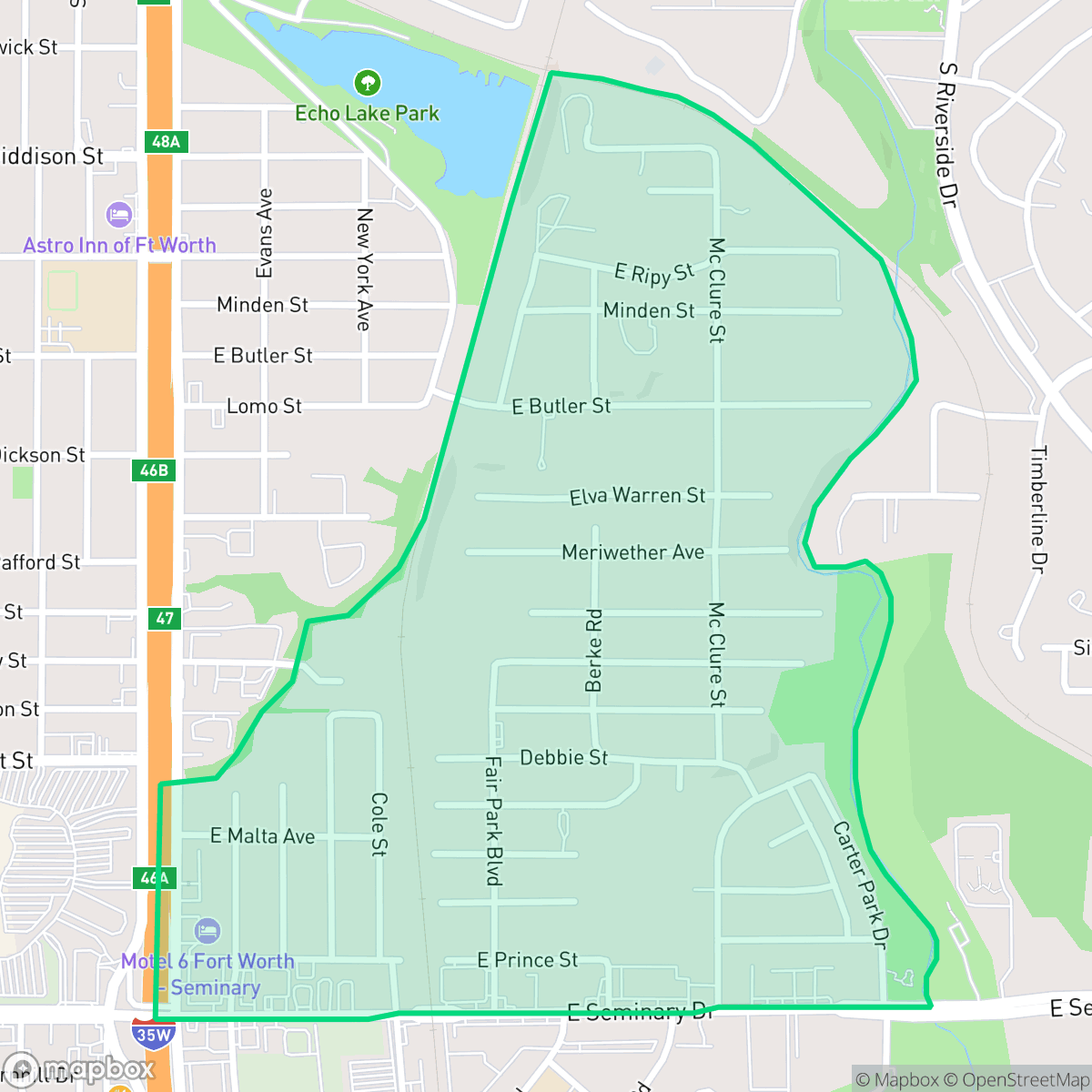
Located in southeast Fort Worth along Sycamore Creek, the Carter Park neighborhood is anchored by its namesake 163-acre linear park. Established in 1951, the park's land was donated by prominent civic leader Amon G. Carter, who collaborated with landscape architect S. Herbert Hare to select the scenic site. In 1955, Carter and his children donated an adjacent six-acre former cow pasture to establish Carter Park Elementary School, which opened using relocated temporary buildings. The surrounding residential area developed primarily between 1940 and 1969, featuring well-established, mid-century single-family homes. Over the decades, the neighborhood has evolved into a culturally rich community with a strong Mexican-American identity, where a significant majority of residents are of Mexican heritage and Spanish is widely spoken.
The area is characterized by its expansive tree canopy and natural corridors, which contribute to a high urban-rural index and a peaceful acoustic environment. Residents benefit from a lack of heavy industrial proximity, ensuring a primarily residential and light commercial landscape. Local social hubs and diverse dining options, such as Alma's Paleteria and Los Magueyes, provide a distinct cultural vibrancy that anchors the community.
Prospective residents should note that the neighborhood presents specific trade-offs, including lower-than-average air quality and significant flood safety concerns. While the area maintains a moderate level of walkability on its paved roads, it lacks consistent sidewalk infrastructure. According to iHuus data, families should also consider the current operational challenges facing the Fort Worth Independent School District when evaluating the area for long-term educational needs.
Neighborhood Scores Across 15 Qualities
Housing spacing varies between dense mid-century clusters and areas bordered by thick woods. According to iHuus data, the level of separation between neighbors is slightly higher than the Fort Worth average.
Residential streets feature sidewalks on one side and safe crossings, though large highway and rail barriers limit connectivity. Overall pedestrian accessibility is lower than the Fort Worth average according to iHuus data.
Standard tract housing defines the area, featuring consistent roof geometries and small yards. This visual landscape is slightly less varied than the Fort Worth average according to iHuus data.
Wooded areas and a central creek corridor provide ample green space for pets. This access to nature and nearby greenbelts makes the area more dog friendly than the Fort Worth average.
Open land and significant tree canopy provide a more rural feel than the typical Fort Worth suburban layout. Residents can expect scattered homes situated among natural corridors and woodlands, according to iHuus data.
Dining options and social hubs provide more activity than the typical Fort Worth area, though the landscape remains largely car-dependent. According to iHuus data, the neighborhood features a mix of lively commercial pockets and quieter, industrial-leaning blocks.
Frequent sounds from nearby railroad tracks and heavy freeway traffic characterize the area. According to iHuus data, acoustic comfort in this neighborhood is lower than the Fort Worth average.
Air quality in this area is slightly better than the Fort Worth average, though residents may encounter occasional periods of unhealthy air that could affect sensitive groups.
Residential life dominates this area with very little heavy industry present. While the neighborhood is slightly more influenced by commercial and transit activity than the Fort Worth average, it lacks large scale industrial hazards or heavy warehouse presence.
Health insurance coverage among residents is notably lower than the Fort Worth average. This disparity may present challenges for accessing affordable medical services within the immediate area.
Voting patterns and census indicators show a distinctly liberal political leaning, which is significantly more pronounced here than the Fort Worth average.
Residents live alongside a diverse spread of young adults, families, and seniors. This demographic distribution is largely consistent with the broader Fort Worth area, according to iHuus data.
Significant flood hazards exist in this area, representing a much higher risk level than the Fort Worth average. Residents should prepare for potential property impacts and elevated insurance premiums according to iHuus data.
Address-Level Insights for Carter Park


iHuus Neighborhood Intelligence Insights
Get address-level neighborhood insights for Carter Park
- Street-level scores — see how individual blocks compare, not just neighborhood averages
- Micro-zone boundaries — identify quiet pockets, flood boundaries, and walkable clusters before you visit
- 15 dimensions in full — walkability, noise, air quality, school quality, insurance coverage, population age profile, urban/rural index, and more
- Boundary risk alerts — know if your address sits near a block boundary where scores drop, the kind of detail no listing will ever mention
- School insights — individual school ratings and insights, not just district-level data
- Compare before you commit — side-by-side data across neighborhoods, down to block precision
No credit card required
Compare with Any Neighborhood
| Dimension | Carter Park | Alamo Heights |
|---|---|---|
| 🚶 Walkabilityavg 7.5 | ||
| 🔊 Acoustic Comfortavg 4.12 | ||
| 🤫 Privacy Indexavg 5.64 | ||
| 🎨 Visual Appealavg 6.38 | ||
| 🐕 Dog Friendlinessavg 6.57 | ||
| 🗺️ Urban-Rural Indexavg 6.92 | ||
| ✨ Neighborhood Vibeavg 4.56 | ||
| 🏥 Health Insurance Coverageavg 5.8 | ||
| 🌿 Air Qualityavg 3.68 | ||
| 🏭 Industrial Proximityavg 8.13 | ||
| 🌊 Flood Safetyavg 3.61 | ||
| 🗳️ Ideological Leanavg 5.62 | ||
| 👥 Population Age Profileavg 4.51 | ||
| 🔥 Fire Safety | ||
| 🏫 School Quality |
Carter Park Rankings
School Districts Serving Carter Park
School Insights for Carter Park
Below average outcomes; significant attendance and academic challenges.
School Insights
See what's really behind every school rating near Carter Park
- Individual school ratings — each school's own score with outcome context, not just a district average
- Enrollment & class size data — student-to-teacher ratio and how it compares to the state average
- Full demographics breakdown — ethnicity and gender composition for every school in the enrollment zone
- Every school in the district — all schools within the enrollment boundary ranked by rating, not just the closest one
- Grade levels & benchmarks — elementary through high school, with below/above state-average flags
No credit card required