Candleridge, Fort Worth
Updated · 4,647 residents
Candleridge is a well-established residential enclave in southwest Fort Worth, defined by its expansive green spaces and mature, tree-lined streets. The area is highly walkable and exceptionally dog-friendly, offering residents a quiet suburban environment with convenient access to local parks and recreational trails.
Key Highlights
About Candleridge
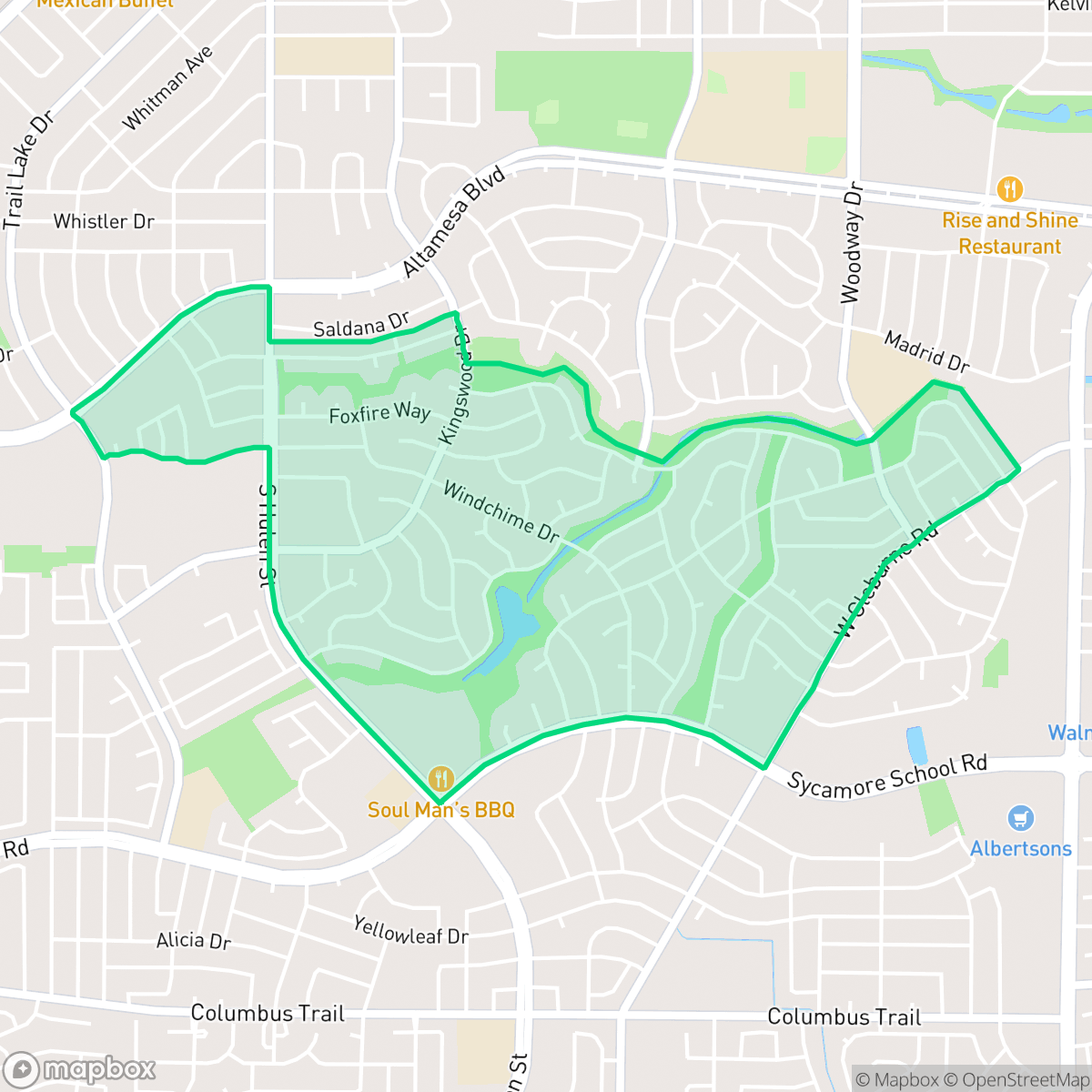
Developed starting in the late 1970s by the Candle Ridge Development Corporation, Candleridge is an established residential neighborhood in southwest Fort Worth. Originally annexed as part of a 1,100-acre tract, the community’s architectural stock consists primarily of traditional 1970s and 1980s ranch-style homes alongside modern-influenced designs. The neighborhood is anchored by the 88-acre Candleridge Park, which grew from an initial seven-acre developer donation and features French Lake, paved walking trails, and mature trees. Culturally, Candleridge is defined by its highly active Candleridge Homeowners Association, founded in 1978. The association gained a city-wide reputation for proactive citizen advocacy, famously partnering with the city to plant and water local trees, which helped the area earn multiple "Neighborhood of the Year" awards in the 1990s.
Candleridge is characterized by a mix of traditional ranch-style homes and modern designs that create a cohesive, visually appealing suburban landscape. The neighborhood serves as a quiet retreat, anchored by an 88-acre park that provides residents with significant access to outdoor recreation, including paved walking trails and French Lake. According to recent data, the area maintains a notably high level of walkability and dog-friendliness compared to the city average, making it a preferred location for those who prioritize outdoor activity and a pedestrian-friendly atmosphere.
Potential residents should consider that the neighborhood is served by the Fort Worth Independent School District, which currently faces significant financial and operational challenges. While the area offers a peaceful residential experience with minimal industrial proximity, prospective buyers should also account for local environmental factors, including moderate air quality and flood safety considerations. It is best suited for individuals or families who value a stable, community-oriented environment and are comfortable navigating the broader district-level educational landscape.
Neighborhood Scores Across 15 Qualities
Residential spacing is typical for the area, offering a mix of shared property lines and distinct yards with moderate buffers between neighbors. This level of density is consistent with the Fort Worth average.
Extensive sidewalk networks and marked crossings provide safe pedestrian movement throughout residential blocks and along main arterials. This connectivity is significantly higher than the Fort Worth average, according to iHuus data.
Large modern homes with private pools and manicured lawns characterize this area, which offers a more polished aesthetic than the Fort Worth average. Many properties feature spacious driveways and well-maintained landscaping according to iHuus data.
Extensive greenbelts, winding park paths, and wide grassy verges provide significant space for pet walking. According to iHuus data, these interconnected open spaces and creek corridors make this area more dog friendly than the Fort Worth average.
Residential layouts consist of traditional suburban sprawl with a mix of single-family homes and apartment complexes. This level of development is slightly less open than the Fort Worth average, according to iHuus data.
A mix of quiet, green residential blocks and lively pockets of dining and social hubs provides a sense of activity that is higher than the Fort Worth average. While some streets offer a calm suburban atmosphere near water features, certain areas feature a diverse selection of accessible restaurants and amenities.
A steady hum from nearby busy streets characterizes the local soundscape. According to iHuus data, acoustic levels in Candleridge are slightly higher than the Fort Worth average.
Air quality in this area fluctuates between acceptable and unhealthy levels, presenting occasional concerns for sensitive groups. According to iHuus data, conditions here are slightly better than the Fort Worth average.
Industrial presence is minimal in Candleridge, as the area consists almost entirely of residential and light commercial zones. This level of separation from heavy industry and warehouses is notably higher than the Fort Worth average, according to iHuus data.
Health insurance access among residents is slightly above the Fort Worth average, according to iHuus data.
Political leanings in this area are notably more liberal than the Fort Worth average. Residents will find a liberal majority with a modest opposing presence according to iHuus data.
Residents live alongside a diverse range of age groups, including young adults, families, and seniors. This demographic distribution is slightly more varied than the average found across Fort Worth, according to iHuus data.
Flood risk in this area is slightly above the Fort Worth average, though official FEMA studies for this specific location remain incomplete. Residents should exercise caution as the lack of detailed mapping makes the precise level of risk difficult to determine.
Address-Level Insights for Candleridge


iHuus Neighborhood Intelligence Insights
Get address-level neighborhood insights for Candleridge
- Street-level scores — see how individual blocks compare, not just neighborhood averages
- Micro-zone boundaries — identify quiet pockets, flood boundaries, and walkable clusters before you visit
- 15 dimensions in full — walkability, noise, air quality, school quality, insurance coverage, population age profile, urban/rural index, and more
- Boundary risk alerts — know if your address sits near a block boundary where scores drop, the kind of detail no listing will ever mention
- School insights — individual school ratings and insights, not just district-level data
- Compare before you commit — side-by-side data across neighborhoods, down to block precision
No credit card required
Compare with Any Neighborhood
| Dimension | Candleridge | Alamo Heights |
|---|---|---|
| 🚶 Walkabilityavg 7.5 | ||
| 🔊 Acoustic Comfortavg 4.12 | ||
| 🤫 Privacy Indexavg 5.64 | ||
| 🎨 Visual Appealavg 6.38 | ||
| 🐕 Dog Friendlinessavg 6.57 | ||
| 🗺️ Urban-Rural Indexavg 6.92 | ||
| ✨ Neighborhood Vibeavg 4.56 | ||
| 🏥 Health Insurance Coverageavg 5.8 | ||
| 🌿 Air Qualityavg 3.68 | ||
| 🏭 Industrial Proximityavg 8.13 | ||
| 🌊 Flood Safetyavg 3.61 | ||
| 🗳️ Ideological Leanavg 5.62 | ||
| 👥 Population Age Profileavg 4.51 | ||
| 🔥 Fire Safety | ||
| 🏫 School Quality |
Candleridge Rankings
School Districts Serving Candleridge
School Insights for Candleridge
Below average outcomes; significant attendance and academic challenges.
School Insights
See what's really behind every school rating near Candleridge
- Individual school ratings — each school's own score with outcome context, not just a district average
- Enrollment & class size data — student-to-teacher ratio and how it compares to the state average
- Full demographics breakdown — ethnicity and gender composition for every school in the enrollment zone
- Every school in the district — all schools within the enrollment boundary ranked by rating, not just the closest one
- Grade levels & benchmarks — elementary through high school, with below/above state-average flags
No credit card required