Candle Ridge West, Fort Worth
Updated · 1,849 residents
Candle Ridge West is a residential enclave in southwest Fort Worth recognized for its highly walkable street layout and well-maintained single-family homes. While the area offers significant aesthetic appeal and consistent access to green spaces, residents should anticipate elevated ambient road noise and must weigh the benefits of the location against the current operational challenges facing the local school district.
Key Highlights
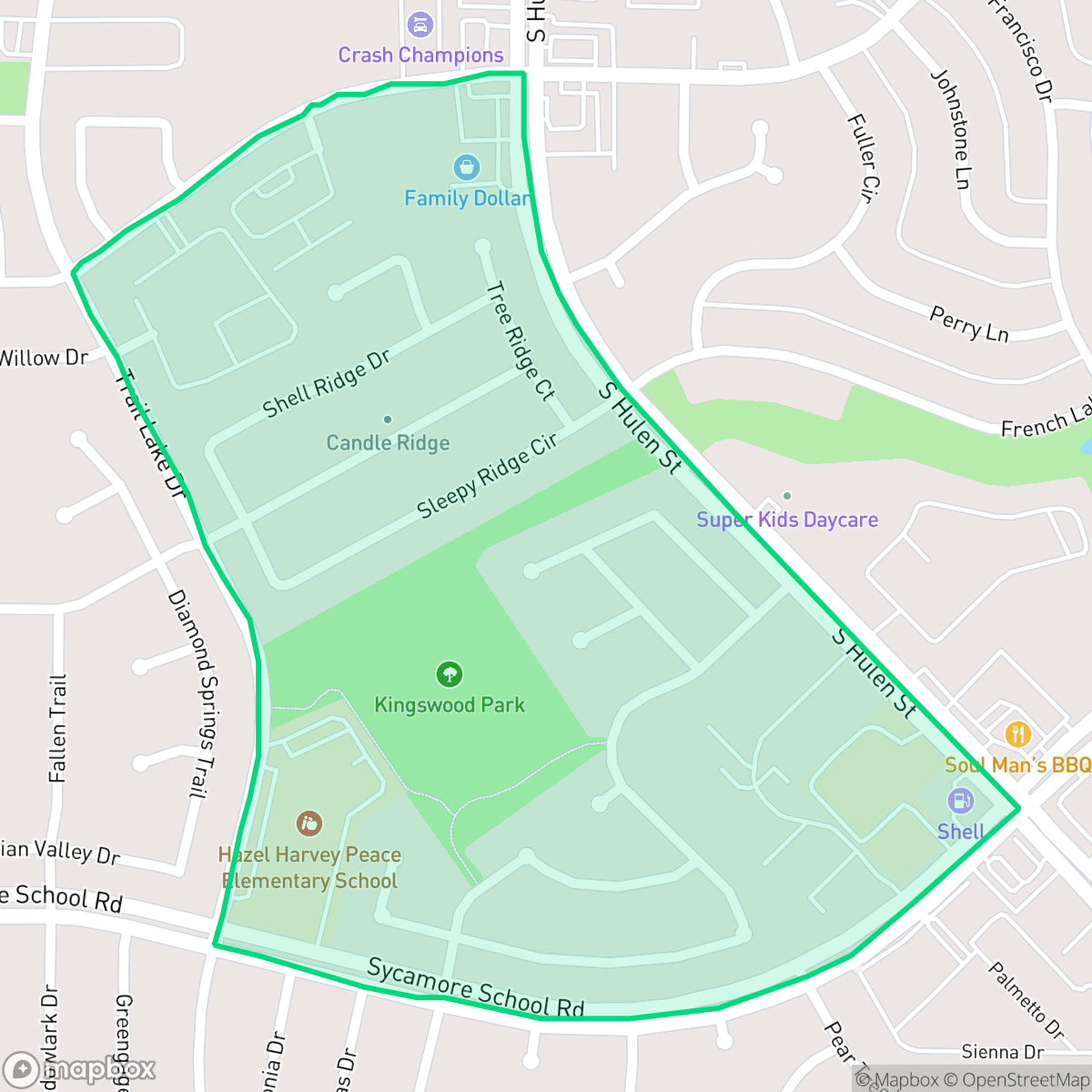
About Candle Ridge West
The Candleridge area of southwest Fort Worth transitioned from rolling ranchland to a suburban residential development starting in 1976. Prior to development, the only prominent structure was the pyramid-roofed Cumberland Presbyterian Church, built in 1968 amidst open pastures. The neighborhood, which includes the Candle Ridge West section, was largely built out between 1976 and 1984, featuring traditional and ranch-style single-family homes. Early homebuilders frequently had to use dynamite during construction due to shallow bedrock. In 1978, residents established the Candleridge Homeowners Association to advocate for municipal services, successfully securing streetlights, mail delivery, and the development of Candleridge Park. The park's central feature, French Lake, was originally a ranch stock tank before being transformed into a neighborhood landmark.
This neighborhood is characterized by its traditional and ranch-style architecture, providing a distinct suburban atmosphere that remains free from industrial activity. It stands out for its exceptional pedestrian infrastructure, as continuous sidewalks on both sides of most streets encourage active movement throughout the community. The area maintains a high standard of visual appeal, with manicured lawns and private amenities contributing to a cohesive residential environment that is well-suited for those who value a structured, suburban lifestyle.
Living in this part of Fort Worth involves specific trade-offs, particularly regarding acoustic comfort, as ambient road traffic creates a noticeable noise floor. According to iHuus data, the neighborhood benefits from high flood safety ratings, though prospective families should be aware that local schools within the Fort Worth Independent School District are currently managing significant budget deficits and enrollment shifts. The area is best suited for residents who prioritize walkability and a established suburban aesthetic over proximity to commercial hubs or quiet, rural-like silence.
Neighborhood Scores Across 15 Qualities
Residential spacing in this area provides a moderate level of separation between neighbors, which is roughly in line with the average for Fort Worth. Some sections feature closer property lines, but most homes maintain typical suburban yards.
Continuous sidewalks and pedestrian-priority areas make navigating the neighborhood easy on foot; this level of connectivity is significantly higher than the Fort Worth average.
Manicured lawns, large modern homes, and private pools create an aesthetic that is notably more polished than the Fort Worth average. According to iHuus data, the presence of upscale amenities and spacious properties defines the area's visual character.
Continuous green fields and wide, grass-lined paths provide ample space for walking pets. According to iHuus data, the availability of connected open spaces here is notably higher than the Fort Worth average.
Residential pockets feature a blend of dense suburban layouts and scattered homes near open spaces. This area feels slightly less developed than the typical Fort Worth landscape according to iHuus data.
Residential streets and green spaces provide a steady but low-key atmosphere that is slightly more subdued than the Fort Worth average. While local dining and social spots are available, most services require a short drive as few businesses are within walking distance.
Steady sound from nearby busy streets is present, though levels are slightly more tranquil than the typical Fort Worth average according to iHuus data.
Air quality levels fluctuate between acceptable and unhealthy conditions, though they remain slightly better than the Fort Worth average according to iHuus data. Sensitive groups should remain aware of occasional days with higher pollution levels.
Industrial activity and heavy warehouses are entirely absent from this area, offering a cleaner environment than much of Fort Worth. According to iHuus data, the neighborhood consists exclusively of residential and institutional spaces with no detected industrial hazards.
Health insurance coverage among residents is notably higher than the Fort Worth average, according to iHuus data.
Political leanings in this area trend significantly more liberal than the Fort Worth average, according to iHuus data.
Residents live alongside a balanced mix of young adults, families, and older populations. This demographic spread is slightly more varied than the typical Fort Worth profile, according to iHuus data.
Flood risk levels are higher than the Fort Worth average, though a definitive assessment is currently unavailable because FEMA has not completed a detailed study for this area. According to iHuus data, the area sits in a category of undetermined risk.
Address-Level Insights for Candle Ridge West


iHuus Neighborhood Intelligence Insights
Get address-level neighborhood insights for Candle Ridge West
- Street-level scores — see how individual blocks compare, not just neighborhood averages
- Micro-zone boundaries — identify quiet pockets, flood boundaries, and walkable clusters before you visit
- 15 dimensions in full — walkability, noise, air quality, school quality, insurance coverage, population age profile, urban/rural index, and more
- Boundary risk alerts — know if your address sits near a block boundary where scores drop, the kind of detail no listing will ever mention
- School insights — individual school ratings and insights, not just district-level data
- Compare before you commit — side-by-side data across neighborhoods, down to block precision
No credit card required
Compare with Any Neighborhood
| Dimension | Candle Ridge West | Alamo Heights |
|---|---|---|
| 🚶 Walkabilityavg 7.5 | ||
| 🔊 Acoustic Comfortavg 4.12 | ||
| 🤫 Privacy Indexavg 5.64 | ||
| 🎨 Visual Appealavg 6.38 | ||
| 🐕 Dog Friendlinessavg 6.57 | ||
| 🗺️ Urban-Rural Indexavg 6.92 | ||
| ✨ Neighborhood Vibeavg 4.56 | ||
| 🏥 Health Insurance Coverageavg 5.8 | ||
| 🌿 Air Qualityavg 3.68 | ||
| 🏭 Industrial Proximityavg 8.13 | ||
| 🌊 Flood Safetyavg 3.61 | ||
| 🗳️ Ideological Leanavg 5.62 | ||
| 👥 Population Age Profileavg 4.51 | ||
| 🔥 Fire Safety | ||
| 🏫 School Quality |
Candle Ridge West Rankings
School Districts Serving Candle Ridge West
School Insights for Candle Ridge West
Below average outcomes; significant attendance and academic challenges.
School Insights
See what's really behind every school rating near Candle Ridge West
- Individual school ratings — each school's own score with outcome context, not just a district average
- Enrollment & class size data — student-to-teacher ratio and how it compares to the state average
- Full demographics breakdown — ethnicity and gender composition for every school in the enrollment zone
- Every school in the district — all schools within the enrollment boundary ranked by rating, not just the closest one
- Grade levels & benchmarks — elementary through high school, with below/above state-average flags
No credit card required