Butler, Fort Worth
Updated · 757 residents
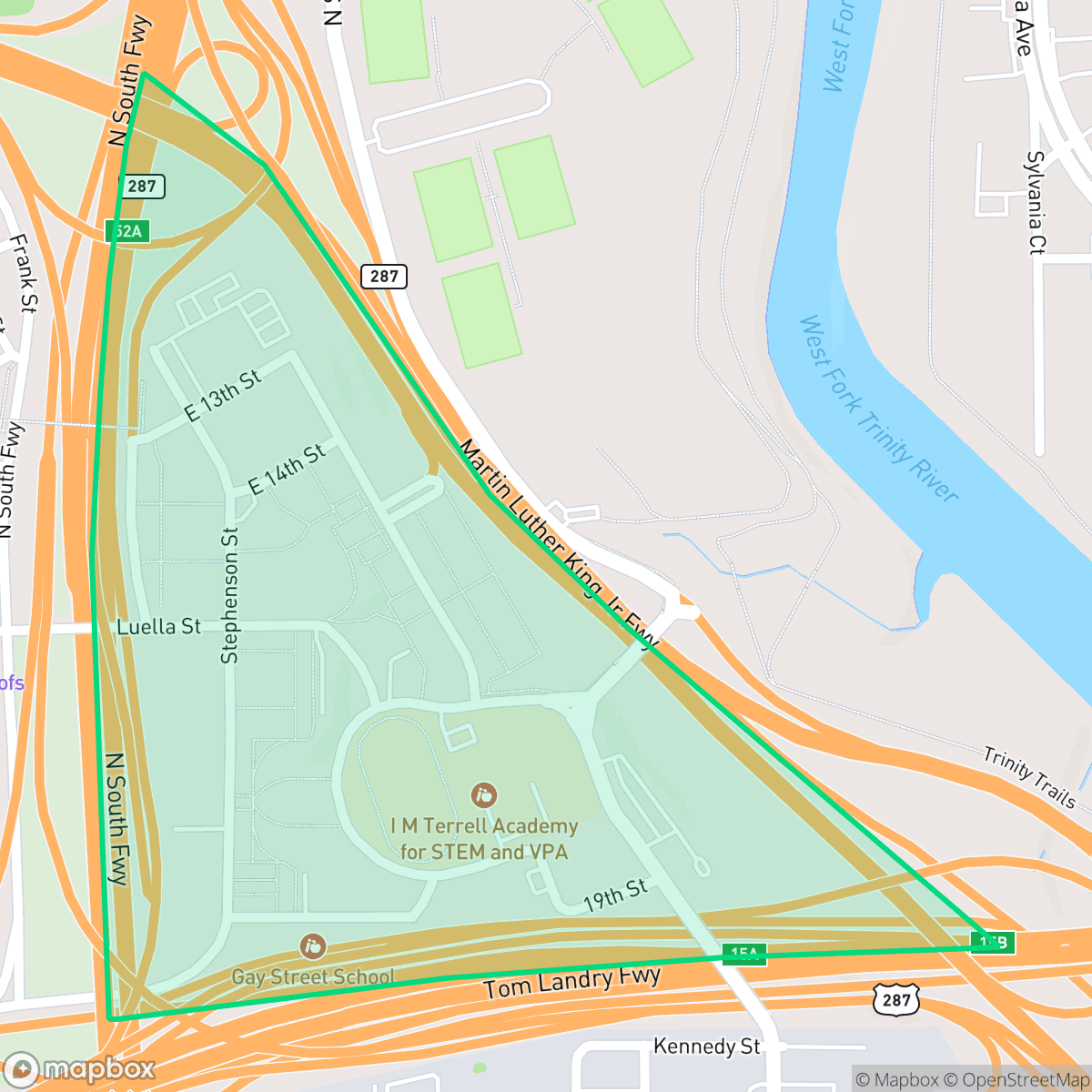
Butler is a quiet, industrial-adjacent neighborhood located east of downtown Fort Worth. The area features a mix of warehouse spaces and residential zones, characterized by significant road noise and limited pedestrian infrastructure.
Key Highlights
About Butler
Located east of downtown Fort Worth, the Butler neighborhood—historically centered around the Butler Place Historic District—was originally the site of a substandard settlement known as Chambers Hill. In 1940, it was redeveloped as one of the nation’s 52 New Deal-era public housing projects. Designed by a team of prominent local architects including Wiley G. Clarkson, the red-brick complex featured a minimal Colonial Revival and Moderne style. It was named in honor of Henry Harrison Butler, a Civil War veteran and the city’s first Black public school teacher. Although the construction of surrounding interstates in the late 1950s isolated the community, it maintained a vibrant cultural identity closely tied to the adjacent historic I.M. Terrell High School. Added to the National Register of Historic Places in 2011, the complex officially closed in 2020.
The area is defined by its proximity to major transportation infrastructure and industrial storage facilities. While the landscape is largely quiet and suburban in its layout, the presence of heavy truck traffic and highway proximity creates a distinct acoustic environment. The neighborhood serves as a functional transition zone between the urban core and surrounding industrial sectors, maintaining a low-density feel that contrasts with the nearby downtown district.
Residents should note that the location presents specific livability trade-offs, including limited pedestrian accessibility and high noise levels from nearby road traffic. According to iHuus data, the area faces challenges regarding flood safety and health insurance coverage, making it a niche environment for those prioritizing proximity to work hubs over traditional neighborhood amenities. While the broader local school district faces systemic instability, the nearby I.M. Terrell Academy for STEM and VPA provides a high-performing educational option for families in the region.
Neighborhood Scores Across 15 Qualities
Residential spacing is mixed, offering some buffer between neighbors. According to iHuus data, this level of privacy is slightly lower than the Fort Worth average.
Limited sidewalk availability and heavy traffic patterns make pedestrian travel uncomfortable. This area is significantly less walkable than the Fort Worth average, according to iHuus data.
Standard tract housing with tidy but small yards defines the area. This level of visual variety sits slightly below the Fort Worth average according to iHuus data.
Connected green spaces and wide, traffic-safe paths make this area more suitable for pet owners than the Fort Worth average, according to iHuus data.
Residential streets and green spaces are balanced by significant industrial blocks and major infrastructure. This area presents a more suburban character than the more densely urbanized parts of Fort Worth.
Primarily composed of industrial corridors and warehouses, this area lacks significant social activity and is notably less lively than the Fort Worth average. Residents will find the landscape focused on utility and transit, requiring a vehicle to access diverse dining or retail services.
Constant auditory disturbances characterize this area, with noise levels significantly higher than the Fort Worth average. Residents can expect much more ambient sound than is typical for the city.
Air quality in this area fluctuates between acceptable and unhealthy levels, though conditions remain slightly better than the Fort Worth average. Sensitive groups should monitor local reports for occasional periods of concern.
Significant logistics hubs, rail yards, and warehouse activity are present alongside residential areas. This concentration of heavy truck traffic and industrial processing is notably higher than the Fort Worth average, according to iHuus data.
Health insurance coverage among residents is notably lower than the Fort Worth average. According to iHuus data, a small portion of the population holds medical coverage.
Political leanings in this area are notably more liberal than the Fort Worth average. Residents will find a community with a significant liberal majority and a modest opposing presence, according to iHuus data.
Residents live alongside a balanced mix of young adults, families, and older individuals. According to iHuus data, this age distribution is slightly more varied than the average seen across Fort Worth.
Significant flood hazards exist in this area, placing it well above the Fort Worth average for risk. Residents should prepare for much higher insurance premiums and potential water damage concerns according to iHuus data.
Address-Level Insights for Butler


iHuus Neighborhood Intelligence Insights
Get address-level neighborhood insights for Butler
- Street-level scores — see how individual blocks compare, not just neighborhood averages
- Micro-zone boundaries — identify quiet pockets, flood boundaries, and walkable clusters before you visit
- 15 dimensions in full — walkability, noise, air quality, school quality, insurance coverage, population age profile, urban/rural index, and more
- Boundary risk alerts — know if your address sits near a block boundary where scores drop, the kind of detail no listing will ever mention
- School insights — individual school ratings and insights, not just district-level data
- Compare before you commit — side-by-side data across neighborhoods, down to block precision
No credit card required
Compare with Any Neighborhood
| Dimension | Butler | Alamo Heights |
|---|---|---|
| 🚶 Walkabilityavg 7.5 | ||
| 🔊 Acoustic Comfortavg 4.12 | ||
| 🤫 Privacy Indexavg 5.64 | ||
| 🎨 Visual Appealavg 6.38 | ||
| 🐕 Dog Friendlinessavg 6.57 | ||
| 🗺️ Urban-Rural Indexavg 6.92 | ||
| ✨ Neighborhood Vibeavg 4.56 | ||
| 🏥 Health Insurance Coverageavg 5.8 | ||
| 🌿 Air Qualityavg 3.68 | ||
| 🏭 Industrial Proximityavg 8.13 | ||
| 🌊 Flood Safetyavg 3.61 | ||
| 🗳️ Ideological Leanavg 5.62 | ||
| 👥 Population Age Profileavg 4.51 | ||
| 🔥 Fire Safety | ||
| 🏫 School Quality |
Butler Rankings
School Districts Serving Butler
School Insights for Butler
Below average outcomes; significant attendance and academic challenges.
School Insights
See what's really behind every school rating near Butler
- Individual school ratings — each school's own score with outcome context, not just a district average
- Enrollment & class size data — student-to-teacher ratio and how it compares to the state average
- Full demographics breakdown — ethnicity and gender composition for every school in the enrollment zone
- Every school in the district — all schools within the enrollment boundary ranked by rating, not just the closest one
- Grade levels & benchmarks — elementary through high school, with below/above state-average flags
No credit card required