Burchill, Fort Worth
Updated · 1,221 residents
Burchill is a dense, historic residential area in East Fort Worth characterized by its collection of 1920s craftsman bungalows and traditional single-family homes. While the neighborhood offers proximity to local dining, it experiences significant noise levels from nearby highway traffic and features limited privacy due to closely spaced housing.
Key Highlights
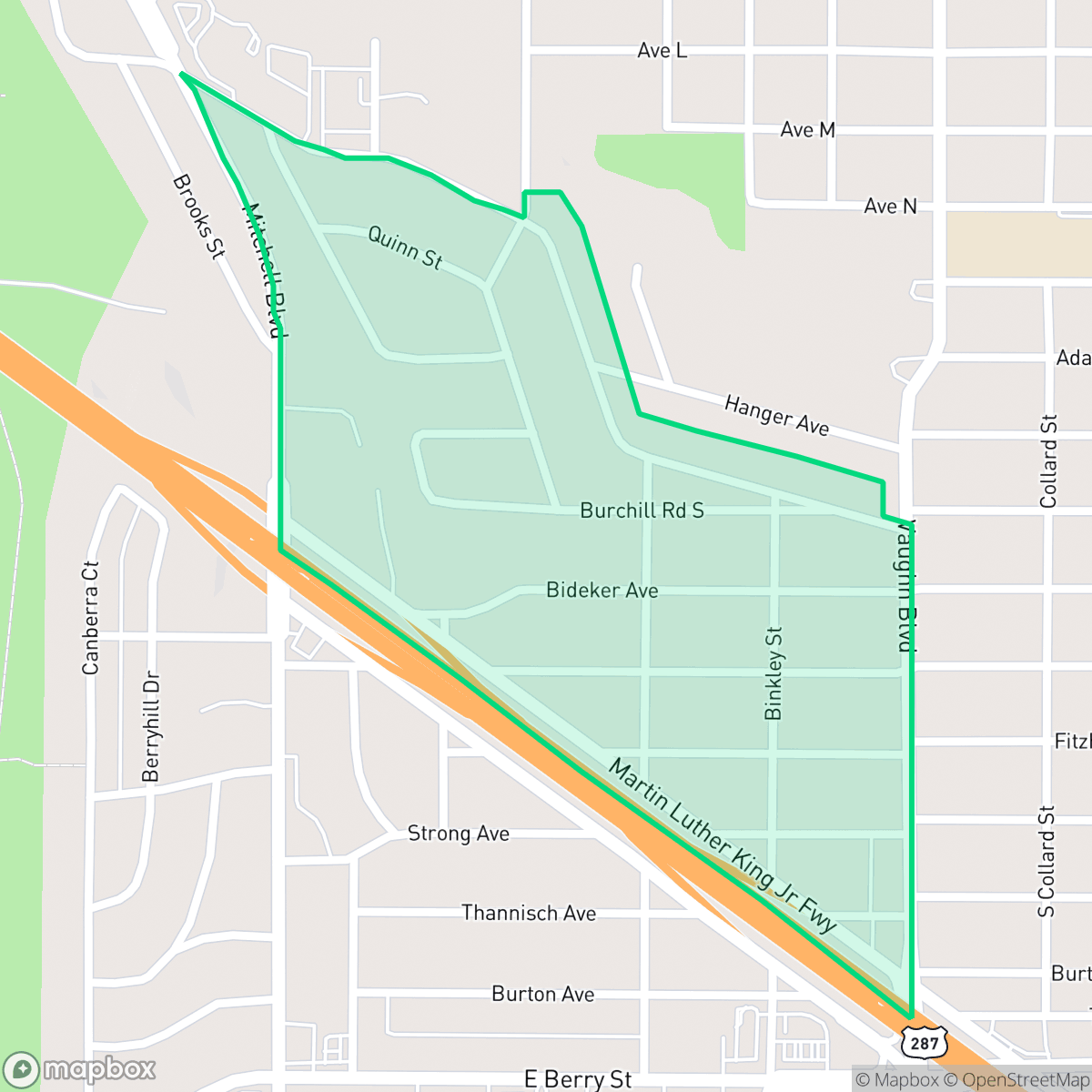
About Burchill
The Burchill neighborhood in east Fort Worth, originally developed as the Burch-Hill Addition around 1910, was established by pioneering educator and civic leader Kate Belle Burchill and her daughter, Edna M. Burchill. Kate Belle Burchill was a highly influential figure in early Fort Worth history, having opened the city's first free school in 1875, served as the city’s postmistress in the 1880s, and co-founded the Fort Worth Benevolent Home. Following her husband's death, she managed extensive real estate holdings and laid out the subdivision with her daughter. Today, the residential neighborhood features a diverse stock of historic housing, with many traditional single-family homes and craftsman-style bungalows dating back to the 1920s.
The area maintains a quiet, suburban grid layout that emphasizes residential density. Residents have access to neighborhood green spaces and local eateries like Delicias Aguascalientes, though the overall pace of the community is calm and low-key. The streetscape is defined by its modest, historic architecture, providing a consistent visual profile across the neighborhood.
Prospective residents should consider the trade-offs of living in this location, particularly regarding noise levels and school district performance. The area is situated near a major highway, which contributes to elevated ambient sound levels. Additionally, the local school district faces significant operational and financial challenges. This neighborhood may be best suited for individuals who prioritize historic character and proximity to major thoroughfares over high-end amenities or absolute quiet.
Neighborhood Scores Across 15 Qualities
Residential spacing varies throughout the area, with some homes situated closely together. According to iHuus data, the level of separation between neighbors is slightly lower than the Fort Worth average.
Sidewalk availability varies across the neighborhood, with many residential blocks featuring visible paths and safe crossings. Pedestrian accessibility is slightly lower than the Fort Worth average due to some streets lacking dedicated sidewalks.
Streetscapes consist of modest homes with simple rooflines and small yards. This area features fewer luxury amenities and more vacant lots than the Fort Worth average, according to iHuus data.
Wooded green belts and a large central park offer reliable areas for pet walking. This level of accessibility to open space is roughly in line with the Fort Worth average.
Residential pockets feature a blend of single-family homes and institutional buildings, though the area feels slightly less open than the Fort Worth average. According to iHuus data, the landscape consists of a dense suburban grid interspersed with pockets of woodland and fields.
Low density of commercial activity and a focus on light industrial uses result in a subdued atmosphere that is below the Fort Worth average. Most daily amenities are car-oriented, though some local dining and religious services are accessible via nearby streets.
Persistent noise from nearby rail lines and major freeways makes this area significantly louder than the Fort Worth average. Residents should expect frequent auditory disturbances from heavy transit traffic according to iHuus data.
Air quality in Burchill fluctuates between acceptable and unhealthy levels, though it remains slightly better than the Fort Worth average. Sensitive groups may experience occasional concern on certain days according to iHuus data.
Occasional warehouses and nearby highway traffic introduce some noise and dust, though the area remains primarily residential. According to iHuus data, the presence of heavy industrial plants is lower here than in most of Fort Worth.
Health insurance coverage is significantly lower than the Fort Worth average. This lack of coverage may present challenges for residents seeking regular medical care according to iHuus data.
Voting patterns and census indicators show a predominantly liberal political leaning, which is significantly more pronounced here than in the Fort Worth average.
A diverse range of age groups resides here, including young adults, families, and older residents. This demographic spread is relatively consistent with the broader Fort Worth area, according to iHuus data.
Significant flood vulnerability exists in this area, which is much higher than the Fort Worth average. Residents should prepare for potential elevation requirements and notably elevated insurance premiums according to iHuus data.
Address-Level Insights for Burchill


iHuus Neighborhood Intelligence Insights
Get address-level neighborhood insights for Burchill
- Street-level scores — see how individual blocks compare, not just neighborhood averages
- Micro-zone boundaries — identify quiet pockets, flood boundaries, and walkable clusters before you visit
- 15 dimensions in full — walkability, noise, air quality, school quality, insurance coverage, population age profile, urban/rural index, and more
- Boundary risk alerts — know if your address sits near a block boundary where scores drop, the kind of detail no listing will ever mention
- School insights — individual school ratings and insights, not just district-level data
- Compare before you commit — side-by-side data across neighborhoods, down to block precision
No credit card required
Compare with Any Neighborhood
| Dimension | Burchill | Alamo Heights |
|---|---|---|
| 🚶 Walkabilityavg 7.5 | ||
| 🔊 Acoustic Comfortavg 4.12 | ||
| 🤫 Privacy Indexavg 5.64 | ||
| 🎨 Visual Appealavg 6.38 | ||
| 🐕 Dog Friendlinessavg 6.57 | ||
| 🗺️ Urban-Rural Indexavg 6.92 | ||
| ✨ Neighborhood Vibeavg 4.56 | ||
| 🏥 Health Insurance Coverageavg 5.8 | ||
| 🌿 Air Qualityavg 3.68 | ||
| 🏭 Industrial Proximityavg 8.13 | ||
| 🌊 Flood Safetyavg 3.61 | ||
| 🗳️ Ideological Leanavg 5.62 | ||
| 👥 Population Age Profileavg 4.51 | ||
| 🔥 Fire Safety | ||
| 🏫 School Quality |
Burchill Rankings
School Districts Serving Burchill
School Insights for Burchill
Below average outcomes; significant attendance and academic challenges.
School Insights
See what's really behind every school rating near Burchill
- Individual school ratings — each school's own score with outcome context, not just a district average
- Enrollment & class size data — student-to-teacher ratio and how it compares to the state average
- Full demographics breakdown — ethnicity and gender composition for every school in the enrollment zone
- Every school in the district — all schools within the enrollment boundary ranked by rating, not just the closest one
- Grade levels & benchmarks — elementary through high school, with below/above state-average flags
No credit card required