Bunch-Ellington, Fort Worth
Updated · 40 residents
Bunch-Ellington is a quiet residential pocket in southeast Fort Worth characterized by its mid-century homes and strong community roots. While the area offers a calm suburban atmosphere, residents experience notable noise levels from nearby road traffic and limited walkability.
Key Highlights
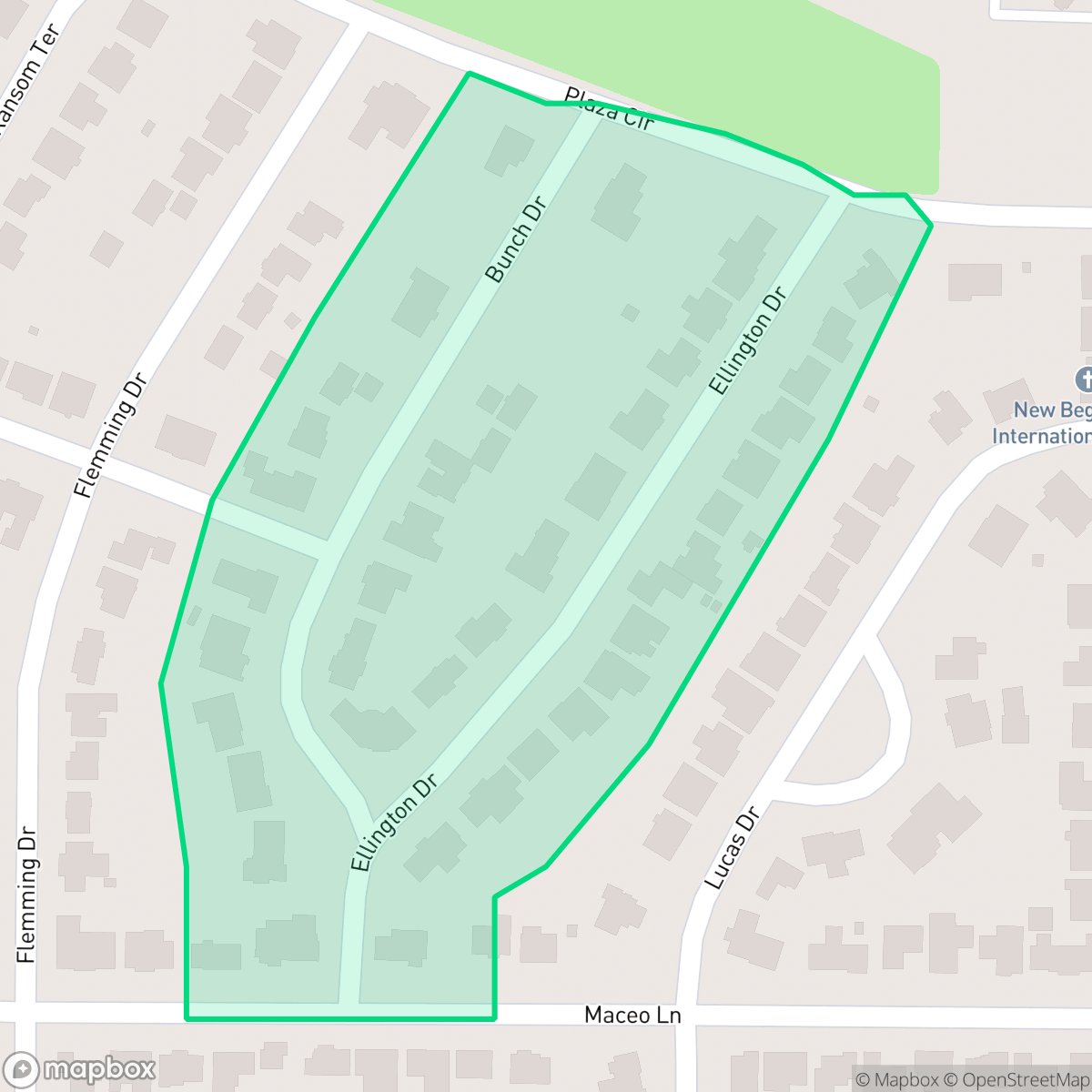
About Bunch-Ellington
Bunche-Ellington (often spelled Bunch-Ellington) is a historic, predominantly African American residential enclave nestled within the larger Stop Six neighborhood of southeast Fort Worth, Texas. Developed primarily between 1940 and 1969, the neighborhood features well-established, mid-century single-family homes. A defining element of its cultural identity is the Bunche-Ellington Neighborhood Club, founded in 1967 by residents of Bunche and Ellington streets to combat local crime and foster civic pride. This tight-knit community organization became a highly successful model for local grassroots neighborhood watch programs. Notable community leaders have been closely associated with the enclave, including former Fort Worth City Councilman and Mayor Pro-Tem Bert Charles Williams, who served as the club's president.
The area functions as a calm residential enclave that balances suburban living with proximity to light industrial zones. It maintains a distinct identity through its established housing stock and a long history of grassroots civic engagement. The landscape features a mix of residential streets and green spaces, anchored by local facilities like the Empowerment Center. According to iHuus data, the neighborhood benefits from relatively high flood safety compared to the broader city, providing a stable physical environment for its long-term residents.
Prospective residents should consider the trade-offs of living in this part of Fort Worth, particularly regarding acoustic comfort and school district performance. The area experiences significant road noise, and the Fort Worth Independent School District faces ongoing operational challenges that impact local educational outcomes. The neighborhood is best suited for those who prioritize community stability and established residential character over immediate access to high-walkability commercial corridors or quiet, low-traffic environments.
Neighborhood Scores Across 15 Qualities
Residential spacing in Bunch-Ellington offers a balanced level of separation between neighbors, sitting slightly above the Fort Worth average. This moderate density provides a mix of open buffer zones and closer-set structures.
Pedestrian access is limited by sidewalks being present on only one side of many streets, making it slightly less walkable than the Fort Worth average. Safe crossings are available, but the area may require more driving for certain errands compared to more pedestrian-friendly districts.
Standard tract housing characterizes this area, featuring tidy but small yards and boxy rooflines. According to iHuus data, the visual variety in the neighborhood is slightly below the Fort Worth average.
Connected green spaces and wide, traffic-safe paths provide adequate areas for pet owners. This level of accessibility is consistent with the Fort Worth average.
Open land and scattered homes among woodlands characterize this area. This setting is slightly less developed than the typical Fort Worth landscape according to iHuus data.
The area offers a calm, low-activity atmosphere characterized by light industrial units, green spaces, and community centers. This level of activity is slightly lower than the Fort Worth average, providing a more subdued environment than more bustling parts of the city.
Frequent disturbances from nearby railroad tracks and heavy freeway traffic characterize the area. According to iHuus data, acoustic comfort in Bunch-Ellington is lower than the Fort Worth average.
Air quality fluctuates between acceptable and unhealthy levels, though conditions remain slightly better than the Fort Worth average according to iHuus data. Sensitive individuals may experience occasional concern during periods of poor air quality.
Light industrial and commercial units exist alongside residential developments, resulting in a lower concentration of industrial activity than the Fort Worth average. According to iHuus data, this mix creates a landscape of active daytime commercial traffic integrated with housing.
Health insurance coverage among residents is notably lower than the Fort Worth average. According to iHuus data, a significant portion of the population lacks coverage, which may impact local access to preventative medical services.
Voting patterns and census indicators in this area reflect a significantly more liberal leaning than the Fort Worth average, according to iHuus data.
Residents live alongside a balanced mix of young professionals, families, and seniors. According to iHuus data, this age distribution is slightly more varied than the Fort Worth average.
Flood risk in this area is higher than the Fort Worth average, though FEMA has not yet completed a detailed study to fully classify the danger. According to iHuus data, residents should remain cautious as the specific level of risk remains undetermined.
Address-Level Insights for Bunch-Ellington


iHuus Neighborhood Intelligence Insights
Get address-level neighborhood insights for Bunch-Ellington
- Street-level scores — see how individual blocks compare, not just neighborhood averages
- Micro-zone boundaries — identify quiet pockets, flood boundaries, and walkable clusters before you visit
- 15 dimensions in full — walkability, noise, air quality, school quality, insurance coverage, population age profile, urban/rural index, and more
- Boundary risk alerts — know if your address sits near a block boundary where scores drop, the kind of detail no listing will ever mention
- School insights — individual school ratings and insights, not just district-level data
- Compare before you commit — side-by-side data across neighborhoods, down to block precision
No credit card required
Compare with Any Neighborhood
| Dimension | Bunch-Ellington | Alamo Heights |
|---|---|---|
| 🚶 Walkabilityavg 7.5 | ||
| 🔊 Acoustic Comfortavg 4.12 | ||
| 🤫 Privacy Indexavg 5.64 | ||
| 🎨 Visual Appealavg 6.38 | ||
| 🐕 Dog Friendlinessavg 6.57 | ||
| 🗺️ Urban-Rural Indexavg 6.92 | ||
| ✨ Neighborhood Vibeavg 4.56 | ||
| 🏥 Health Insurance Coverageavg 5.8 | ||
| 🌿 Air Qualityavg 3.68 | ||
| 🏭 Industrial Proximityavg 8.13 | ||
| 🌊 Flood Safetyavg 3.61 | ||
| 🗳️ Ideological Leanavg 5.62 | ||
| 👥 Population Age Profileavg 4.51 | ||
| 🔥 Fire Safety | ||
| 🏫 School Quality |
Bunch-Ellington Rankings
School Districts Serving Bunch-Ellington
School Insights for Bunch-Ellington
Below average outcomes; significant attendance and academic challenges.
School Insights
See what's really behind every school rating near Bunch-Ellington
- Individual school ratings — each school's own score with outcome context, not just a district average
- Enrollment & class size data — student-to-teacher ratio and how it compares to the state average
- Full demographics breakdown — ethnicity and gender composition for every school in the enrollment zone
- Every school in the district — all schools within the enrollment boundary ranked by rating, not just the closest one
- Grade levels & benchmarks — elementary through high school, with below/above state-average flags
No credit card required