Bomber Heights, Fort Worth
Updated · 4,856 residents
Bomber Heights is a mid-century residential neighborhood in west Fort Worth defined by its post-war housing and proximity to major aviation hubs. While the area offers a quiet, suburban atmosphere with high rates of health insurance coverage, residents experience significant road traffic noise and limited walkability due to a lack of sidewalks.
Key Highlights
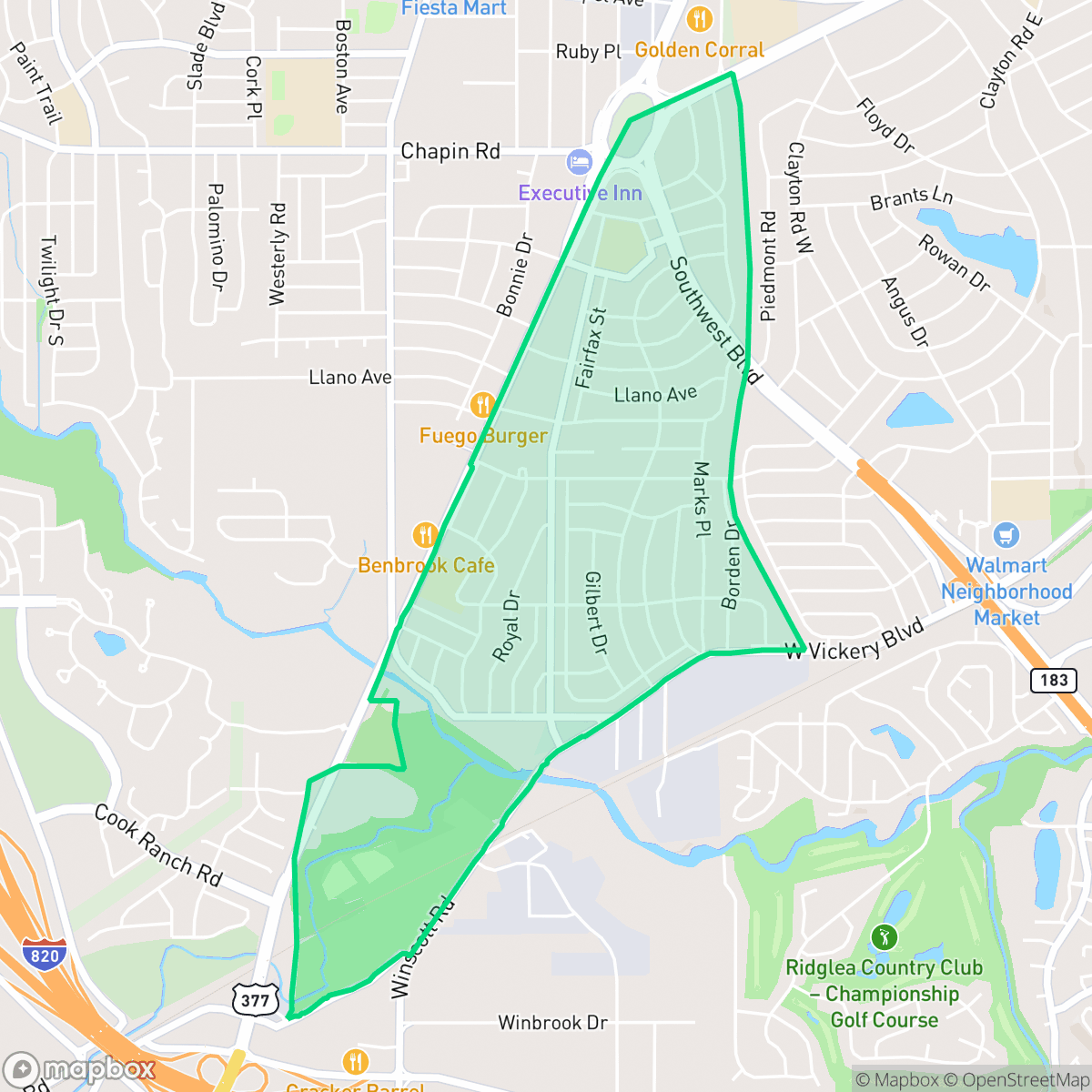
About Bomber Heights
Located in west Fort Worth, the Bomber Heights neighborhood was established in the late 1940s to house thousands of workers and their families employed at the nearby Convair "bomber plant" (now Lockheed Martin) and Carswell Air Force Base. The neighborhood’s development was directly tied to the production of the massive Consolidated Vultee B-36 Peacemaker strategic bomber. Architecturally, the area is characterized by mid-20th-century single-family homes, including Fort Worth’s only known Lustron prefabricated steel house, built in 1949. Local heritage is preserved at Z. Boaz Bomber Heights Park, which features public art honoring the B-36, and the Bomber Spur Trail, a multi-use path built along an abandoned railroad line that once served the historic aircraft plant.
The neighborhood maintains a dense, suburban fabric characterized by single-family homes on small lots, reflecting its mid-20th-century development roots. Residents benefit from a stable environment with high health insurance coverage, though the area faces challenges regarding acoustic comfort, as road traffic noise levels average 64 decibels. The landscape is primarily residential with pockets of light commercial and industrial activity, creating a functional but quiet atmosphere that prioritizes private, fenced-in yards over large public green spaces. For prospective residents, the area presents a trade-off between its historical character and modern infrastructure limitations. While it lacks the high walkability scores found in other parts of Fort Worth, the neighborhood remains a practical choice for those working in nearby industrial or aviation sectors. According to iHuus data, the area is notably resilient to flooding, though families should carefully evaluate local school options, as the broader district faces operational instability despite the presence of high-performing specialty schools like the World Languages Institute.
Neighborhood Scores Across 15 Qualities
Residential spacing provides a modest buffer between neighbors, offering slightly more separation than the Fort Worth average. According to iHuus data, houses are situated at moderate densities typical of established suburban blocks.
Low-traffic residential streets provide a calm environment for walking, though a lack of consistent sidewalks makes the area less walkable than many parts of Fort Worth. According to iHuus data, the wide pavements and minimal vehicle activity allow for easy movement despite the absence of dedicated pedestrian paths.
Standard tract housing with uniform rooflines and small yards defines much of the landscape. According to iHuus data, the visual character of this area is roughly comparable to the Fort Worth average.
Private fenced yards are common here, but the lack of large public parks and narrow sidewalk verges makes this area less dog friendly than the Fort Worth average.
Residential areas consist of low-density housing interspersed with small commercial and industrial clusters. This layout is slightly more developed than the typical semi-rural character found across Fort Worth, according to iHuus data.
Low-density residential streets and light industrial zones create a subdued atmosphere that is less active than the Fort Worth average. While occasional dining and wellness spots provide a steady rhythm of life, the car-dependent layout offers limited opportunities for spontaneous social interaction or walking to local services.
Frequent disturbances from nearby railroad tracks and heavy freeway traffic characterize the area. According to iHuus data, acoustic comfort in this neighborhood is lower than the Fort Worth average.
Air quality levels fluctuate between acceptable and unhealthy at times, posing occasional concerns for sensitive groups. This environment is slightly less clear than the Fort Worth average, according to iHuus data.
Residential life remains largely uninterrupted by heavy industry, as the area consists primarily of housing and light commercial zones. According to iHuus data, this lack of industrial activity is consistent with the broader Fort Worth average.
Health insurance access is notably higher here than the Fort Worth average, according to iHuus data. Most residents in the area are covered by a health insurance plan.
Political leanings in this area are notably more conservative than the Fort Worth average. Residents will find a clear conservative majority with a modest presence of opposing viewpoints.
Residents live alongside a balanced mix of young adults, families, and seniors. According to iHuus data, this age distribution is slightly more varied than the Fort Worth average.
Property located within a 100-year floodplain face significant flood risks, and residents should expect that flood insurance is typically required. This level of risk is consistent with the average seen across Fort Worth.
Address-Level Insights for Bomber Heights


iHuus Neighborhood Intelligence Insights
Get address-level neighborhood insights for Bomber Heights
- Street-level scores — see how individual blocks compare, not just neighborhood averages
- Micro-zone boundaries — identify quiet pockets, flood boundaries, and walkable clusters before you visit
- 15 dimensions in full — walkability, noise, air quality, school quality, insurance coverage, population age profile, urban/rural index, and more
- Boundary risk alerts — know if your address sits near a block boundary where scores drop, the kind of detail no listing will ever mention
- School insights — individual school ratings and insights, not just district-level data
- Compare before you commit — side-by-side data across neighborhoods, down to block precision
No credit card required
Compare with Any Neighborhood
| Dimension | Bomber Heights | Alamo Heights |
|---|---|---|
| 🚶 Walkabilityavg 7.5 | ||
| 🔊 Acoustic Comfortavg 4.12 | ||
| 🤫 Privacy Indexavg 5.64 | ||
| 🎨 Visual Appealavg 6.38 | ||
| 🐕 Dog Friendlinessavg 6.57 | ||
| 🗺️ Urban-Rural Indexavg 6.92 | ||
| ✨ Neighborhood Vibeavg 4.56 | ||
| 🏥 Health Insurance Coverageavg 5.8 | ||
| 🌿 Air Qualityavg 3.68 | ||
| 🏭 Industrial Proximityavg 8.13 | ||
| 🌊 Flood Safetyavg 3.61 | ||
| 🗳️ Ideological Leanavg 5.62 | ||
| 👥 Population Age Profileavg 4.51 | ||
| 🔥 Fire Safety | ||
| 🏫 School Quality |
Bomber Heights Rankings
School Districts Serving Bomber Heights
School Insights for Bomber Heights
Below average outcomes; significant attendance and academic challenges.
School Insights
See what's really behind every school rating near Bomber Heights
- Individual school ratings — each school's own score with outcome context, not just a district average
- Enrollment & class size data — student-to-teacher ratio and how it compares to the state average
- Full demographics breakdown — ethnicity and gender composition for every school in the enrollment zone
- Every school in the district — all schools within the enrollment boundary ranked by rating, not just the closest one
- Grade levels & benchmarks — elementary through high school, with below/above state-average flags
No credit card required