Bluebonnet Place, Fort Worth
Updated · 965 residents
Bluebonnet Place is a highly walkable neighborhood known for its dense residential layout and convenient access to local commercial hubs. While the area offers a vibrant atmosphere, residents should expect moderate noise levels from nearby traffic and limited private outdoor space.
Key Highlights
About Bluebonnet Place
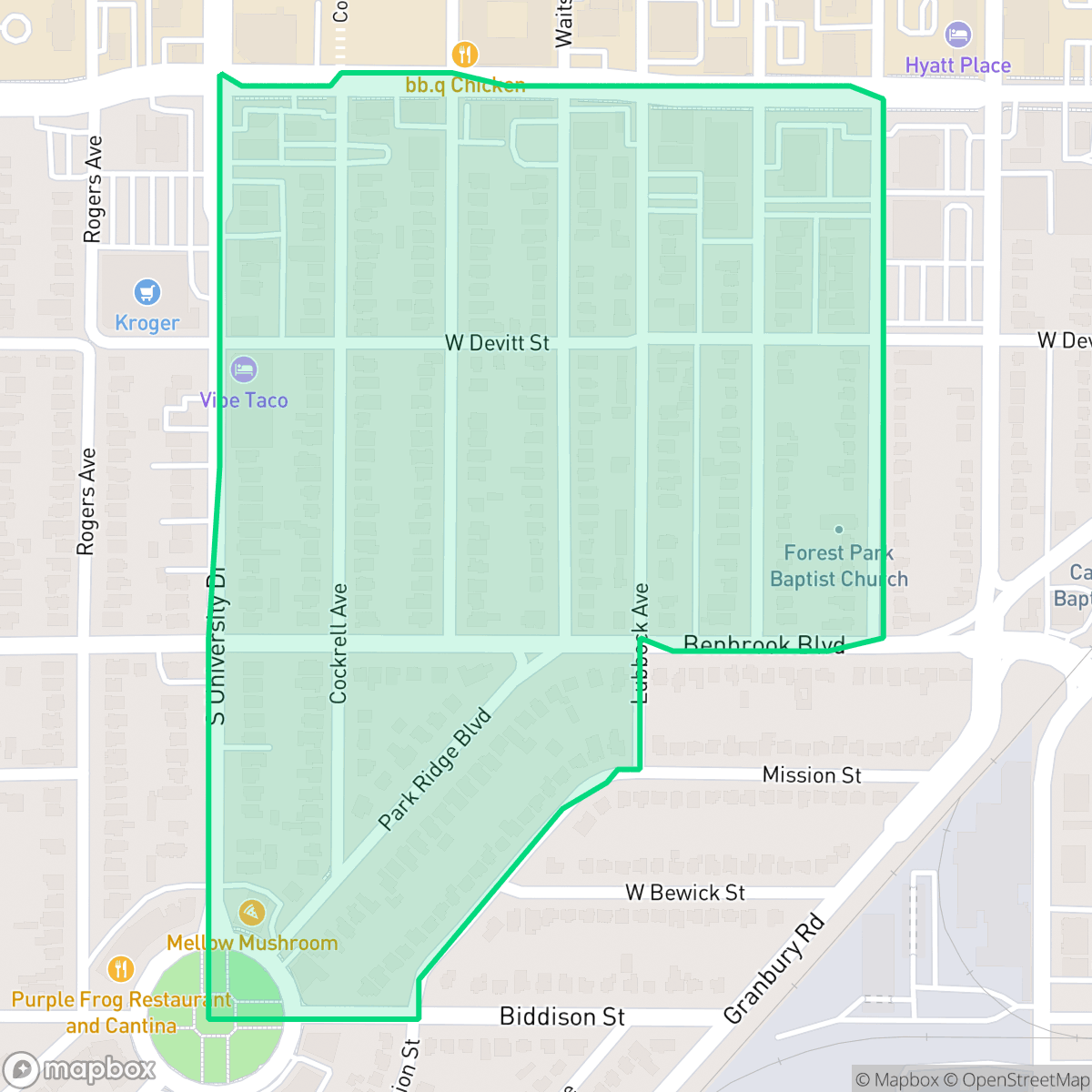
Located four miles southwest of downtown Fort Worth, Bluebonnet Place—originally platted in 1929 as Bluebonnet Hills—occupies 165.5 acres of the historic 1864 Elijah Sutherland Survey. Development of the neighborhood began in 1930, with major construction led by the Bluebonnet Hills Development Company starting in 1932. The area's history is closely tied to neighboring Texas Christian University; Edgevale Street was renamed Stadium Drive in 1929 when TCU's football stadium was built there. Annexed by Fort Worth in 1937, the neighborhood is anchored by the historic Bluebonnet Circle traffic hub. Architecturally, Bluebonnet Place is defined by its charming 1920s and 1930s prairie bungalows and Tudor cottages, though it has evolved into a highly walkable enclave popular with students.
The neighborhood functions as a lively urban enclave that balances its historic architectural roots with modern, high-density residential needs. According to iHuus data, the area maintains a high walkability score, allowing residents to easily access local amenities such as coffee shops and dining clusters. The streetscape is characterized by a mix of mid-century housing and newer multi-family developments, creating a diverse environment that remains well-connected to the broader Fort Worth region.
Prospective residents should consider several trade-offs, including a lower privacy index due to narrow setbacks between homes and a lack of expansive public green space for pets. Acoustic comfort is impacted by road and rail traffic, and the local school district, Fort Worth ISD, currently faces significant operational and financial challenges. Furthermore, the area has limited flood safety protections, making it essential for homeowners to review local hazard disclosures carefully before settling in this compact, active community.
Neighborhood Scores Across 15 Qualities
Neighboring structures often feature narrow side-yard setbacks, which provides less separation than the Fort Worth average. According to iHuus data, some areas contain dense residential lots and multi-unit housing that offer limited distance between properties.
Extensive sidewalk networks and pedestrian-friendly roundabouts make navigating the area on foot very easy. This level of connectivity is significantly higher than the Fort Worth average, according to iHuus data.
Large, well-maintained residences and frequent private amenities like backyard pools contribute to a landscape that is more aesthetically pleasing than the Fort Worth average. According to iHuus data, the area features spacious driveways and significant greenery throughout the residential blocks.
Access to large campus lawns and nearby public parks provides ample space for pets. According to iHuus data, the area offers slightly better access to green spaces than the Fort Worth average.
Residential grids and green spaces exist in roughly equal measure, providing a more suburban feel than the denser urban average for Fort Worth. According to iHuus data, the area features a blend of single-family housing and institutional spaces such as nearby campus buildings.
Frequent activity and a notable concentration of local dining and retail options make this area significantly more lively than the Fort Worth average. Residents have access to a diverse range of social hubs, including coffee shops, parks, and various eateries, according to iHuus data.
Steady traffic hum from a nearby busy street is present, though levels remain slightly more tranquil than the Fort Worth average according to iHuus data.
Air quality in this area fluctuates between acceptable and unhealthy levels, though it remains slightly better than the Fort Worth average. Sensitive groups should monitor local conditions for occasional periods of concern according to iHuus data.
Industrial presence is minimal within this area, which is notably lower than the Fort Worth average. According to iHuus data, the landscape is composed of residential and institutional structures without any detected heavy industrial hazards or warehouses.
Health insurance access is notably higher here than the Fort Worth average, according to iHuus data. This suggests a more stable level of healthcare accessibility for the local population.
Political views in this area are evenly distributed between conservative and liberal leanings, representing a more moderate landscape than the Fort Worth average.
Young adults represent the largest demographic segment in this area, which is notably younger than the Fort Worth average. According to iHuus data, the neighborhood features a modest presence of families and older residents.
Flood risk in this area is higher than the Fort Worth average, though current FEMA studies for the neighborhood remain incomplete. Residents should remain aware of potential vulnerabilities due to the lack of a detailed flood study for this specific location.
Address-Level Insights for Bluebonnet Place


iHuus Neighborhood Intelligence Insights
Get address-level neighborhood insights for Bluebonnet Place
- Street-level scores — see how individual blocks compare, not just neighborhood averages
- Micro-zone boundaries — identify quiet pockets, flood boundaries, and walkable clusters before you visit
- 15 dimensions in full — walkability, noise, air quality, school quality, insurance coverage, population age profile, urban/rural index, and more
- Boundary risk alerts — know if your address sits near a block boundary where scores drop, the kind of detail no listing will ever mention
- School insights — individual school ratings and insights, not just district-level data
- Compare before you commit — side-by-side data across neighborhoods, down to block precision
No credit card required
Compare with Any Neighborhood
| Dimension | Bluebonnet Place | Alamo Heights |
|---|---|---|
| 🚶 Walkabilityavg 7.5 | ||
| 🔊 Acoustic Comfortavg 4.12 | ||
| 🤫 Privacy Indexavg 5.64 | ||
| 🎨 Visual Appealavg 6.38 | ||
| 🐕 Dog Friendlinessavg 6.57 | ||
| 🗺️ Urban-Rural Indexavg 6.92 | ||
| ✨ Neighborhood Vibeavg 4.56 | ||
| 🏥 Health Insurance Coverageavg 5.8 | ||
| 🌿 Air Qualityavg 3.68 | ||
| 🏭 Industrial Proximityavg 8.13 | ||
| 🌊 Flood Safetyavg 3.61 | ||
| 🗳️ Ideological Leanavg 5.62 | ||
| 👥 Population Age Profileavg 4.51 | ||
| 🔥 Fire Safety | ||
| 🏫 School Quality |
Bluebonnet Place Rankings
School Districts Serving Bluebonnet Place
School Insights for Bluebonnet Place
Below average outcomes; significant attendance and academic challenges.
School Insights
See what's really behind every school rating near Bluebonnet Place
- Individual school ratings — each school's own score with outcome context, not just a district average
- Enrollment & class size data — student-to-teacher ratio and how it compares to the state average
- Full demographics breakdown — ethnicity and gender composition for every school in the enrollment zone
- Every school in the district — all schools within the enrollment boundary ranked by rating, not just the closest one
- Grade levels & benchmarks — elementary through high school, with below/above state-average flags
No credit card required