Bluebonnet Hills, Fort Worth
Updated · 1,237 residents
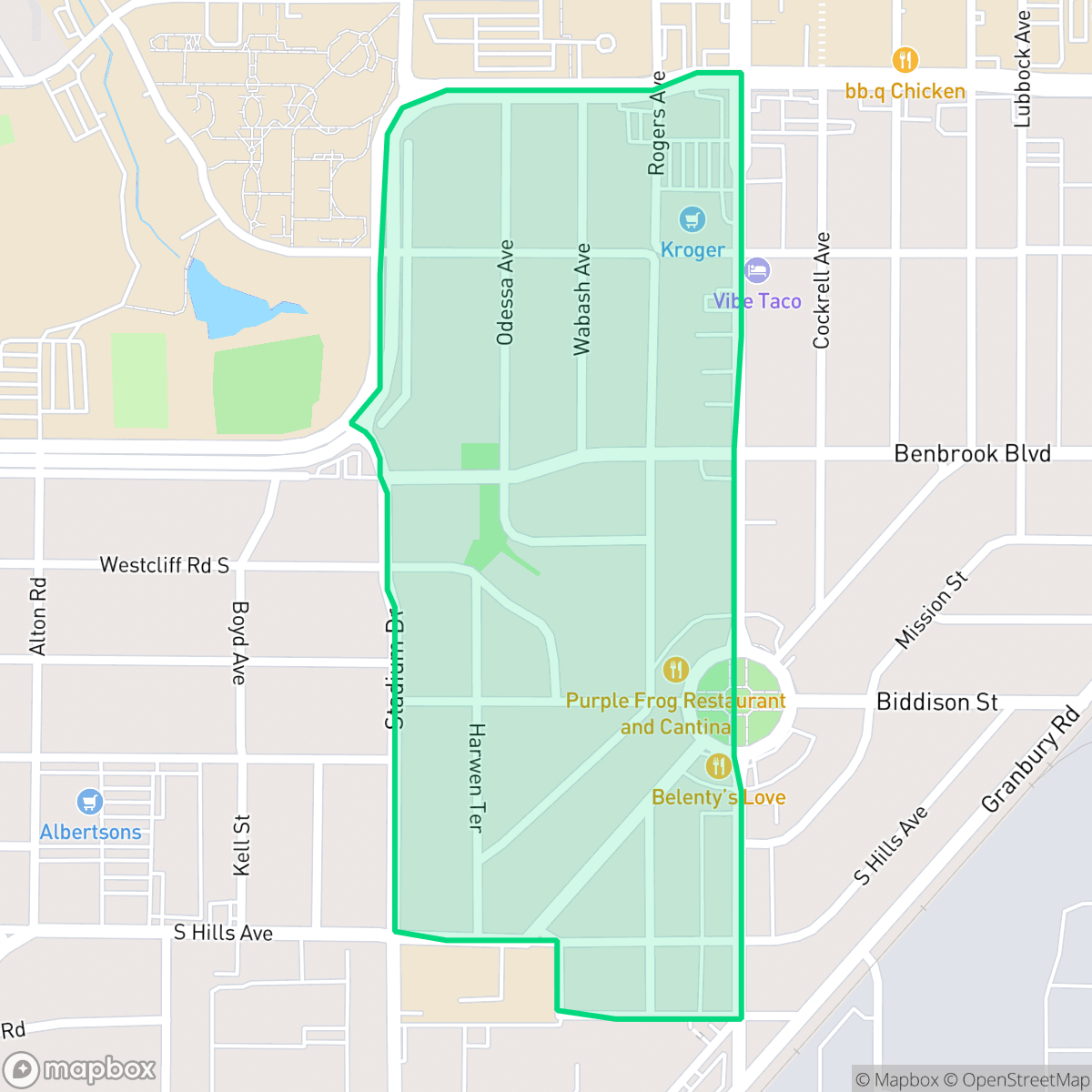
Bluebonnet Hills is a highly walkable neighborhood defined by its central circular plaza and proximity to Texas Christian University. Residents enjoy a vibrant local atmosphere with diverse dining options and accessible green spaces, though the area experiences moderate road noise.
Key Highlights
About Bluebonnet Hills
Platted in 1929 on the 1864 Elijah Sutherland survey, Bluebonnet Hills is a historic neighborhood in southwest Fort Worth, Texas, located near Texas Christian University. Developed primarily in the 1930s by the Bluebonnet Hills Development Company, the neighborhood was designed as a middle-class enclave with strict deed restrictions requiring homes to cost at least $3,500. It was annexed by the city in 1937. Architecturally, Bluebonnet Hills is defined by its well-preserved, one-story Period Revival homes, including Tudor cottages and Prairie-style bungalows. At the heart of the community lies Blue Bonnet Circle Park, a 1.25-acre green space established in 1949 within Fort Worth's first traffic circle. Designed by the renowned landscape architecture firm Hare and Hare, the park and its surrounding circular plaza serve as a central hub for local businesses and residents.
The area functions as a dense, pedestrian-oriented enclave where the layout encourages movement through consistent sidewalk infrastructure. With exceptional walkability, the neighborhood provides immediate access to local businesses and public parks, creating a lively suburban environment that balances institutional proximity with residential comfort. The visual appeal remains high, characterized by well-maintained properties and mature landscaping that contributes to a cohesive aesthetic.
Prospective residents should weigh the benefits of the neighborhood's connectivity against the moderate ambient noise levels caused by local road traffic. While the area offers significant advantages in terms of design and accessibility, families should consider the current operational challenges facing the local school district. The neighborhood is well-suited for those who prioritize a walkable lifestyle and an active, community-focused setting over absolute quiet or top-tier public schooling.
Neighborhood Scores Across 15 Qualities
Residential lots feature moderate density with consistent yard buffers between neighbors. This level of privacy is slightly higher than the Fort Worth average, according to iHuus data.
Pedestrian infrastructure is well-developed with sidewalks on both sides of most streets and accessible roundabouts. This area offers greater walkability than the Fort Worth average, according to iHuus data.
Large, well-maintained homes and frequent private amenities like backyard pools contribute to a visual appeal that is above the Fort Worth average. According to iHuus data, the area is characterized by expansive driveways and significant greenery.
Access to a large public park and green buffers between sidewalks and streets provides safe walking routes for pets. This level of accessibility is consistent with the Fort Worth average.
Open landscapes and scattered woodland areas provide a more rural atmosphere than the Fort Worth average. Some portions of the neighborhood transition into a denser suburban layout near local institutional campuses.
Local amenities and dining options provide more activity than the typical Fort Worth neighborhood. Residents can find a mix of quiet residential streets and accessible spots like cafes, parks, and local eateries.
A steady hum from nearby busy streets provides a more active acoustic environment than the Fort Worth average. According to iHuus data, this level of sound is noticeable but typical for a residential area near local transit corridors.
Air quality levels fluctuate between acceptable and unhealthy, presenting occasional concerns for sensitive groups. According to iHuus data, conditions in this area are slightly better than the Fort Worth average.
Primarily residential in character, this area lacks significant industrial warehouses or factories and maintains a cleaner profile than the Fort Worth average. Local surroundings consist mostly of residential and institutional structures with only occasional light commercial activity.
Health insurance enrollment among residents is significantly higher than the Fort Worth average, according to iHuus data.
Political leanings in this area are split relatively evenly between conservative and liberal residents; this represents a more moderate ideological balance than the broader Fort Worth average, according to iHuus data.
A majority of residents are young adults, making the demographic profile notably younger than the Fort Worth average. According to iHuus data, the area features a modest presence of families and older residents.
Flood safety in this area is significantly higher than the Fort Worth average, though some residual risk remains due to proximity to the 500-year floodplain. According to iHuus data, the neighborhood is situated in a zone that is generally considered more secure than most parts of the city.
Address-Level Insights for Bluebonnet Hills


iHuus Neighborhood Intelligence Insights
Get address-level neighborhood insights for Bluebonnet Hills
- Street-level scores — see how individual blocks compare, not just neighborhood averages
- Micro-zone boundaries — identify quiet pockets, flood boundaries, and walkable clusters before you visit
- 15 dimensions in full — walkability, noise, air quality, school quality, insurance coverage, population age profile, urban/rural index, and more
- Boundary risk alerts — know if your address sits near a block boundary where scores drop, the kind of detail no listing will ever mention
- School insights — individual school ratings and insights, not just district-level data
- Compare before you commit — side-by-side data across neighborhoods, down to block precision
No credit card required
Compare with Any Neighborhood
| Dimension | Bluebonnet Hills | Alamo Heights |
|---|---|---|
| 🚶 Walkabilityavg 7.5 | ||
| 🔊 Acoustic Comfortavg 4.12 | ||
| 🤫 Privacy Indexavg 5.64 | ||
| 🎨 Visual Appealavg 6.38 | ||
| 🐕 Dog Friendlinessavg 6.57 | ||
| 🗺️ Urban-Rural Indexavg 6.92 | ||
| ✨ Neighborhood Vibeavg 4.56 | ||
| 🏥 Health Insurance Coverageavg 5.8 | ||
| 🌿 Air Qualityavg 3.68 | ||
| 🏭 Industrial Proximityavg 8.13 | ||
| 🌊 Flood Safetyavg 3.61 | ||
| 🗳️ Ideological Leanavg 5.62 | ||
| 👥 Population Age Profileavg 4.51 | ||
| 🔥 Fire Safety | ||
| 🏫 School Quality |
Bluebonnet Hills Rankings
School Districts Serving Bluebonnet Hills
School Insights for Bluebonnet Hills
Below average outcomes; significant attendance and academic challenges.
School Insights
See what's really behind every school rating near Bluebonnet Hills
- Individual school ratings — each school's own score with outcome context, not just a district average
- Enrollment & class size data — student-to-teacher ratio and how it compares to the state average
- Full demographics breakdown — ethnicity and gender composition for every school in the enrollment zone
- Every school in the district — all schools within the enrollment boundary ranked by rating, not just the closest one
- Grade levels & benchmarks — elementary through high school, with below/above state-average flags
No credit card required